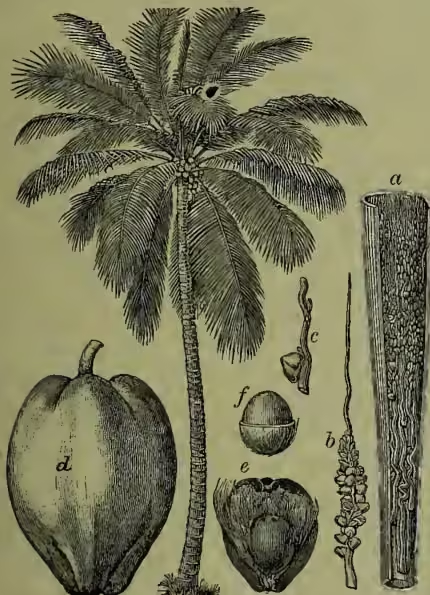
Cocoa-nut is the current English form of what was till Dr Johnson's time spelt Coco-nut; coco, 'mask,' being the Portuguese name given to the nut from the resemblance of its lower part to a mask. It is the well-known fruit of a species of palm, Cocos nucifera, perhaps originally a native only of the Indian coasts and South Sea Islands, but now diffused over all tropical regions, generally succeeding best in sandy soils near the sea. It is always one of the first of the larger plants to establish itself in the low islands of the Pacific Ocean, so soon as there is soil enough, its nuts being widely distributed by marine currents, while the thick husk protects the embryo from injury. It has a cylindrical stem, about 1½ feet in diameter, and from 60 to 90 feet high, with many rings marking the places of former leaves, and bearing at its summit a crown of from sixteen to twenty leaves, which generally curve downwards, and are from 10 to 15 feet in length. The short racemes bear from five to fifteen or more nuts; and ten or twelve of these racemes, in different stages, may be seen at once on a tree, about eighty or one hundred nuts being its ordinary annual produce; the best trees are said to produce two hundred. The tree bears fruit in from seven to eight years from the time of planting, and continues productive for seventy or eighty years, the fruit being gathered four or five times annually. This affords to the inhabitants of many tropical coasts and islands great part of their food; it is not only eaten as it comes from the tree, both ripe and unripe, being filled in a young state with a pleasant milky fluid, but it is also prepared in a variety of ways. The structure of the fruit will be understood by reference to the article PALMS.
The kernel of the cocoa-nut contains more than 70 per cent. of a fixed oil called Cocoa-nut Oil, or Cocoa-nut Butter, which, however, must not be confounded with the fixed oil of the chocolate, also known as cocoa butter. The oil is itself an important article of commerce, being much employed in Europe, particularly for the manufacture of stearine candles; and also of a marine soap, which forms a lather with sea-water. In tropical countries, and particularly in the East, it is much used as a lamp oil and as an unguent. It is also employed as an article of food, so long as it remains free from rancidity, to which, however, it is very liable. It has been recommended as a substitute for lard in the preparation of ointments, and in this connection its property of readily taking up a large quantity of water has given it a certain value. It may be used instead of cod-liver oil in consumption, for which purpose it is more palatable and less likely to cause nausea. It is obtained by pressure of the bruised kernel, or by boiling over a slow fire, and skimming off the oil as it floats on the surface: A quart, it is said, may be obtained from seven or eight cocoa-nuts. It is liquid in the ordinary temperatures of tropical countries, but in colder climates becomes a white, solid, butter-like oil. It becomes liquid about 74° (23.3° C.). It can be separated by compression in the cold into a more liquid portion called olein, and a more solid part termed cocostearin, or cocosin, which is of complex constitution, and contains at least six fatty acids.
The root of the cocoa-nut palm possesses narcotic properties, and is sometimes chewed instead of the areca-nut. The terminal bud (Palm Cabbage) is esteemed a delicacy, and trees are often cut down for the sake of it; the central part of the young stem is also succulent and eatable.—The saccharine sap (toddy) of this, as of some other palms, is an esteemed beverage in tropical countries, either in the state in which it is obtained from the tree, or after fermentation, which takes place in a few hours; and from the fermented sap (palm wine) a spirituous liquor (arrack) is obtained by distillation. The juice is often also in the East Indies boiled down to yield sugar (jaggery). A variety of arrack is also distilled from the fermented milk.
The dried leaves of the cocoa-nut palm are much used for thatch, and for many other purposes, as the making of mats, screens, baskets, &c., by plaiting the leaflets. The midribs of the leaves supply the natives of tropical coasts with oars.—The wood of the lower part of the well-grown stem is very hard, takes a beautiful polish, is employed for a great variety of purposes, and is imported into Britain for ornamental joinery, under the name of Porcupine Wood.—The fibrous tissue of the less mature stems is made into cordage. A kind of gum is also frequently obtained from the stem.—By far the most important fibrous product of the cocoa-nut tree is Coir (q.v.), the fibre of the husk of the imperfectly ripened nut. The husk of the ripened nut is used for fuel, and also, when cut across, for polishing furniture, scrubbing floors, &c.
The shell of the cocoa-nut is made into cups, goblets, ladles, &c., and is often polished or carved. Within the nut there is occasionally found a small stony substance, of a bluish-white colour, 'a sort of vegetable bezoar,' called in India Calappa, to which the Chinese ascribe great virtues. There are about 30 species of the genus, mostly South American, of which C. butyracea and C. coronata may be mentioned as specially important sources of oil and starch respectively.—The Double Cocoa-nut of the Seychelles Islands is the fruit of a totally different palm, Lodoicea Seychellarum. See COCO DE MER.