Comet. The word comet is derived from the Greek kómē, 'hair,' a title which had its origin in the hairy appearance often exhibited by the haze or luminous vapour, the presence of which is at first sight the most striking characteristic of the celestial bodies called by this name. The general features of a comet are—a definite point or nucleus, a nebulous light surrounding the nucleus, and a luminous train preceding or following the nucleus. Anciently, when the train preceded the nucleus—as is the case when a comet has passed its perihelion, and recedes from the sun—it was called the beard, being only termed the tail when seen following the nucleus as the sun is approached. This distinction has disappeared from all modern astronomical works, and the name tail is given to the appendage, whatever its apparent position. Neither the tail nor the nucleus is now considered an essential cometary element, but all bodies visible in interplanetary space, which describe orbits round the sun of an extremely elongated form, are classed as comets. There are several plain points of difference between comets and planets. The planets move all in the same direction, from west to east, which is astronomically called 'direct motion'; but the movements of comets are often from east to west, or retrograde. The orbits of all the planets are confined to a zone of no great breadth on either side of the ecliptic; but the paths of comets cut the ecliptic in every direction, some being even perpendicular to it. The orbits of all the planets are nearly circular; or, more properly speaking, are ellipses of very small eccentricity. The orbits of comets, on the other hand, present every variety of eccentricity, some of them being ellipses or elongated closed orbits of various degrees of elongation; others, hyperbolas; while the majority have a form of orbit not differing sensibly from the parabola, which is the limiting form of curve to which both the ellipse and hyperbola approximate under given conditions.
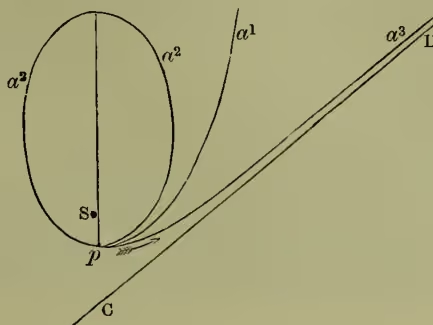
Let be the point of perihelion passage of a comet, and let the direction of its motion be in the direction indicated by the arrow. There is a certain velocity of motion at this point which would give the orbit the form of a parabola, , the direction of motion always tending to parallelism with the straight line through . Any velocity less than this would cause it to describe a closed curve, , any greater velocity would cause it to describe the hyperbola, , in which case it would approximate to the direction of the straight line, CD, and would never return. This would be the case if there were no disturbing force to interfere with the sun's attraction; and conversely, comets approaching the sun along the various paths above described would pass the perihelion with the various velocities above indicated. Any attraction, however, of an extraneous body interfering with the attraction of the sun might change the orbit from the ellipse to the hyperbola, and vice versa, or from the parabola to either. As, however, there is only one parabola corresponding to infinite sets of ellipses and hyperbolas, an interfering cause is not likely to change the orbit from an ellipse or hyperbola to the parabolic form.
There are twenty known periodical comets, eleven of which have been observed at more than one perihelion passage. These latter have periods in years as follows: Encke's, 3.3; Winnecke's, 5.6; Broersen's, 5.5; Tempel's I, 6; D'Arrest's, 6.4; Biela's, 6.6; Faye's, 7.4; Tuttle's, 13.8; Halley's, 76; Tempel's II, 5.2; Swift's, 5.5.
The orbits of forty-three comets appear to be ellipses. These are probably periodical. The paths of about two hundred cannot be distinguished from parabolas. These are possibly periodical, as the ellipse, when very eccentric, cannot near perihelion be distinguished from a parabola. Only six or seven have orbits possibly hyperbolic.
Elliptic comets in a large majority move directly—i.e. from west to east. Parabolic comets usually move in the contrary direction. But, on the whole, there is no general tendency in these bodies to move either way. Periodic comets have orbits but little inclined to the ecliptic; but, on the whole, cometary orbits show a tendency to gather round a plane inclined 50° to the ecliptic. The perihelia gather about two opposite regions, in longitude 60° to 120°, and 240° to 300°. The nodes of the orbits gather also about two regions, not, however, directly opposite.
The discovery that comets are celestial bodies, extraneous to our atmosphere, is due to Tycho Brahé, who measured the parallax of the comet of 1557. Newton succeeded in demonstrating that they are guided in their movements by the same principle which controls the planets in their orbits; and Halley was the first, by determining the parabolic elements of a number of comets from the recorded observations, to identify the comet of 1682 with one which had been observed in 1607 and the observations recorded by Kepler and Longomontanus, and also with a comet observed in 1531 by Apian, at Ingolstadt, and thus confidently to predict the return at the end of 1758 or beginning of 1759, of a comet which would have the same parabolic elements. These parabolic elements are elements of a parabola nearly coincident with the elongated elliptic orbit of the comet. They are: (1) The inclination. (2) The longitude of the node. These two determine the plane of the orbit. (3) The longitude of the perihelion, or point of nearest approach to the sun. (4) The perihelion distance, or nearness of approach to the sun. (5) The time of perihelion passage. (6) The direction of motion, whether direct or retrograde.
To determine these parabolic elements, three observations of the comet are sufficient; and by a table of such elements deduced from the recorded observations, it is possible at once to ascertain whether any newly observed comet is identical with any that have been previously observed. To predict, however, with accuracy the time of the return of a comet, a much more elaborate calculation must be made of the orbit, taking into account the perturbations of the planets to whose influence it is subject. This difficult problem was solved, in the case of Halley's comet, by the joint work of Laland, Madame Lepante, and Clairaut, who announced, in November 1758, just as astronomers began to look out for the return of the comet, that it would take 618 days more to return to the perihelion than on the preceding revolution. The perihelion passage was fixed about the middle of April 1759; but Clairaut distinctly forewarned the world that, being pressed for time, he had neglected small values, which collectively might amount to about a month in the seventy-six years. The comet passed the perihelion on the 12th March 1759, exactly a month before the time announced, but within the assigned limits of divergence from that date. The elements of its orbit proclaimed it to be the comet of the former periods by their similarity. For the next perihelion passage, the different calculations executed by MM. Damoiseau, Rosenberger, Lehmann, and De Pontécoulant, fixed respectively the 4th, the 26th, the 11th, and the 13th November 1835. Subsequently, observations indicated the 16th—that is to say, a deviation of only three days from what turned out the most accurate calculation, and a deviation of twelve days from the most remote. We have adverted to the perihelion passages of this comet in 1531, 1607, 1682, 1759, and 1835. It is also now identified with a comet observed in 1456, and one in 1378, recorded by Chinese observations. There are no sufficiently reliable European observations previous to 1456, but it is conjectured by Arago that this comet is the same with the comet of 1305; that of 1230; a comet mentioned in 1006 by Hali Ben Rodoan; that of 885; finally, a comet seen in the year 52 before our era.
This account of Halley's comet has been given at length to illustrate the principles on which the calculations are made. A simple method, due to Olbers, enables the elements of cometary orbits to be calculated in a comparatively short time, and almost all comets discovered have now their paths roughly determined soon after they become visible.
There are two other periodical comets of peculiar interest: (1) That of Encke, with a short period of 1204 days. Its orbit does not extend so far as the orbit of Jupiter, and a slight acceleration in its periodic times of return was regarded until lately as suggesting the possibility of the space, within our solar system at least, being occupied by a resisting medium, though of extreme rarity. (2) That of Biela or Gambart, having a period of six years and three-quarters. During the visit of this comet in 1846, it was seen first at New Haven, U.S., by Messrs Herrick and Bradley, on December 29, 1845, in the act of separating into two distinct comets, which kept moving side by side till they disappeared. On the return of the comet in the autumn of 1852, the distance between the two nuclei had much increased. Since then, although repeatedly due, it has not again been seen.
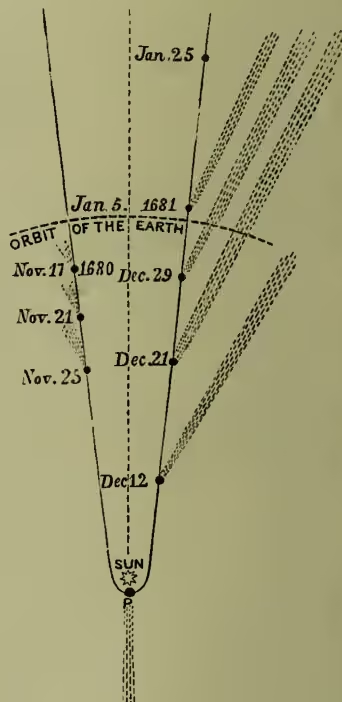
The celebrated comet of 1680, which furnished Newton with the occasion for proving that comets revolve around the sun in conic sections, and that, consequently, they are retained in their orbits by the same force as that which regulates the movements of the planets, appears to have been about the most remarkable for brilliancy of any of which we have authentic accounts. This comet is supposed to be identical with the one that appeared about the time of Cæsar's death (44 B.C.), with that which was seen in the reign of Justinian in the year 531, and with another in the year 1106, in the reign of Henry II., the period of revolution, according to the orbit calculated for it by Whiston, being about 575 years. There is, however, some doubt among astronomers as to the real form of its orbit, the one assigned to it by Encke giving it a period of 8813 years. This comet approached nearer to the sun than any known, except that of 1843. The comet of 1680 approached the sun within the 163d of the semi-diameter of the earth's orbit. The annexed diagram shows a part of its path; the same diagram shows the direction of the tail. In the first half of the 19th century, the comets chiefly notable are those of 1811 and 1843. The former was a most brilliant object for many weeks in the northern heavens. It is periodic, though travelling at aphelion to the enormous distance from the sun of 40,121,000,000 miles. The latter was also remarkable for its brilliance, but chiefly for its very near approach to the sun, passing so near that a trifling change in its direction of approach would have caused a collision. Not more than 32,000 miles separated their surfaces when nearest. Its tail also was enormous, reaching in length 200,000,000 miles. Since 1850 many brilliant comets are recorded: Donati's in 1858; and the great comet of 1861, through the tail of which our earth passed on June 30th of that year, with scarcely a sign observable of the passage; also Coggia's comet in 1874, remarkable for the series of envelopes of luminous matter which seemed to combine to form its tail. The great comet of 1880 astonished astronomers by following the same track as that of 1843, almost grazing the sun. That of 1881 iii followed the track of that of 1807, for a return of which it was at first mistaken. These two examples demonstrated that in some cases several comets travel on the same orbit, at great distances, however, from one another. The comet 1881 iii was the first successfully photographed, Janssen obtaining a picture including , and Dr Henry Draper of New York one including , of its tail. Dr Huggins and Dr Draper were also both successful in photographing its spectrum, with results confirming what eye observations already had revealed. Dr Schäberle at Ann Arbor, Michigan, discovered another bright comet, the fourth for the year 1881, which for a time accompanied 1881 iii, both being in the northern heavens together. At Dudley Observatory, U.S., a comparatively small comet was discovered soon after by Mr Wells, remarkable as the first in whose spectrum the sodium line was seen. In 1882 the surprise of 1880 was repeated. Another bright comet appeared in September, following the tracks of the 1843 and 1880 comets, making the third in an orbital procession in space. It was seen in New Zealand on September 3, at the Cape of Good Hope on September 8, and at Rio de Janeiro on the 11th. Mr Common at London had been seeking for a short time to catch a bright comet near the sun in the daytime. Independently, on September 17, he discovered this one, close to and rapidly nearing the sun. Clouds prevented him from seeing the passage, but it was observed at the Cape of Good Hope by Messrs Finlay and Elkin, who were watching at the time. Passing in front of the sun, it disappeared from view, overpowered by the solar brilliance, to reappear shortly passing off the other edge of the disc. All next day it was clearly seen, only surpassed in brilliancy by the sun itself. Though it had passed so close to the sun, it experienced no retardation of speed, proving that very near the solar surface there can be no resisting medium of density to affect such a body. It was followed with the telescope to a distance from the earth of 470,000,000 miles. This long observation enabled its period to be well ascertained as about 700 years. It exhibited in a marked degree a tendency to disruption. 'Space appeared,' says Miss Clarke, 'to be strewn with the filmy debris of this extraordinary body all along the track of its retreat from the sun.' Its tails corresponded to types 1 and 2 (see post), and there was a vast outburst of luminous matter in October towards the sun, having a diameter of 4,000,000 miles. Its spectrum showed the sodium line in addition to the usual cometary bands. The year 1883 was barren in cometary results; 1884 saw three new comets discovered respectively in Tennessee, Australia, and Europe by Barnard, Ross, and Wolf. In 1885, on the 27th November, there was a grand display of the meteors into which Biela's comet is now generally considered to have broken up; 50 to 60 a minute being recorded. Brooks, of Phelps, New York, discovered a comet on August 31 in that year. But in the next year (1886), within two months, three comets rewarded this diligent observer, a record equalled in 1887 by Barnard, of Nashville, Tennessee. In 1888 comets were discovered by Sawerthal on February 18, and by Brooks, New York, on August 7. The returns of Encke's comet and of Faye's comet also marked that year, as they again did the year 1895, in which De Vico's comet was seen for the first time since 1844. Seven new comets were seen for the first time between Nov. 1895 and Nov. 1896.
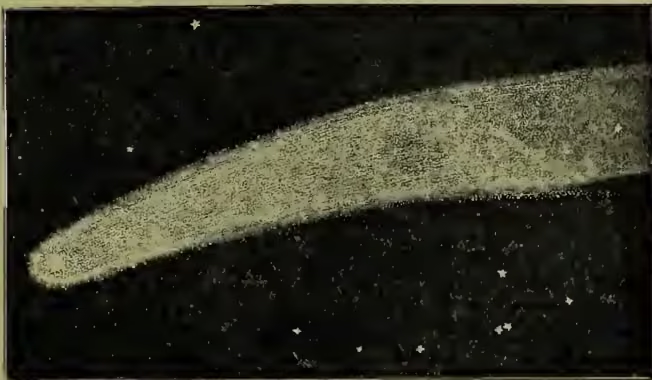
The quantity of matter in even the largest comet is known to be very small, or so of that of the earth in a calculated instance, much less probably in many others. The nucleus, in which most of this is contained, is generally admitted to be a more or less close congeries of meteoric fragments. This is shown by the smallness of its mass as compared with its size, its spectrum, and the fact that comets and meteors follow one another in similar orbits.
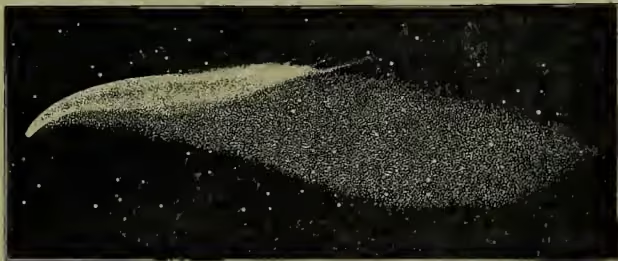
Biela's lost comet is now probably scattered into the meteor stream which pursues its track (see ante). The close agreement of cometary and meteoric orbits may appear from the fact that Tempel's comet (1866) has a period of 33.28 years, and the three groups of November meteors, following the same line, periods respectively of 32.25, 33.31, and 33.11 years. Also just as these groups follow one another in procession round the sun, so do the comets above mentioned of 1843, 1880, and 1882. Other systems of mingled comets and meteors are also known, and the spectroscopic researches of Lockyer may be said to have demonstrated that the peculiar spectrum of comets can be produced from meteors. Carbon, hydrogen, and sodium have been shown to enter into the composition of cometary nuclei. A banded spectrum of a hydrocarbon is the usual type, the sodium line only showing when the nucleus is close to the sun, and sweeping rapidly past it in a state of great disturbance. Usually as the nucleus nears the sun, it appears disturbed; then jets or masses of luminous material, gas or fine dust, are thrown up. Some repulsive force appears to seize these and sweep them out into space with enormous rapidity, producing the splendid phenomena of the tail. The researches of Olbers, Bessel, Norton of Yale College, U.S., C. F. Pope, Zöllner, and especially Professor Bredichin, late of Moscow Observatory, have gone far to establish the existence of this force, and to identify it with electric repulsion. Professor Bredichin has divided comets' tails into three classes, those of hydrogen, of hydrocarbons, and of iron, due respectively to a repellent force (1) of 12 times solar gravity, (2) equal to it, and (3) of it. The first material and force give straight, the second slightly curved, and the third strongly curved tails. The comet, 1886 f, showed three tails, one corresponding to each of these types. Observation and calculation have verified these conclusions as to the forces, and forms of tails, but not yet as to the electric nature of the forces. The light of comets is mainly due to electric discharges; a part, however, is reflected solar light, and a part perhaps due to incandescence. The tenuity of comets' tails is inconceivable to us, stars, which the slightest fog would conceal, shining clearly through a thickness of millions of miles of their material. Hence, although so great a display is caused by the matter swept away from the comet at perihelion, it loses but little in apparent bulk, though in the course of centuries the loss is abundantly perceptible. Some comets, Professor Kirkwood suggests, are probably asteroids, thrown out of their proper track by the disturbing force of Jupiter.
Comets have been alternately regarded with terror and with welcome in the popular mind. The appearance of Halley's comet in 1456, just as the Turks had become masters of Constantinople, and threatened an advance into Europe, was regarded by Christendom with a superstitious dread, and to the Ave Maria was added the prayer: 'Lord save us from the devil, the Turk, and the comet.' At Constantinople the occurrence of a lunar eclipse at the same time increased the portentousness of the event. The discoveries of science of the magnitude of the space filled by their bodies, and their prodigious velocity, together with the confessed impossibility of always predicting their approach, produced fears of another kind, which have sometimes been, especially in France, extravagantly exaggerated in the public mind. The groundlessness of such alarms, from the extreme improbability of collision with the nucleus, the innocuousness of a contact with the extremely attenuated surrounding matter, and, possibly, to the greater part of the world, of a collision with the nucleus itself, will be sufficiently evident from what has been said above. It is certain that already, on many occasions, some of the attenuated vapour in the tail of comets must have come within the earth's attraction, and been absorbed in its atmosphere. Whether the effect is deleterious or salubrious, or whether it has any perceptible influence at all, is only matter of speculation. The salubrity of cometary influence is now a popular idea; and the vintages of 1811 and 1858 were favourable seasons, whose produce has been advertised as the comet wines. It is scarcely worth while, however, to follow further speculation on these subjects, and it has been considered preferable to confine this article chiefly to the description of the general characteristics of comets, and the facts respecting them afforded by science.