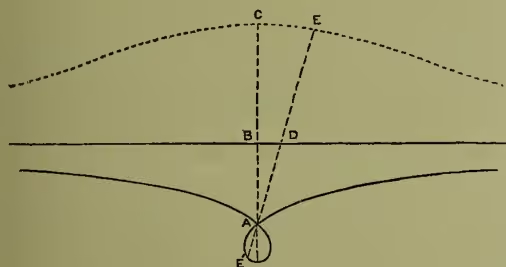
Conchoid (Gr., 'shell-like,' from the shape), a plane curve invented to solve the problem of trisecting a plane angle, doubling the cube, &c. Given any straight line and a point without it, we can describe two companion curves which are dissimilar, but have the straight line as their common Asymptote (q.v.) between them. Thus both branches extend in either direction to infinity, and can never meet though continually approaching each other. The conchoid is obviously symmetrical with respect to the straight line drawn perpendicular to the given line from the given point. This curve has been utilised in architecture to give a waving outline to tapering columns. Through A the fixed point draw any line ADE, measure DE and DE' each = BC, then E and E' trace the two branches of the conchoid. When BC = BA, there is a cusp at A; when BC is greater than BA, the inferior branch has a loop as in the figure.