Condenser is an apparatus in which aqueous or other water is condensed into a liquid form either by the introduction of cold water, as in the condensing Steam-engine (q.v.), or as in distillation, by placing the condenser in another vessel, through which a current of cold water passes. When the water-supply is deficient at sea or on the coast, salt water may be distilled and condensed. See DISTILLATION, GAS, WATER, RETORT.
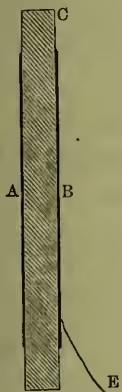
The ELECTRIC CONDENSER is an apparatus consisting essentially of two parallel conducting plates, separated by a layer of non-conducting material or dielectric, employed to receive and retain quantities of electricity greater than either or both of the plates would do alone. The simplest and typical form of condenser is that which was first used by Franklin. It is simply a sheet of glass, C (see fig.), both sides of which, excepting a margin at the edges, are covered with tinfoil, A and B. To charge such a condenser, one of the sheets of tinfoil, say B, is connected with the ground, E (either by some metallic connection or by being placed on the hand of the experimenter), while the sheet, A, remains insulated. If A be now charged with electricity, positive for example, a negative charge is induced on that side of B nearer A, while an equal quantity passes to the ground. Increasing the charge in A induces a corresponding increase in B. This process, although by means of it large quantities of electricity may be accumulated, cannot go on indefinitely; for on reaching a certain limit, depending on the dimension, &c. of the apparatus, the nature of the dielectric used, and the difference of potential of the two conducting plates, either a disruptive discharge (see ELECTRICITY) takes place, or the charge passes off through the insulating supports of the condenser.
All the various forms of condensers satisfy the definition given above. One useful form is that in which the two conducting plates are fixed on the ends of brass rods which pass through brass knobs on the tops of two glass pillars, the dielectric in this case being air. The more common form, however, is the Leyden Jar (q.v.). Another is made up of sheets of tinfoil and paraffined paper, placed alternately in layers; the first, third, fifth, &c. sheets of tinfoil are connected to one terminal, and the second, fourth, sixth, &c. to another.
The capacity of a condenser is defined to be that quantity of electricity with which one plate must be charged in order to raise its potential by one unit. It can be shown that, in the case of condensers of the Leyden jar form, the capacity is numerically equal to the product of the outer and inner radii of the coating, divided by the difference of the radii—i.e. is greater as that difference is less. Hence the thinner (within certain limits) the glass between the two coatings of such a condenser, the greater is its capacity.