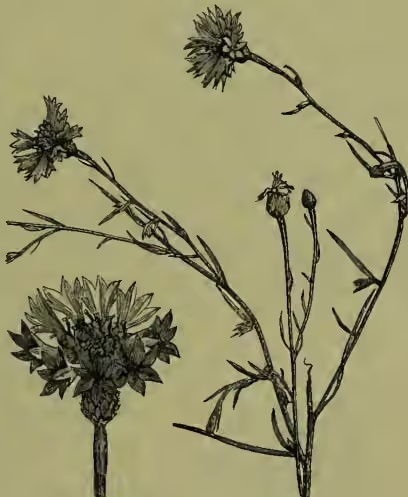
Corn-flower

Chambers's Encyclopaedia, Volume 3: Catarrh to Dion, p. 485
A botanical illustration of a Corn-flower (Centaurea cyanus). The drawing shows a single, upright stem with several large, deeply lobed, blue-purple flowers. The flowers have a distinct 'blue bottle' shape, with a long, narrow tube and a wide, flared corolla. The stem is shown with some leaves and a few smaller, unopened flower buds.

Corn-flower (see CENTAUREA) is a well-known composite weed of cornfields, universally known and admired for the beauty of its wreath-like circle of outer barren florets, and the splendid deep azure of their hue. It was formerly of some little medicinal repute, and its blue flowers were used in domestic dyeing; from early times, too, it has been used for decoration in wreaths and garlands. This use became specially prominent in Germany after 1870, on account of its being the Emperor William's favourite flower.

Source scan(s): p. 0496