Cornet (Ital. cornetto, Fr. cornet à piston), a brass treble wind-instrument, with a cup mouthpiece, is a comparatively modern modification of the Trumpet (q.v.). The tube, which is more tapered than in the trumpet, is less so than in the Bugle (q.v.), giving the cornet a tone intermediate between these, and more in harmony with other brass instruments of the trombone and saxhorn kind. It has the usual open notes, C (below the treble stave), G, C, E (stave), G, Bb, E (above the stave). It has also four higher notes, D, E, F, G, and a fundamental note, C (octave below the stave), but they are almost never used. To provide the connecting notes and half notes of the scale, it has three slides (1, 2, 3 in the fig.), the first, lengthening the tube to the extent of one tone; the second, a semitone; the third, three semitones. In playing, the air is diverted through these slides by means of three valves or pistons, which are depressed by the fingers of the performer, singly or in combination.
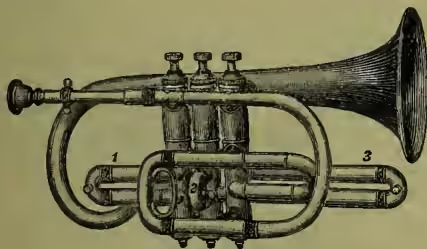
Although the cornet, from its recent invention, has not a place in classical music, it is sometimes used to play trumpet parts; and in modern orchestral music, it is an indispensable and popular solo instrument. In military reed and brass bands it is a solo and leading instrument respectively.
Originally the cornet or cornopean, as it was then called, was provided with 'crooks' (pieces of tube to insert between the instrument and the mouthpiece), to alter the pitch, which is naturally Bb, to A, Ab, G, and others, but it is now only used in Bb and A. Smaller cornets in Eb and Db are sometimes used in military brass bands. The cornet-stop in the organ is named after an obsolete wind-instrument of the oboe species.