Cotton, an important vegetable fibre, extensively cultivated in various parts of the globe within the 35th parallels of latitude.
(1) Botanical and Commercial Classifications.—Cotton is the produce of all the species of the genus Gossypium, which belongs to the natural order Malvaceæ, and is thus allied to Mallow, Hollyhock, Hibiscus, &c., the general resemblance to which is very apparent both in the foliage and flowers. The species are partly shrubs, partly herbaceous, and either perennial or annual; they are natives of the tropical parts of Asia, Africa, and America, but their cultivation has extended far into the temperate zones. They all have leaves with three to five lobes, which in a very young state are often sprinkled with black points, and rather large flowers, which are mostly yellow, but sometimes in whole or in part purple; the flowers very soon fall off; they grow singly from the axils of the leaves, and are surrounded at the base by three large, heart-shaped, cut or toothed, involucre leaves or bracts, partially growing together as one. The fruit is a 3-5-celled capsule, springing open when ripe by 3-5 valves, and containing numerous seeds enveloped in cotton, which is generally white, but sometimes yellow, and issues elastically from the capsule after it has burst open. The fibres are long cylindrico-spiral tubes of from th to th of an inch in breadth, which when platted adhere firmly together. The wool is also very susceptible of dyeing. The figure shows the manner in which the cotton escapes from the capsule. Some in height, bears a yellow flower, and the seeds are small, black, and quite smooth, and the wool is easily separated therefrom; but when sown far inland, away from the saline influences of the coast, the seeds increase in size, and become covered with innumerable short hairs. A large percentage of the crops raised in Alabama, Louisiana, Mississippi, Texas, &c., are also varieties of this species, though, owing to climatic influences, the plant is smaller (4 to 6 feet in height), and the wool is shorter in staple ( to inch), and less easily separated from the seeds than Sea Island. In 1888 the commercial value of the latter kind varied from 10d. to 21d. per lb., rare specimens sometimes realising 2s. 6d. to 3s. per lb. The better descriptions of Egyptian cotton belong to G. Barbadense, and bring 9d. to 18d. per lb. in the Liverpool market (staple 1 to inch). The short-staple varieties, known as New Orleans, Mobile, Uplands, &c., sell at from 4d. to 7d., extra qualities sometimes bringing 9d. to 10d. per lb. G. herbaceum is found in India, China, Africa, &c. The principal commercial varieties are those known as Surat, Madras, Bengal, &c. It is a small shrubby plant (2 to 4 feet high), bears a yellow flower, the seeds are covered with short grayish down, and the staple produced, though not long ( to 1 inch), is very fine. Its price varies from 3d. to 5d. per lb. The cotton known as nankeen is thought to belong to this species. G. herbaceum can be profitably cultivated in colder countries than any other species of cotton-plant. The third species (G. peruvianum) is a native of South America, and the 'green seed' cotton of the United States appears to be a variety. The stem reaches 10 to 15 feet in height, the flowers are yellow, and the capsules contain eight or ten black seeds firmly attached together in a cone-like mass. The wool is long (1 to inch) and strong-stapled, and in value stands next in order to Sea Island and Egyptian. Pernambuco, Maranhão, Bahia, Maceio, and Peruvian are varieties which sell in Liverpool at from 5d. to 6d.; extra qualities of Peruvian bring 6d. to 8d., and Sea Island Peruvian is worth 9d. to 12d. per lb. G. arboreum is found in India, China, &c., and, as its name imports, is a large tree-like plant. It bears a red flower, and produces a fine yellowish-white wool. Varieties of it have been long cultivated in the United States, and with the requisite soil and climate, are said to produce a wool somewhat resembling Sea Island.
The finer kinds of yarn are spun from Sea Island and long-stapled Egyptian, and from them are fabricated our muslins, laces, &c. From Brazil and the better classes of short-stapled American come our cambrics, calicoes, shirtings, sheetings, &c., and from the inferior qualities of American and Surat are spun the coarse yarns required for fustians and other heavy fabrics. Yorkshire broadcloths are sometimes half cotton. From warps of cotton, and wefts of wool or worsted, are formed varieties of Orleans cloths, Coburgs, mousselines de laine, &c. There are also fabrics composed of silk and cotton, linen and cotton, alpaca and cotton, &c.
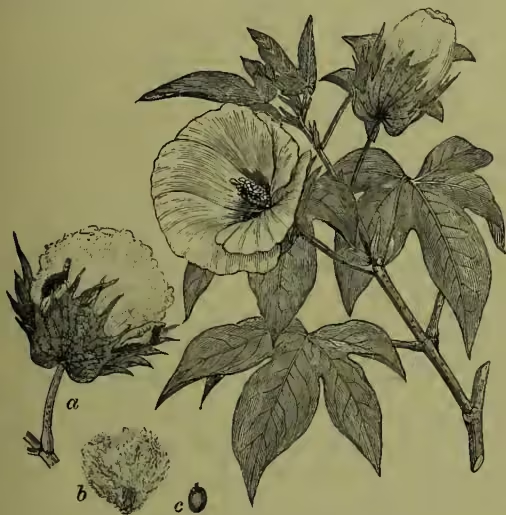
a, ripe capsule after dehiscence; b, a seed; c, the same deprived of its hairs. (From Bentley & Trimen.)
(2) Cultivation.—The plant is a very delicate organism, and requires a peculiar soil and climate for its due development. The method of cultivation is much the same in the various countries where the fibre is grown; but the most perfect system is that which obtains in the United States of America. Although the plant is not, strictly speaking, an annual, it is found more profitable to destroy the shrub, after the crop is gathered, and sow new seed every year. The preparation of the land takes place during the winter months. After the ground has been thoroughly ploughed, and as soon as all symptoms of frost have disappeared, the soil is laid of the kinds have the flowers larger in proportion, and the leaves divided into more numerous and much deeper and narrower lobes, but the general appearance of all is very similar.
Difference of opinion exists among botanists as to the number of distinct species, and there are very many varieties in cultivation, the number of which, through climatic influences and other causes, is continually increasing; but there are certain leading peculiarities on account of which some botanists and planters reduce all, at least of the cultivated kinds, to four primary species—viz. (1) Gossypium Barbadense; (2) G. herbaceum or indicum; (3) G. peruvianum; and (4) G. arboreum. The produce of the first species is the most valuable. The beautiful long-stapled ( to inches) silky wool known as 'Sea Island' is a variety, and is grown exclusively upon the islands and a portion of the mainland of Georgia, South Carolina, and Florida; the saline ingredients of the soil and atmosphere being indispensable elements of the growth. The plant, 6 to 12 feet off into rows varying in width from 3 to 4 feet, according to the situation and quality of the soil. The seed is then sown along the centre of the beds in a straight furrow made with a small plough or opener; but in some plantations the seed is sown in holes from 12 to 18 inches apart. The sowing commences in March, and generally continues through April; but sometimes, owing to late spring frosts, the planting is prolonged to May. The young shoot appears above ground in about eight to ten days, and is then and subsequently weeded and thinned. Blooming takes place about the beginning of June—in early seasons, towards the latter end of May; the average date is about June 5. For ploughing, the planter requires just sufficient rain to give the soil a moist and spongy texture. During the early stages of its growth, the crop flourishes best with a warm steamy sort of weather, with an occasional shower until blooming; too much rain being productive of weeds and wood at the expense of wool, whilst a severe drought produces a stunted plant, forced into too early maturity, and resulting in a small and light-stapled crop. A great deal, however, depends upon the position of the plantation; lands situated in hilly or upland districts obviously requiring more moisture than those lying in the plains and river-bottoms. From the date of blooming to the close of the picking season, warm dry weather is essential. Picking generally commences in August, occasionally in July, and continues until the occurrence of frost—about the end of October or beginning of November—puts a stop to the further growth of the plant. Occasionally, in the absence of a killing frost, picking extends to December or January, and even into February, but the cotton is inferior in grade and quality. All the available hands of the plantation, young and old, are called into full employment during the harvest. The cotton is gathered into baskets or bags suspended from the shoulders of the pickers, and when the crop has been secured, it is spread out and dried, and then separated from the seeds.
The latter process was formerly performed by hand—a tedious operation, by which one hand could clean only a pound or so a day; but since the invention of the saw-gin by Eli Whitney in 1793, the process of cleaning has been both rapid and effectual. This machine is composed of a hopper, having one side formed of strong parallel wires placed so close together as to exclude the passage of the seeds from within. The wool is dragged through the apertures by means of circular saws attached to a large roller, and made to revolve between the wires, the seeds sinking to the bottom of the hopper. This process is adopted only in cleaning the short-stapled varieties of American cotton, the wool of which adheres so firmly to the seeds as to require a considerable amount of force to separate them. The Sea Island variety is cleaned by being passed through two small rollers which revolve in opposite directions, and easily throw off the hard smooth seeds. In India, though the saw and other machine-gins have been introduced in some districts (notably the Macarthy-gin in Broach, and the saw-gin in Dharwar), the wool is mostly cleaned by means of the primitive roller. Prior to the American war the roller-gin was in exclusive use in Egypt and the Brazils, but the cotton famine led to the invention of the Macarthy-gin (which in principle is an improved roller-gin), and to its introduction into Egypt, and to the adoption of the saw-gin by the planters of Brazil; the effect in both cases being a considerable extension of the culture. The cotton cleaned by the roller-gin, being uninjured thereby in staple, realises the better price; but the deterioration caused by the saw-gin is compensated for by the greatly increased quantity cleaned: the latter turning out four or five times as much wool as the former in an equal space of time.
In India, throughout the greater portion of the Bombay Presidency, the North-west Provinces, the Central Provinces, and the Berars, sowing generally takes place between the middle of June and the middle of July, but in Dharwar and other southern districts of Bombay, and in the Madras Presidency, not until August or September—in some places later still. In the first-named districts picking commences in November, but in some portions not until January or February, and in Madras not until March or April. The extension of the railway system brings cotton which formerly went to other ports to Bombay (q.v.), and 80 per cent. of the total export from India is now from that port, while the bulk of the shipments takes place in the first six months of the year. In Egypt sowing commences in March or April, and picking in October—continuing until January. The busiest export months are November to February. In Brazil planting takes place as early as January or as late as May, according to district, and picking six months later. The chief shipping months are October to May.
(3) Production and Distribution.—The oldest cotton-producing country is India, in which empire the plant has been grown and manufactured from time immemorial. The first notice of it in connection with China dates no further back than the 11th century, but it is exceedingly probable that the plant was cultivated there long prior to that period, as cotton fabrics were known in China before the Christian era. Early mention is made of it in the annals of Egypt, and it is believed to have a high antiquity in all parts of Africa. It has for many centuries been produced in Asia Minor, in several of the Mediterranean islands, in Greece, and Southern Italy. In the western world, it was found by Columbus in the West Indies, and in Mexico and South America by his immediate successors, but was not so extensively cultivated as in the East; though during the past half-century the culture there has outstripped, both in quantity and quality, the produce of the Old World. Down to the commencement of the 19th century the cotton consumers of Europe were dependent upon the East and West Indies and the Levant for their raw material; but the inventive genius, superior farming, and greater energy of the planters of the southern states of America had, prior to the civil war, almost secured the monopoly of supplying the manufactures of Great Britain and the European continent with this valuable fibre. The following table gives at a glance the movements for a century back. The figures represent the annual imports into Great Britain from the chief sources of supply, in bales of the uniform weight of 400 lb. each, in quinquennial averages, except that the last column is based on the average imports for two years only:
| 1786-90. | 1816-20. | 1846-50. | 1876-80. | 1886-87. | |
|---|---|---|---|---|---|
| British West... | 45,000 | 23,800 | 1,910 | 1,670 | 660 |
| Indies..... | 13,000 | 1,030 | 31,310 | 402,190 | 435,590 |
| Mediterranean... | 5,000 | 55,760 | 57,860 | 85,330 | 126,040 |
| Brazil..... | 500 | 93,710 | 196,140 | 510,800 | 601,710 |
| East Indies..... | 100 | 166,310 | 1,297,230 | 2,589,070 | 3,186,790 |
| United States..... | .. | 10,970 | 2,870 | 51,710 | 32,310 |
| Sundries..... | 63,600 | 351,580 | 1,587,320 | 3,640,770 | 4,883,100 |
At the close of the 18th century the British West Indies supplied 70 per cent. of the cotton imported into Great Britain, but owing to the competition occasioned by the rapid expansion of the culture in the southern states of the American Union, the imports gradually decreased; the planters finding it more profitable to employ their labour and capital in the production of sugar and other articles. In the thirty years ended 1820, the quantity fell off nearly 50 per cent., while the proportion of West Indian in the total imports from all countries fell from 70 per cent. down to barely 7 per cent. Thirty years later it was only about one-tenth of 1 per cent. During the American war there was an increase to about 10,000 bales. After the close of the war the import fell rapidly away. In 1870 it was about 6000 bales; in 1886, only 150 bales; in 1887, 1160 bales.
After the West Indies, the chief sources of supply a century ago were the countries bordering on the Mediterranean—Asia Minor, Cyprus, &c. The large increase in the imports from the Mediterranean since 1820 is due to the development of the cotton industry in Egypt. The cotton-plant has been in existence in Egypt from time immemorial, but the cotton known as Egyptian is the product of an exotic plant introduced by the French about the beginning of the present century from the Isle de Bourbon, into which it had been introduced from Barbadoes. M. Jumelle, a French mechanician, saw the plant in a garden at Cairo in 1821, and at his suggestion Mehmet Ali gave instructions that as much seed as could be obtained should be planted in Lower Egypt. The first crop produced about 1000 cantars of 93 lb. net, and with the seed from this about 35,000 cantars were raised in the succeeding season (1822-23), say about 8000 bales of 400 lb. In 1824-25 the crop reached 228,000 cantars, or 53,000 bales of 400 lb. During the subsequent ten years the culture was more or less interrupted, owing to political disturbances, and at times seriously reduced in consequence of the withdrawal of a large number of labourers to carry on the wars of the Pasha in the Soudan, Syria, &c. From 1867 to 1879-80, with occasional fluctuations owing to unfavourable seasons, there was a gradual increase, until the total reached 3,168,000 cantars, since which but little progress has been made, partly in consequence of the fall in prices, and partly owing to the slower increase in the demand for long-stapled cotton, compared with that of the shorter stapled growth of America. In 1884-85 (a good year) the area planted was 912,000 English acres, and the product 335,000,000 lb.; in 1887-88 (a poor year) 1,060,000 acres produced 282,700,000 lb.
There are several varieties of cotton produced, but they are all from one species. Out of a total crop of 3,000,000 cantars, about 2,500,000 consist of Asimouni and similar varieties. The staple is good and the colour brown. About 100,000 cantars consist of Gallini, which is long and silky in staple, and competes with Sea Island. The remaining 400,000 cantars will consist of white cotton similar in staple to the brown, and not unlike extra-stapled Orleans. Gallini was (1888) quoted 8¾d. to 11d. per lb., brown 3¾d. to 8d. per lb., and white 5¾d. to 7d. per lb.; against 11½d. to 21d. per lb. for Sea Island, and 4¾d. to 6d. for the current grades of Orleans.
In 1860 the total import of cotton into Europe from Turkey and other Mediterranean countries, except Egypt, was only 21,000 bales of 400 lb. In 1865 it rose to 239,000 bales, fell to 129,000 in 1867, and rose to 207,000 in 1869. Since 1880 it has fluctuated between 24,000 and 50,000 bales of 400 lb. During the height of the cotton famine (1863-65), Italy and Greece produced 100,000 to 120,000 bales of 400 lb., a large part of which is included in the imports of these years, but they do not now produce more than 10,000 bales.
The first import from Brazil arrived in 1781. In the five years 1786-90 the receipts averaged 5000 bales of 400 lb. In thirty years they were increased tenfold; but with a plentiful supply from the United States there was little further progress during the thirty years ended 1850. The cotton famine led to an extensive expansion in production. In 1879 there had been a reduction to 47,000 bales; but by 1887 there was a recovery to 207,000 bales. From other places in Central and South America the imports into Great Britain in the five years (1883-87) from Peru fluctuated from 3,050,000 to 7,411,000 lb.; from Chili, 284,000 to 1,560,000 lb.; from Venezuela and other portions of South America, 310,000 to 1,549,000 lb. Mexico uses about 180,000 bales of 400 lb., of which 130,000 bales are home-grown, and 50,000 imported from the United States (44,000 bales of 456 lb.).
In their search for the increased supply of cotton requisite to meet the wants of the rapidly growing industry of a hundred years ago, the spinners of Lancashire naturally directed their eyes towards India, where the plant had been cultivated and the manufacture carried on from time immemorial; and at their suggestion the East India Company imported a small parcel in 1789—about 5000 lb., which was followed by about 400,000 lb. in 1790. The venture, however, was not satisfactory, and in 1791 the arrivals fell to about 3000 lb., and in 1792 to nothing. But high prices brought renewed supplies, and in 1880 the imports reached 6,630,000 lb., or about 16,000 bales of 400 lb. In 1790 West India cotton was selling at 12d. to 21d. per lb., but in 1798 the quotation ranged from 25d. to 40d. per lb., in which year American was quoted at 22d. to 45d. per lb. Thence to the end of the Napoleonic wars there were very wide fluctuations (see next page). These variations in prices led to considerable fluctuations in the imports of cotton from India, but the general tendency was in the direction of increased figures; the arrivals in 1806-10 averaged 25,000 bales of 400 lb. per annum; in 1816-20 they rose to nearly 94,000 bales, but in 1826-30 fell to 55,000 bales. The large import between 1816 and 1820 became so unsaleable that 10,000 bales (Bengals) were shipped from London to China! Since 1830 the imports have been large or small, according to the outturn of the crops in the United States. This was especially the case prior to the American war, but the impetus given to the industry by the cotton famine incidental to that event, led to such greatly improved methods of ginning and handling the crop, that the supply from India is no longer merely supplementary to that from America. The quality is greatly superior to the imports of a quarter of a century ago, and of recent years the consumption in Europe has averaged 1,500,000 bales, against only 500,000 in 1860, and only about 200,000 in 1850. The total crop of India is about 2,600,000 bales of 400 lb., of which 1,000,000 bales are consumed in India, and 1,600,000 bales exported. Considerable changes have taken place in the distribution of the crop during the past quarter of a century. Prior to the opening of the Suez Canal (November 1869), the bulk of the cotton received into Europe from India came in the first place to England. Half the imports were also spun in Great Britain; but since the opening of the canal, continental spinners have taken the bulk of their requirements direct, while the quantity consumed in England is only about one-sixth of the total consumption of Europe. These changes are set forth in the following account of the imports into Europe, and the deliveries for consumption in the years named in 1000's of bales as imported (360 lb. to 393 lb.) :
| IMPORT—direct. | CONSUMPTION. | ||||||
|---|---|---|---|---|---|---|---|
| Great Britain. | Continent. | Total. | Great Britain. | Continent. | Total. | ||
| 1861 | 986 | 13 | 999 | 348 | 423 | 770 | |
| 1863 | 1452 | 193 | 1645 | 801 | 859 | 1660 | |
| 1872 | 1288 | 408 | 1696 | 687 | 942 | 1629 | |
| 1882 | 1052 | 721 | 1773 | 465 | 1133 | 1598 | |
| 1887 | 668 | 934 | 1602 | 259 | 1268 | 1527 | |
The variations in the two totals arise from varia- tions in the stocks at the end of the year. The consumption in India in 1887 was about 1,000,000 bales, including about 700,000 to 750,000 used by mills containing machinery imported from England, and built and worked as in Lancashire.
The first import of cotton from the United States took place in 1784, and consisted of eight bags weighing about 1200 lb. Occasional small shipments had been received from the American colonies prior to this date, but they consisted chiefly of West Indian produce transshipped, and as the colonies were now independent, the eight bags just mentioned were detained by one of the customs' officials, on the ground that as West Indian produce it was a breach of the then existing navigation laws to import them in a foreign vessel. But the parcel was liberated on proof being forthcoming that the cotton was really the produce of the United States. In 1791 about 189,000 lb. were exported, but in 1792 only 138,000 lb. In 1793 Eli Whitney invented the saw-gin, and the cultivation of the plant increased so rapidly that the exports bounded from less than 500,000 lb. in 1793 to over 6,000,000 lb. in 1795, to more than 9,000,000 in 1798, and to 20,000,000 lb. in 1801, or in eight years from about 1200 bales of 400 lb. to 50,000 bales. What has since taken place is shown at a glance in the following table, which gives the crops of the various states, the total quantity exported, and the balance left for consumption and stock in various years from 1800 to 1887, in 1000's of bales of the uniform weight of 400 lb. :
| 1800. | 1820. | 1840. | 1860. | 1870. | 1880. | 1887. | |
|---|---|---|---|---|---|---|---|
| Virginia..... | 12 | 20 | 25 | 55 | 3 | 65 | 57 |
| Tennessee..... | 3 | 45 | 69 | 297 | 182 | 372 | 328 |
| North Carolina.. | 10 | 25 | 130 | 146 | 145 | 438 | 400 |
| South Carolina.. | 40 | 110 | 154 | 353 | 224 | 587 | 577 |
| Georgia..... | 25 | 100 | 408 | 702 | 474 | 916 | 965 |
| Alabama..... | .. | 50 | 293 | 990 | 429 | 787 | 873 |
| Mississippi..... | .. | 25 | 488 | 1203 | 565 | 1083 | 1080 |
| Louisiana..... | .. | 25 | 381 | 778 | 351 | 571 | 523 |
| Florida..... | .. | .. | 30 | 65 | 40 | 62 | 68 |
| Arkansas..... | .. | .. | 15 | 367 | 248 | 684 | 791 |
| Texas..... | .. | .. | .. | 431 | 351 | 905 | 1763 |
| Total crop..... | 90 | 400 | 1993 | 5387 | 3012 | 6470 | 7425 |
| Exported..... | 50 | 320 | 1653 | 4419 | 2016 | 4550 | 5130 |
| Consumed..... | 40 | 80 | 340 | 968 | 996 | 1920 | 2295 |
The Virginian figures for 1880 and 1887 include some cotton raised in Missouri. Alabama was admitted into the Union in 1819, Mississippi in 1817, Louisiana in 1811 (purchased from France in 1803), Florida in 1845 (ceded by Spain in 1819), Arkansas in 1836, and Texas in 1845. The reduced crop of 1870 shows the extent to which the agricultural industry of the South had been thrown back by the war of 1861-65. Even in 1887 the crops of several of the states were still below those of 1860, in consequence of the transference of labour farther west to Texas and Arkansas. Of the total increase of 1,083,000 in 1880 over 1860, 791,000 belonged to these two states, which also figure for 1,756,000 bales out of the 2,038,000 increase in 1887 over 1860.
As the crops increased prices declined, especially as the cost of production was gradually reduced by improved methods of cultivation and cleaning. The cost to consumers in Europe was also diminished by cheapened freights and carriage, and by other economies brought about by the competition amongst the various middlemen who had the handling of the crop from the plantations to the spindles. At the opening of the century the average price of middling American was about 18d. per lb. In 1803 it fell to 12d., but in 1814 it stood at 30d., and during the year was as high as 36d., owing to the partial cessation of imports caused by the war. Thence (with fluctuations) the tendency was downwards until 1829, in which year the average was only 5½d. Production had outrun consumption, and the stock of American cotton in Great Britain at the end of 1827 was equal to thirty-eight weeks' requirements. The low prices retarded production and stimulated consumption, and by 1835 the stock of American was reduced to only ten weeks' requirements, while the average price advanced to 10¼d. per lb. During the subsequent ten years, production again overtook consumption, and in 1845 the stock of American in England was equal to thirty-three weeks' requirements, while the average price was only 4½d., after having in the course of the year touched 3½d. per lb. These prices were repeated in 1848 owing to disturbed politics. In 1850 there was a rebound to 7d., but thence to 1852 a fall to 5½d., owing to increased crops. Thence to 1860 the average price fluctuated between 5½d. and 7½d., ending in 6½d. The war between North and South cut off supplies, and prices rapidly advanced, until in 1864 the average reached 27½d., while as high as 31½d. had been touched in the course of the year. In 1865, with peace, the average fell to 19d., and it was thought that values would rapidly decline to the ante-war level. But the war, and the abolition of slavery incidental to it, had so thoroughly disorganised the industrial system of the South, and so completely impoverished the planters, that the average price of 1860 (6½d.) was not touched until 1876, while the crop of 1860 (4,824,000 bales), though almost repeated in 1876 (4,660,000 bales), was not actually exceeded until 1879 (5,073,000 bales). Between 1876 and 1879 the average price ranged from 6½d. to 6½d. Since then the tendency has been downwards. In 1886 it fell to 5½d., but in 1887 rose to 5½d. The decline in prices which has taken place within the past ten years has been due mainly to reduced cost of production, to diminished land and ocean freights, and to lessened intermediate charges brought about by the elimination of unnecessary middlemen, though part of the fall is, no doubt, traceable to the currency changes, which have affected values in general.
The variations in the outturn of the crops were due to climatic causes. In 1881-82 the plant suffered from severe drought; 1882-83 was a phenomenally perfect season; 1883-85 were drought seasons; 1885-87 were average seasons; 1887-88 was better than an average, but not so good as that of 1882-83. The 6,514,000 bales produced in 1886-87 weighed 2,970,384,000 lb. net, equal to 7,425,000 bales of 400 lb., as given in the table above, containing particulars of the crops of each state separately.
Particulars of the extent of land planted, and of the weight of cotton produced, are given in the following table :
| Season. | Area Planted, acres. |
Pounds of Cotton. | |
|---|---|---|---|
| Total. | Per acre. | ||
| 1881-82 | 16,711,000 | 2,424,456,000 | 145.0 |
| 1882-83 | 16,277,000 | 3,216,320,000 | 197.5 |
| 1883-84 | 16,778,000 | 2,582,728,000 | 153.9 |
| 1884-85 | 17,426,000 | 2,556,719,000 | 146.6 |
| 1885-86 | 18,379,000 | 2,980,250,000 | 162.1 |
| 1886-87 | 18,632,000 | 2,970,384,000 | 159.4 |
| 1887-88 | 18,790,000 | 3,192,735,000 | 169.9 |
The production per acre varies considerably—from less than 100 lb. per acre in the poorest upland soils to 500 lb. per acre in the rich bottom lands of the south-west. The average production per season, for the entire cotton-growing region, has for the past seven years ranged from 145 to 197½ lb. per acre. The average for the seven seasons was 162 lb., or about one-third of a bale. The crop of 1886-87 was worth at the plantations about £51,800,000, according to the annual report of the Department of Agriculture.
The following is an account of the imports of cotton into all Europe (in bales of the uniform weight of 400 lb.) in and since 1860 :
| United States. | Brazil. | Egypt. | Turkey, &c. | W. Indies, &c. | E. Indies, &c. | China and Japan. | Total. | Average including Unloading Uplands. | |
|---|---|---|---|---|---|---|---|---|---|
| 1860 | 4058 | 48 | 135 | 21 | 23 | 552 | .. | 4837 | 6 |
| 1861 | 3075 | 46 | 124 | 36 | 18 | 949 | .. | 4248 | 8 |
| 1862 | 102 | 65 | 132 | 58 | 20 | 1010 | 2 | 1439 | 17 |
| 1863 | 163 | 67 | 294 | 127 | 36 | 1179 | 81 | 1947 | 23 |
| 1864 | 241 | 127 | 427 | 183 | 39 | 1374 | 239 | 2635 | 27 |
| 1865 | 522 | 150 | 549 | 239 | 84 | 1231 | 85 | 2860 | 19 |
| 1866 | 1555 | 222 | 279 | 161 | 77 | 1706 | 15 | 4015 | 15 |
| 1867 | 1659 | 220 | 305 | 129 | 103 | 1389 | 1 | 3806 | 10 |
| 1868 | 1946 | 309 | 355 | 145 | 85 | 1476 | .. | 4316 | 10 |
| 1869 | 1583 | 281 | 353 | 207 | 92 | 1578 | .. | 4094 | 12 |
| 1870 | 2345 | 217 | 379 | 136 | 79 | 1057 | .. | 4213 | 9 |
| 1871 | 3409 | 281 | 396 | 119 | 130 | 1384 | .. | 5719 | 8 |
| 1872 | 2234 | 377 | 489 | 133 | 121 | 1526 | .. | 4835 | 10 |
| 1873 | 2908 | 243 | 484 | 143 | 105 | 1155 | .. | 5033 | 9 |
| 1874 | 3177 | 252 | 532 | 93 | 98 | 1317 | .. | 5469 | 8 |
| 1875 | 3112 | 216 | 552 | 88 | 69 | 1420 | .. | 5457 | 7 |
| 1876 | 3461 | 169 | 749 | 89 | 55 | 1134 | .. | 5657 | 6 |
| 1877 | 3163 | 149 | 625 | 89 | 37 | 930 | .. | 4993 | 6 |
| 1878 | 3905 | 68 | 458 | 51 | 73 | 813 | .. | 5318 | 6 |
| 1879 | 4329 | 47 | 616 | 31 | 42 | 868 | .. | 5933 | 6 |
| 1880 | 4520 | 78 | 553 | 24 | 33 | 1074 | .. | 6312 | 6 |
| 1881 | 4815 | 135 | 726 | 26 | 33 | 1093 | .. | 6843 | 6 |
| 1882 | 4457 | 166 | 597 | 38 | 32 | 1677 | .. | 6967 | 6 |
| 1883 | 5104 | 154 | 620 | 24 | 30 | 1520 | .. | 7452 | 5 |
| 1884 | 4681 | 130 | 703 | 62 | 30 | 1553 | .. | 7159 | 6 |
| 1885 | 4371 | 99 | 808 | 65 | 29 | 943 | .. | 6315 | 5 |
| 1886 | 5025 | 96 | 709 | 46 | 30 | 1306 | .. | 7212 | 5 |
| 1887 | 5320 | 203 | 734 | 41 | 23 | 1575 | .. | 7915 | 5 |
Of the total quantity of cotton imported into Europe in 1860, no less than 83.9 per cent. came from the United States. For a number of years it had averaged about 75 per cent. This virtual dependence of a vast industrial system upon one source of supply for the raw material necessary to keep its labour and machinery fully employed, had long been regarded with considerable anxiety; the more so as it was known that sooner or later a great crisis would, for a period of more or less duration, dislocate the agricultural industry of the South; but all attempts to escape from so undesirable a state of things were frustrated by the one important fact that no other cotton-producing country had been able successfully to compete with America in either quality or price. The war, by raising values to a famine level, led to a largely increased production of cotton in India, Egypt, South America, &c.; but even after the conflict had lasted four years, scarcely half of the decrease in the imports from the South had been made up by increased receipts from all the world besides. The average import from America in the two years 1860-61 was 3,566,000 bales of 400 lb., but in 1864-65 only 381,000, showing a loss of 3,185,000 bales. The average import from all other sources in 1860-61 was 976,000, and in 1864-65, 2,366,000, showing a gain of only 1,390,000 bales, or barely 46 per cent. of the deficit in the supply from the States. After peace had been restored, and cotton-planting at the South had been resumed, prices rapidly declined; but for ten years after the war they remained considerably above the rates current prior to 1861, and yet the import of cotton into Europe from countries other than America never exceeded 2,651,000 bales of 400 lb. (1872), while the annual average for the ten years ended 1875 was only 2,309,000 bales, against 2,366,000 in 1864-65. Between 1875 and 1880, with a fall to ante-war prices, the imports from countries other than the United States fell to an average of only 1,767,000 bales, while those from the South rose to 3,875,000 bales, and in 1881 the receipts from America represented 70 per cent of the total imports into Europe. In 1886 the proportion was 69 per cent., and in 1887, 67 per cent.
Prior to the American war, very exaggerated notions prevailed respecting the quantity of cotton produced in India: the current estimates being 5,000,000 to 6,000,000 bales of American weight (450 lb.), while some computations ran as high as 10,000,000 bales. But the fact that famine prices attracted to Europe only about a million and a quarter bales per annum in the three years ended 1865, proved that the crop was much smaller than had previously been calculated upon, and the investigations and inquiries made by the government in 1867-68 showed that the annual yield could not at any time have exceeded 2 to 2 million bales of 400 lb. The consumption of cotton goods in India is about 2 lb. per head per annum, or a total of 650,000,000 lb. for a population of 260,000,000. In the three years ended 1887, the weight of goods and yarn imported into India averaged 390,000,000 lb., of which about 70,000,000 lb. were re-exported, leaving 320,000,000 lb. for consumption. The consumption of native-made goods would therefore be about 330,000,000 lb. This item, added to 90,000,000 lb. Indian yarn and goods exported, and 550,000,000 raw cotton exported, gives a total of 970,000,000 lb. as the probable extent of the cotton crop in 1885-87. This calculation cannot be far astray inasmuch as the area under cotton did not exceed 14,000,000 acres, which at 70 lb. per acre (the estimated average yield) gives a total of 980,000,000 lb., or 2,450,000 bales of 400 lb.
No cotton was received from China (except occasional small samples) until prices had risen to about 2s. per lb., and even this extravagant figure brought to Europe only 380,000 bales of 400 lb. during the four years of the famine, a proof that the cotton crop of China is much smaller than even that of India. Assuming the consumption of cotton fabrics to be at the rate of 2 lb. per head, and allowing for yarns, goods, and raw cotton imported, the crop cannot exceed 1,500,000 bales of 400 lb. A similar calculation for Japan, Java, &c., gives a crop of 130,000 bales.
Small imports of cotton are received every year from Africa, but they rarely exceed a few hundred bales. The plant is cultivated throughout the continent, and if the per capita consumption averages only half that in India and China, the 200,000,000 inhabitants will require 250,000,000 lb. of cotton fabrics; but as 100,000,000 lb. of goods are imported, the crop required would be only 150,000,000 lb., or 375,000 bales of 400 lb.
The crops of the various countries and districts of the world in 1887 were, as nearly as can be ascertained, as follows (in bales of the uniform weight of 400 lb.):
| Bales. | Per Cent. | |
|---|---|---|
| United States of America ..... | 7,425,000 | 55.81 |
| South America, West Indies, &c.. | 430,000 | 3.24 |
| East Indies ..... | 2,500,000 | 18.79 |
| China ..... | 1,500,000 | 11.27 |
| Japan, &c. .... | 130,000 | 0.98 |
| Turkey and Persia ..... | 120,000 | 0.90 |
| Asiatic Russia ..... | 100,000 | 0.75 |
| Egypt ..... | 713,000 | 5.35 |
| Africa (except Egypt) ..... | 375,000 | 2.82 |
| Italy and Greece ..... | 10,000 | 0.07 |
| Australia, Fiji, &c. .... | 2,000 | 0.02 |
| Total for the world ..... | 13,305,000 | 100.00 |
It will be observed that the United States produce more than half the cotton grown in the world, although they only commenced the business about one hundred years since.
(4) Consumption.—Great Britain.—It is not possible to ascertain with certainty the first beginnings of the trade in Europe. It existed in Spain in the 10th century, and no doubt quite as early in Italy and Greece. The first recorded import of cotton into England was in the 13th century, and quite as early imports took place into France through Marseilles. The first mention of the industry in connection with Germany, Holland, and Switzer- land was in the 16th century, and in Russia in the 18th. But until the close of the last century, the cotton used was either for candle wicks or for mixture with flax or wool. The first piece of British-made calico—i.e. a fabric all cotton—was produced in 1783. Prior to that date cotton-yarn had been used for weft only, the warp being supplied by flax or wool. Hargreave's 'spinning-jenny' (invented 1764, patented 1770) could not produce a yarn strong and hard enough for warp; but this difficulty was overcome by Arkwright's 'water-frame' (spinning by rollers), brought out in 1769, and further improved in 1775. Hargreave's 'spinning-jenny' was virtually superseded by Crompton's 'mule' (so called from the circumstance that it combined the principles of both Hargreave's and Arkwright's inventions), patented in 1779. It was also called the 'muslin-wheel,' because it produced a finer and more uniform yarn than was possible by either the 'jenny' or the 'water-frame.' Up to the date of Crompton's invention, the progress of the industry had been very slow; the import of cotton in that year being only about 6,000,000 lb., against nearly 4,000,000 lb. in 1764, and nearly 3,000,000 lb. in 1751. In 1785 Arkwright's patents, which comprised improvements connected with carding, drawing, roving, and spinning, were thrown open, and the industry at once advanced by leaps and bounds—the import of cotton reaching 18,000,000 lb. in 1785, and 31,000,000 lb. in 1790, or 45,000 bales of 400 lb., and 77,000 bales respectively. There was now a plethora of yarn, but this was overcome by improvements in weaving. Dr Cartwright invented the power-loom in 1785, and added to its utility in 1787. These were the first improvements since Kay's 'fly-shuttle' (1738) and 'drop-box' (1760). Between 1790 and 1797 the cry was for more cotton; prices advancing from a range of 12d. to 22d. per lb. to one of 25d. to 40d. The spinners looked to India, but the invention of the 'saw-gin' in 1793 brought relief from America, and the import in 1800 reached 46,000,000 lb. In the meantime Bell had invented 'cylinder printing' (1783), which enabled one man and a boy to do the work of 100 men and 100 boys; and in the same year oxymuriatic acid was first applied to bleaching, whereby work which had previously taken up several months could now be done in a few days. Watt's steam-engine was invented in 1769, improved in 1781, and first used in connection with cotton-spinning and manufacturing in 1785. Vast improvements have been made upon the original inventions of Arkwright, Crompton, and Cartwright during the present century; but the improvements in spinning were for many years much more rapid than those in weaving. The 'self-acting mule' was brought out by Messrs Sharp & Roberts in 1825, and further improved in 1830, about which time, too, considerable improvements were made in the 'water-frame;' but in the last-named year there were still only about 80,000 power-looms at work against about three times the number of hand-looms. In 1841, however, Messrs Kenworthy & Bullough brought out a power-loom, which, while reducing the labour of the weaver nearly one-half, produced a greater quantity, as well as an improved quality of cloth. Still further improvements have since been made, all tending towards augmented outturn and diminished cost of production. Hargreave's first 'jenny' contained only 8 spindles, but the number was increased by degrees until it reached 120. At the opening of the present century the 'mule' contained about 200 spindles; it now contains from 1000 to 1200, while within quite recent times the speed at which the spindles run has been increased from 7000 revolutions per minute to 10,000 revolutions. Fifty years since the speed of the loom varied from 90 to 112 picks (throws of the shuttle) a minute; now it ranges from 180 to 200 picks a minute, and in some instances still more. At the Oldham Exhibition there was shown a light calico loom capable of running as high as 400 picks per minute.
The leading economical results of the inventions of a century ago, and of the subsequent improvements are briefly set forth in the following table, which gives the weight of cotton consumed in Great Britain, the weight of yarn, and the quantity of piece-goods exported in millions of lbs. and yards, and the value of all kinds of cotton products exported in various years, commencing with 1779, the year in which Crompton's 'mule' was brought out, followed by 1785, the year in which Arkwright's patents were thrown open. Figures in millions of lbs., yards, and £'s:
| Years. | Cotton Consumed. | Yarn Exported. | Piece-goods Exported. | Value of all kinds Cotton Products exported. | |||
|---|---|---|---|---|---|---|---|
| lb. | Average per lb. d. | lb. | Average per lb. d. | Yards. | Average per yd. d. | ||
| 1779 | 6 | 18 | .. | .. | .. | .. | 0.3 |
| 1785 | 11 | 20 | .. | .. | .. | .. | 0.8 |
| 1790 | 30 | 17 | .. | .. | .. | .. | 1.6 |
| 1800 | 52 | 18 | 5 | .. | 77 | .. | 5.8 |
| 1820 | 120 | 11½ | 23 | 29½ | 351 | 12½ | 16.5 |
| 1840 | 459 | 6 | 118 | 14½ | 790 | 4½ | 24.6 |
| 1860 | 1084 | 6¼ | 197 | 12 | 2776 | 3½ | 52.0 |
| 1880 | 1373 | 6¼ | 215 | 13¼ | 4474 | 3¾ | 75.5 |
| 1887 | 1487 | 5½ | 252 | 10½ | 4904 | 2½ | 70.9 |
The complete particulars from 1779 to 1800 are not obtainable. The average price of cotton is for West Indian from 1779 to 1790; but for 1800 and since it is for middling American. The value of goods, &c. exported from 1779 to 1800 is the 'official' value; since then, the real or declared value. The average prices of yarn and goods exported are those of the Board of Trade. The effect of the continued improvements in machinery is shown still more strikingly in the following statement of the cost at various dates of producing yarn of forty hanks to the pound. The first line of figures represent the selling-price of the yarn, the second the cost of the cotton used (18 oz. in weight), and the third the balance left for labour and capital:
| 1779. | 1784. | 1799. | 1812. | 1830. | 1860. | 1887. | |
|---|---|---|---|---|---|---|---|
| s. d. | s. d. | s. d. | s. d. | s. d. | s. d. | s. d. | |
| Price ..... | 16 0 | 10 11 | 7 6 | 2 6 | 1 2½ | 0 11½ | 0 9½ |
| Cotton ..... | 2 0 | 2 0 | 3 4 | 1 6 | 0 7½ | 0 6½ | 0 6½ |
| Labour, &c..... | 14 0 | 8 11 | 4 2 | 1 0 | 0 6½ | 0 4½ | 0 3 |
The cost of weaving has also been vastly reduced. A species of calico selling at 6s. per yard towards the close of the last century can now be had for as many pence! The decline in the price of calico since 1815 is greater in proportion than the fall in the price of yarn: 40's yarn, for instance, is only worth about one-third the price current in 1812, but calico is not worth more than one-sixth or one-seventh.
The rapid increase in consumption between 1785 and 1790 was due to the spread of Crompton's and Arkwright's inventions. The great increase in the volume of trade, and the material decline in the prices of yarn and piece-goods, between 1820 and 1840, was owing chiefly to the invention of the 'self-acting mule.' The still more important developments between 1840 and 1860 were due chiefly to the improvements in the power-loom, but in a great measure also to the opening up of the trade with China. The progress made in the export branch of the industry is shown more fully in the following account of the shipments of piece-goods and yarn from Britain to the leading districts of the world at various periods from 1820 onwards, in millions of yards and lbs.:
| PIECE-GOODS. | 1820. | 1840. | 1860. | 1880. | 1887. |
|---|---|---|---|---|---|
| yds. | yds. | yds. | yds. | yds. | |
| Europe (except Turkey)... | 127.7 | 200.4 | 200.5 | 365.1 | 447.2 |
| Turkey, Egypt, and Africa. | 9.5 | 74.6 | 357.8 | 588.6 | 573.4 |
| America (except U.S.) | 56.0 | 278.6 | 527.1 | 651.6 | 846.4 |
| United States | 23.8 | 32.1 | 226.8 | 77.9 | 44.0 |
| British East Indies | 14.2 | 145.1 | 825.1 | 1813.4 | 1973.4 |
| China, Japan, Java, &c. | 29.9 | 29.9 | 324.2 | 632.0 | 763.0 |
| All other Countries | 19.7 | 29.9 | 214.7 | 367.7 | 256.7 |
Total yards..... 250.0 790.6 2676.2 4496.3 4904.1
| YARN. | lb. | lb. | lb. | lb. | lb. |
|---|---|---|---|---|---|
| Europe (except Turkey)... | 22.0 | 91.9 | 116.0 | 95.1 | 129.8 |
| Turkey | 0.5 | 3.3 | 19.6 | 12.4 | 24.4 |
| British East Indies | .. | 16.1 | 30.7 | 47.1 | 35.3 |
| China, Japan, Java, &c. | .. | 1.8 | 8.8 | 46.4 | 51.5 |
| All other Countries | 0.5 | 5.4 | 22.2 | 14.7 | 10.0 |
Total lb..... 23.0 118.5 197.3 215.7 251.0
Continental Europe was the principal outlet for both goods and yarn in 1820, and is so still in respect of yarn. Next followed America. There was a considerable increase in the exports to both districts between 1820 and 1840, but between 1840 and 1860 the business with the Continent was almost stationary, owing to the large increase in domestic cotton industries of the various countries. The trade with the United States increased considerably down to 1860, but since then the highly protective tariff introduced during the war has reduced the business to an insignificant compass. The low prices brought about by diminished cost of production (1840 to 1860) led to a large increase in the trade with Turkey, and there has since been an almost constant, though more gradual, movement in the same direction. One hundred years ago, about the time when Arkwright's patents were thrown open, Manchester complained loudly of the injurious competition of calico imported from India, and from time to time the duties were increased. About fifty years later (1831) the manufacturers and dealers of Bengal asked for the removal of these duties, on the ground that the native industry was being seriously injured by the import of cotton fabrics from England, although the shipments from this side had not yet assumed important proportions. Even in 1840 they were only 145 million yards, but in 1860 they reached 825 million yards, thanks to the improvements in the power-loom already mentioned. The same circumstance, and the opening of the ports in 1841-42, led to a similar expansion in the trade with China. Since 1869 (except the temporary interruption occasioned by the cotton famine), the business with the East has been largely augmented, and now more than half the piece-goods and more than one-third of the yarn exported from Great Britain go to India and China.
The following statement gives the weight of yarn produced, number of spindles at work, number of hands employed, and the production per spindle and hand in Great Britain, at various dates:
| Yarn Produced. | Spindles at Work. | Hands Employed. | Production per Spindle. | Production per Hand. | |
|---|---|---|---|---|---|
| lb. | No. | No. | lb. | lb. | |
| 1819-21 | 106,500,000 | 7,000,000 | 110,000 | 15.2 | 968 |
| 1829-31 | 216,500,000 | 10,000,000 | 140,000 | 21.6 | 1546 |
| 1844-46 | 523,300,000 | 19,500,000 | 190,000 | 26.8 | 2754 |
| 1859-61 | 910,000,000 | 30,400,000 | 248,000 | 30.0 | 3671 |
| 1886-87 | 1,415,000,000 | 43,000,000 | 245,000 | 32.9 | 5900 |
A portion of the yarn produced is exported; the balance is woven into piece-goods. The particulars compare as follows:
| Goods Produced. | Looms at Work. | Hands Employed. | Production per Loom. | Production per Hand. | |
|---|---|---|---|---|---|
| lb. | No. | No. | lb. | lb. | |
| 1819-21 | 80,620,000 | 225,000 | 250,000 | 335 | 342 |
| 1829-31 | 142,000,000 | 305,000 | 275,000 | 470 | 521 |
| 1844-46 | 348,110,000 | 282,000 | 210,000 | 1234 | 1681 |
| 1859-61 | 650,870,000 | 400,000 | 203,000 | 1627 | 3206 |
| 1886-87 | 1,162,000,000 | 580,000 | 255,000 | 2003 | 4559 |
There were 240,000 hand-loom and 15,000 power-loom at work in 1819-21; 225,000 and 80,000 respectively in 1829-31; and 60,000 and 220,000 respectively in 1844-46. In 1859-61 the hand-loom had practically disappeared.
The factory returns for 1885 gave the number of spindles in the United Kingdom as only 44,348,921 against 44,206,690 in 1878, of which 40,121,451 against 39,527,920 were spinning-spindles, but these figures were defective. The number of spinning-spindles actually in existence was certainly little if any less than 43,000,000, as about 3,000,000 had been put up in the Oldham district alone between 1878 and 1885. The number of looms is stated as 560,000, but this is also too small. In 1888 it was said by those in the trade that about 600,000 were at work, and 580,000 is a fair estimate for 1886-87. The capital employed in the industry may be stated as follows:
| 43,000,000 spinning-spindles and 5,000,000 doubling-spindles. Probable cost 24s. per spindle, present value about 18s. per spindle. | £43,200,000 |
| 580,000 looms. Probable cost £24 each, present value about £20 each. | 11,600,000 |
| Floating capital requisite to carry on the business | 25,000,000 |
| Capital employed in printing, bleaching, and other works. | 18,000,000 |
| Capital employed in the manufacture of cotton, lace, and hosiery. | 7,000,000 |
| Total..... | £104,800,000 |
According to the census tables for 1881 there were 686,000 operatives and others employed in the cotton industry. In 1889 there were about 700,000. The average rate of wages is about £42 per annum, or a total of £29,400,000. The amount paid for raw cotton in 1887 was £34,460,000—viz. 1,486,855,000 lb. at 5s/6d. per lb. The value of all kinds of cotton products exported was £70,957,000, and the value of the products consumed at home £30,440,000. These figures compare as follows with those for 1859-61:
| 1859-61. | 1887. | |
|---|---|---|
| Value of products exported..... | £49,029,000 | £70,957,000 |
| Value of home consumption..... | 27,971,000 | 30,440,000 |
| Total value of products..... | £77,000,000 | £101,397,000 |
| Paid for cotton..... | 29,290,000 | 34,460,000 |
| Paid for wages..... | 20,995,000 | 29,400,000 |
| Balance for all other exp. and profits | 26,715,000 | 37,537,000 |
| Total as above..... | £77,000,000 | £101,397,000 |
Taking into consideration the persons employed in the building of the mills and making of the machines, and in the buying and selling of the raw and manufactured articles, it will be found that something like 41/2 to 5 million individuals are dependent upon the prosperity of the cotton trade for their livelihood.
The earnings of the work-people have upon the whole steadily increased from year to year. The following table furnishes the rates current in 1839, 1849, 1859, and 1887. It will be observed that the proportionate advance during the last-mentioned period was on an average much greater in the lowest than in the highest paid hands:
AVERAGE WEEKLY WAGES.
| 1839. | 1849. | 1859. | 1887. | |
|---|---|---|---|---|
| 69 Hours. | 60 Hours. | 561/2 Hours. | 561/2 Hours. | |
| Carding Department— | s. d. | s. d. | s. d. | s. d. |
| Scutchers (1)..... | 7 0 | 7 6 | 8 0 | 12 0 to 15 0 |
| Strippers (2)..... | 11 0 | 12 0 | 14 0 | 16 3 " 19 0 |
| Overlookers..... | 25 0 | 28 0 | 28 0 | 28 0 " 60 0 |
| Mule-Spinning— | ||||
| Minders..... | 16 0 | 18 0 | 20 0 | 23 0 " 40 0 |
| Piecers (3)..... | 8 0 | 9 0 | 10 0 | 11 0 " 20 0 |
| Overlookers..... | 20 0 | 22 0 | 26 0 | 28 0 " 57 0 |
| Throstle Spinning— | ||||
| Spinners (4)..... | 4 0 | 4 6 | 5 0 | 9 0 " 14 0 |
| " (women)..... | 7 0 | 7 6 | 9 0 | 14 0 " 20 0 |
| Overlookers..... | 18 0 | 20 0 | 24 0 | 30 0 " 35 0 |
| Weaving— | ||||
| Winders (5)..... | 9 0 | 9 6 | 9 6 | 10 0 " 20 0 |
| Sizers (men)..... | 23 0 | 23 0 | 25 0 | 30 0 " 45 0 |
| Three-loom weavers (6)..... | 13 0 | 13 0 | 15 0 | 16 0 " 19 0 |
| Four-loom " "..... | 17 0 | 16 0 | 19 0 | 20 0 " 36 6 |
| Six-loom " "..... | .. | .. | .. | 29 0 " 32 0 |
Note.—(1) Women and girls; (2) young men; (3) women and young men; (4) girls 14 to 18 years; (5) young women; (6) women and men.
The average rate of wages paid in 1887 was about 80 per cent. more than in 1839, 69 per cent. more than in 1849, and 55 per cent. more than in 1859. In the meantime, the hours of labour have been reduced from 69 per week to 56½ per week.
Continental Europe.—Up to within about fifteen years from the close of the last century, the quantity of cotton consumed on the Continent was certainly larger than the weight spun in England; but at the close of the century, thanks to the mechanical inventions to which reference has already been made, England unquestionably stood first. Severe penalties were inflicted upon any one found guilty of either enticing cotton operatives or of exporting cotton machinery to foreign countries. Nevertheless, both operatives and machinery found their way to various portions of the Continent; and cotton-spinning on the English plan was introduced into Russia in 1799, Switzerland in 1800, Belgium in 1801, and France in 1803. Germany, Holland, Spain, Italy, and Austria followed later on. Between 1801 and 1821 France increased its consumpt from 42,000 bales (of 400 lb.) to 80,000, and the rest of the Continent from 33,000 to 80,000.
The chief increase on the Continent between 1811 and 1821 was gained after the peace of 1815. The consumption in France in 1816 was only about 65,000 bales. France held the lead on the Continent until the war of 1870, since which she has been passed by Russia and Germany. The following table shows the progress made by each country since 1830. It gives the consumption of cotton in the years named in 1000's of bales of the uniform weight of 400 lb. each.
| Countries. | 1830. | 1840. | 1850. | 1860. | 1869. | 1880. | 1886. |
|---|---|---|---|---|---|---|---|
| Russia..... | 10 | 36 | 119 | 218 | 243 | 550 | 660 |
| Sweden..... | 2 | 4 | 20 | 40 | 40 | 62 | 70 |
| Germany..... | 40 | 66 | 115 | 350 | 367 | 715 | 890 |
| Austria..... | 50 | 85 | 145 | 235 | 240 | 350 | 460 |
| Switzerland.... | 22 | 45 | 60 | 76 | 98 | 122 | 130 |
| Holland..... | 5 | 10 | 12 | 16 | 24 | 50 | 60 |
| Belgium..... | 20 | 40 | 55 | 72 | 88 | 125 | 130 |
| France..... | 170 | 291 | 350 | 565 | 550 | 500 | 600 |
| Spain..... | 15 | 35 | 85 | 130 | 125 | 220 | 275 |
| Italy..... | 10 | 20 | 40 | 65 | 66 | 160 | 260 |
| Total..... | 344 | 632 | 1001 | 1767 | 1841 | 2854 | 3535 |
The large increase between 1840 and 1850, especially in Russia, was partly due to the repeal (1843) of the enactment which prohibited the export of cotton machinery from this country. The figures for 1869 are given instead of those for 1870, because the movements of trade in the last-named year were disturbed by the Franco-German war. The small general increase between 1860 and 1869, compared with that in the previous decade, was due to the cotton famine incidental to the American war. In 1871, 1,500,000 spindles (those of Alsace) were transferred from France to Germany. This accounts for the decrease in the quantity of cotton consumed in France in 1880 as compared with 1869, and for part of the exceptionally large increase in quantity consumed in Germany. The total number of spindles in France in 1869 was 6,120,000; in 1870, 4,620,000. As less than 1,600,000 people had been transferred along with the 1,500,000 spindles, the 4,620,000 remaining spindles had to supply yarn for a population of 46,000,000. The consequence was considerable activity in mill-building or enlarging, and by 1872 the number of spindles had increased to 5,011,000. During the subsequent ten years there was very little change, except the substitution of new for old spindles, which enabled the spinners to turn off a greater weight of yarn. In 1884 there were in France 5,111,000 spindles, of which 227,000 were idle, against 5,011,000 and 385,000 respectively in 1872. The number at work in 1884 was 4,884,000 against 4,626,000 in 1872. The cotton industry of Switzerland has been almost stationary of late years, owing to the adverse influence of foreign competition and hostile tariffs, and there are no more spindles at work than there were ten years ago, while the number in existence is smaller owing to mills burned down not having been rebuilt. The figures for Italy are exclusive of cotton grown in Italy itself, of the extent of which there are no authentic records. The quantity has been quite small, however, during the past fifteen years. Besides the countries mentioned above, there are about 24,000 bales of 400 lb. used in Portugal, and about 18,000 bales spun in Greece.
The following is a statement of the number of spindles and the weight of cotton spun in each country in 1886:
| Country. | Number of Spindles. | Cotton Consumed. lb. | Per Spindle. |
|---|---|---|---|
| Russia..... | 4,400,000 | 264,000,000 | 60.0 |
| Sweden..... | 320,000 | 28,000,000 | 87.5 |
| Germany..... | 5,150,000 | 356,000,000 | 69.1 |
| Austria..... | 2,035,000 | 184,000,000 | 88.2 |
| Switzerland..... | 1,850,000 | 52,000,000 | 28.1 |
| Holland..... | 260,000 | 24,000,000 | 92.3 |
| Belgium..... | 840,000 | 52,000,000 | 61.9 |
| France..... | 4,900,000 | 240,000,000 | 48.9 |
| Spain..... | 2,035,000 | 110,000,000 | 54.0 |
| Portugal..... | 140,000 | 10,000,000 | 71.4 |
| Italy..... | 1,210,000 | 104,000,000 | 85.1 |
| Greece..... | 65,000 | 7,150,000 | 110.0 |
| Total..... | 23,255,000 | 1,431,150,000 | 61.1 |
The Russian figures are exclusive of cotton received from Asia, estimated at 100,000 bales of 400 lb. per annum. The variations in the average weight of cotton per spindle are occasioned by the differences in the counts of yarn spun, or in the number of hours worked per day. Switzerland consumes only a small weight of cotton per spindle because she produces very fine yarns, similar to those spun at Bolton.
America.—The first cotton-mill built in the United States was put up in 1793. Others followed at short intervals, but the progress was not very rapid until during the war of 1812-14, which led to such an extraordinary rise in prices, that cotton goods similar to those which had been imported from England at 20 cents per yard rose to 75 cents per yard. This stimulated mill-building to such an extent, that when the war was over, and importations resumed, prices fell back to a lower point than ever, and the new domestic industry suffered so severely that an agitation was at once commenced in favour of increased import duties. Hitherto the tariff on imported textiles had been only from 7½ to 10 per cent.; but in 1816 the duties were raised all round to 25 per cent., and henceforth the protected industry made rapid progress; the consumption of cotton advancing from 80,000 bales of 400 lb. in 1820, to 340,000 in 1840, and 968,000 bales in 1860. Thence to 1870 there was only a slight increase; the quantity consumed in that year being only 996,000. In 1880 it reached 1,920,000 bales; and in 1887, 2,795,000 bales. The census returns of 1880 gave the amount of capital employed in the cotton manufacturing industry as £41,756,000, including £3,533,000 in the South; the number of spindles as 10,678,516, including 583,696 in the South; the number of looms as 227,156, including 12,194 in the South. In 1887 there were 13,500,000 spindles in the States, including 1,225,000 in the South. The consumption of cotton represented 30 per cent. of the crop against about the same in 1880, but against only 18 per cent. in 1860, and 17 per cent. in 1840. The New England manufacturers have hitherto been unable successfully to compete with the old country in the outside markets of the world; the value of the entire exports of cotton products in 1887 being only £2,986,000, against £1,996,000 in 1880, £757,000 in 1870, £2,187,000 in 1860, £947,000 in 1850, and £710,000 in 1840.
The cotton industry of Canada has recently gained in importance. The consumption in 1887 was about 80,000 bales of 400 lb., against about 40,000 bales in 1881, and only about 15,000 bales in 1877. There are about 300,000 spindles at work. The consumption of cotton in Mexico in 1887 was about 130,000 bales of 400 lb., and there were about 500,000 spindles at work. The native consumption of Brazil and other parts of South America is estimated at about 100,000 bales of 400 lb., but it probably exceeds this figure.
Asia.—One hundred years ago Lancashire complained that her then new industry was being injured by the competition of goods imported from India; fifty years later Indian manufacturers complained of the injurious influence of imports from England; and now Lancashire is once more in fear of the competition of India; not on account of imports into England (these, so far, being only slight), but on account of the extensive shipments of Indian-spun yarn and Indian-made goods to China, Japan, and other markets in the East. This competition is only of recent growth, and has arisen from the extensive erection of cotton-mills in Bombay and elsewhere, on the Lancashire plan. In 1861 there were only 338,000 spindles at work in all India, and as late as 1874 the number was only 593,000; but there are now 2,420,000 at work. The movements for the past eleven years, as shown in the figures for 1877, 1882, and 1887, compare as follows:
| 1877. | 1882. | 1887. | |
|---|---|---|---|
| Cotton spun, lb. .... | 88,600,000 | 154,400,000 | 284,590,000 |
| Yarn exported, lb. .... | 8,796,000 | 33,230,000 | 91,804,000 |
| Goods exported, yards. . | 15,544,000 | 29,900,000 | 53,405,000 |
| Weight of exports, lb. . | 11,905,000 | 39,211,000 | 102,485,000 |
In arriving at the total weight of yarn and goods exported, it is assumed that 5 yards of goods are equal to 1 lb. of yarn.
The cotton crop of China, as already stated, is about 1,500,000 bales of 400 lb. The whole is consumed at home, along with about 100,000 bales imported from India. Japan produces about 100,000 bales, of which only trifling quantities are exported. Japan is imitating Bombay, and there are now about 200,000 spindles at work. Of these, 120,000 were put up in 1888.
Recapitulation.—The following statement shows the relative importance of the cotton industries of Great Britain, continental Europe, the United States, and India, as exhibited in the quantity of cotton consumed in each of the various seasons named since that of 1860-61, in 1000's of bales of 400 lb.:
| 1860-61. | 1862-63. | 1870-71. | 1876-77. | 1882-83. | 1886-87. | 1887-88. | ||||||||
|---|---|---|---|---|---|---|---|---|---|---|---|---|---|---|
| Bales. | Per cent. | Bales. | Per cent. | Bales. | Per cent. | Bales. | Per cent. | Bales. | Per cent. | Bales. | Per cent. | Bales. | Per cent. | |
| Great Britain. .... | 2614 | 48.3 | 1161 | 49.2 | 3013 | 48.3 | 3182 | 42.8 | 3770 | 37.7 | 3691 | 35.2 | 3841 | 35.2 |
| Continent. .... | 1723 | 31.8 | 732 | 31.0 | 1962 | 31.7 | 2450 | 33.0 | 3437 | 34.4 | 3640 | 34.7 | 3770 | 34.6 |
| United States. .... | 1009 | 18.7 | 435 | 18.4 | 1116 | 18.1 | 1571 | 21.1 | 2360 | 23.6 | 2448 | 23.3 | 2528 | 23.2 |
| India. .... | 65 | 1.2 | 32 | 1.4 | 87 | 1.3 | 231 | 3.1 | 431 | 4.3 | 710 | 6.8 | 771 | 7.0 |
| Total. .... | 5411 | 100.0 | 2360 | 100.0 | 6178 | 100.0 | 7434 | 100.0 | 9998 | 100.0 | 10,489 | 100.0 | 10,910 | 100.0 |
The figures for 1862-63 are inserted as showing the effect of the American war. As respects the general movement, Great Britain held her own between 1860-61 and 1870-71; but since then her competitors have made relatively and positively much greater progress, but so far without encroaching upon our export trade. The diminished consumption in Great Britain in 1886-87 as compared with 1882-83 was due partly to 'short-time' in the summer, and partly to the circumstance that the American crop was less wasty than that of 1882-83. The increased production on the Continent is almost entirely consumed at home, and is due partly to the improved economical condition of the people, and partly to the circumstance that cotton goods are overtaking linens and woollens. The increased production in the United States is also mostly consumed at home. Lancashire's only formidable competitor in the outside markets of the world is India, but even in this respect nothing serious has yet taken place. The increase in the Indian mills has, so far, been chiefly at the expense of the old native hand industry, which is rapidly disappearing.
A recapitulation of spindles compares as follows:
| 1861. | 1877. | 1887. | |
|---|---|---|---|
| Great Britain. .... | 30,300,000 | 39,500,000 | 43,000,000 |
| Continent. .... | 10,000,000 | 19,600,000 | 23,750,000 |
| United States. .... | 5,000,000 | 10,000,000 | 13,500,000 |
| India. .... | 338,000 | 1,230,000 | 2,400,000 |
| Total. .... | 45,638,000 | 70,330,000 | 82,650,000 |
Cotton-seed Oil.—Pulp is now made from cotton stalks, and converted into the finest writing-paper, an enormous saving of waste being thus effected. Cotton seed is remarkably rich in oil, now used for a variety of purposes. The crop of cotton seed in the United States amounts to about 3,500,000 tons. The bulk of this is returned to the ground. In 1887 about 500,000 tons were crushed at the oil-mills of the United States—producing 175,000 tons of cake, 75,000 tons of oil, and 6250 tons of linters (the short fibres left on the seed after ginning); the remaining 243,750 tons being waste. The total cotton-oil product is estimated at from 15,000,000 to 17,000,000 gallons, most of which is consumed in the manufacture of lard, which it is said to equal for culinary purposes. Cotton-seed cake or meal is especially rich in nutritious matter for farm-stock, causing cattle to fatten rapidly, and producing very rich milk (though the butter is not improved). Boiled cotton seed with hay or straw is admirable feeding. The seed is worth in America about £4, 10s. per ton; the oil, 1s. 3d. per gallon; the cake, £3, 10s. per ton; and the linters, 2½d. per lb. About 300,000 tons of Egyptian cotton seed are crushed in Great Britain per annum.
The Cotton Famine.—The American civil war broke out in 1861, and in 1862 our import of cotton fell to 524 million lb., against 1257 million in 1861, and 1391 million in 1860. Increased supplies from India and other sources brought the arrivals up to 669 million in 1863, 893 million in 1864, and 978 million in 1865. The war closed in 1865, trade with America was resumed, and the imports in 1866 rose to 1377 million lb., and the cotton industry shortly afterwards resumed its former dimensions. At the crisis of the famine the mills were not working more than half-time, and in December 1862, 247,000 cotton operatives and others connected with the trade were out of employment, and 165,000 others only partially employed. In the same month, 234,000 persons, or 24 per cent. of the total population of the districts affected, were in receipt of charitable relief. In 1863 the average number of persons out of work was 189,000, and that of those only partially employed, 129,000; in 1864 the figures were 134,000 and 97,000 respectively; and those for the first five months of 1865, 107,000 and 68,000. During the course of the famine the losses of the trade amounted to between £65,000,000 and £70,000,000, including from £28,000,000 to £30,000,000 loss of wages to operatives.
Recent Statistics.—In the five years 1894–98 an average of 16,334,211 cwt. of raw cotton, of the value of £33,193,300, was imported. The imports for 1898 were in excess of the average, amounting to 19,004,896 cwt., of which 16,119,077 cwt. came from the United States, 2,463,657 cwt. from Egypt, 244,194 cwt. from India, 87,808 cwt. from Peru, 53,769 cwt. from Brazil, and small quantities from Canada, British West Indies, and Australasia. Of the total average imports for the five years mentioned, 1,884,189 cwt. were re-exported in a raw state, leaving 14,450,022 cwt. to be manufactured for home use and exportation. The following gives the different forms in which it is exported, with the annual quantities and values, the figures giving in all cases the average for the five years 1894–98: Yarn and twist unbleached, and bleached and dyed, 246,752,340 lb., of the value of £9,294,910, the principal quantities going to Holland and Belgium, 43,900,000 lb.; Germany, 43,150,000 lb.; India, 42,000,000 lb.; Japan, 20,130,000 lb.; and Turkey, 20,000,000 lb. Piece goods, unbleached and bleached, 3,458,208,820 yards, value £28,647,309; piece goods, printed, 977,416,020 yards, value £10,455,289; piece goods, dyed or manufactured of dyed yarn, 698,408,860 yards, value £9,181,744: the principal quantities of these combined items going to India, 2,118,000,000 yards; China, 387,000,000 yards; Turkey, 371,000,000 yards; Brazil, 183,000,000 yards; Egypt, 175,000,000 yards; Australasia, 148,000,000 yards; Java, 128,000,000 yards; Argentine Republic, 98,000,000 yards; Holland and Belgium, 97,000,000 yards; Hong-kong, 92,000,000 yards; Japan, 92,000,000 yards; Chili, 73,500,000 yards; British West Africa, 72,000,000 yards; British West Indies, 67,500,000 yards; Colombia, 62,000,000 yards; United States, 54,000,000 yards; Germany, 53,000,000 yards; West Africa (foreign possessions), 45,000,000 yards; Mexico, 41,000,000 yards; Venezuela, 39,000,000 yards; Cape of Good Hope, 37,500,000 yards; Morocco, 35,000,000 yards; Persia, 26,500,000 yards; Portugal, 23,000,000 yards; the remainder going in smaller quantities to nearly every region in the habitable globe. Piece goods of mixed material, cotton predominating, and other unenumerated kinds, to the value of £2,143,416; lace and patent net, value £2,090,492; hosiery of various kinds, value £390,570; sewing thread, 24,060,980 lb., value £3,209,803—the total value of the exports of manufactured cotton thus amounting to £65,413,933; the three greatest consumers being India, China, and Turkey. Besides the imports of raw cotton, there were imported 5,710,150 lb. of cotton yarn, mostly from Germany; 49,483,867 yards of muslin and other piece goods, four-fifths coming from the United States and Holland and Belgium; and hosiery, &c., to the value of £2,284,845, of all which nearly one-half was re-exported. In addition to the manufactured cotton goods exported by Great Britain given above, there were retained for home consumption manufactured goods to the value of nearly £40,000,000. In 1897 the comparative amount of raw cotton consumed in various countries was: Great Britain, 1,570,000,000 lb.; United States, 1,340,000,000 lb.; Germany, 640,000,000 lb.; India, 480,000,000 lb.; Russia, 430,000,000 lb.; France, 400,000,000 lb.; Austria, 270,000,000 lb.; Italy, 240,000,000 lb.; Spain, 160,000,000 lb.; Japan, 160,000,000 lb.; Brazil, 120,000,000 lb.; and various, 110,000,000 lb.;—representing a total estimated value of about £130,000,000; while the estimated total value of the manufactured goods amounted to £360,000,000. The United States is still the largest producer of the raw material, the total produce in 1898 being 50,689,965 cwt. In the same year the States exported raw cotton to the value of 230,442,215, and manufactured cotton to the value of 17,024,092. Egypt exported in 1897 raw cotton to the value of £8,915,640. Brazil, besides exporting 319,920 cwt. of raw cotton in 1897, has 155 mills for its manufacture, employing about 200,000 persons. Peru exported 111,720 cwt. of the raw material in 1897. In British India a large amount of cotton is grown, 9,458,842 acres being under its cultivation; and there are over 150 cotton-mills in operation, containing about 38,000 looms and 4,000,000 spindles. The number of cotton factories in Great Britain is above 2530, with about 650,000 power-looms and 4,500,000 spindles, giving employment to about 550,000 operatives. In Germany there are in operation 7,880,000 spindles; in Austria, 2,070,000; in Switzerland, 1,710,000; in Belgium, 610,000; and in Poland, 510,000 spindles.
For the manufacture of cotton, see SPINNING, WEAVING, CALICO-PRINTING, FUSTIAN, VELVET, GUN-COTTON, CELLULOID, &c. And see for further information Ellison, The Cotton Trade of Great Britain (new ed. 1886); Marsden, Cotton Manufacture (new ed. 1886); Forbes Royle, Cotton in India (1851); and Dana, Cotton from Seed to Loom (New York and London, 1878); Lister, A Practical Manual of Cotton Manufacture (1894); Taylor, Cotton Weaving and Designing (1893); French works by Reybaud (1863) and Alcan (1875), and German books by Fritz (1889) and Kuhn (1892).