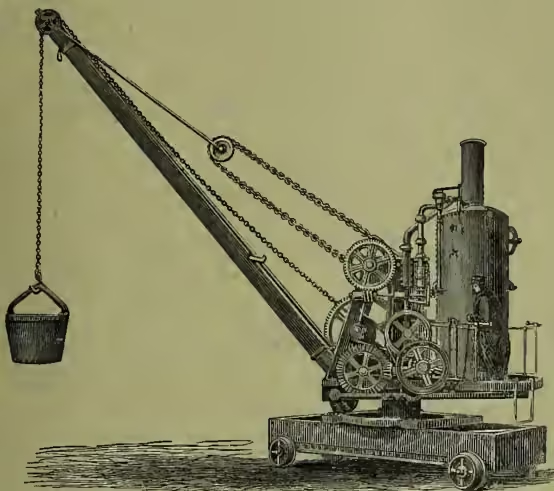
Crane, a machine for lifting weights, worked either by hand, or by steam, or by hydraulic power. The most common hand form consists of an upright revolving post and a projecting arm (usually at an angle of about 45°), the jib with a fixed pulley at its extremity. The lifting chain or rope is secured to the weight, passes over the fixed pulley, and then round a drum or cylinder; suitable toothed-wheel gearing worked by a handle revolves this drum, and thus winds up or unwinds the rope or chain, and so raises or lowers the weight, while at the same time the effort applied by the men at the handles is greatly magnified—namely, disregarding frictional losses, in the same proportion that the peripheral speed of the handles is reduced by the gearing interposed between handle axis and drum axis. The revolving motion of the upright post enables the load to be deposited at any point within the sweep of the jib. It is often arranged that the jib shall be hollow; the chain then passes down it, and there is no fear of fouling; if also the jib is of a curved form, we obtain the full benefit of the lift, while in the ordinary crane the form of the jib or the tie interferes with the usual height of lift.
Whenever much hoisting or heavy work has to be done, steam or hydraulic power is always used; the cranes are then either stationary or portable, the latter type being used whenever it is more convenient to move the crane to its work than the converse. The stationary power cranes differ from the hand ones mainly in their vastly greater power, and consequently greater size and complexity of gearing; where steam is used there are generally two direct-acting steam-cylinders, which replace the two handles worked by hand. The very powerful stationary cranes used in docks capable of lifting 50 to 75 tons are examples of this kind; they are always mounted on massive foundations, and so arranged as to sweep a whole circle. Hydraulic power is very largely used in cranes for these places and in great steel-works; they are simpler in construction, a good deal of gearing being done away with; the water in the operating cylinder is always under great pressure, usually 700 lb. on the square inch. In the hydraulic cranes originally introduced by Sir William Armstrong & Co., the power given out by the hydraulic cylinder is reduced by using systems of pulleys in the inverse order, the lifting chain being attached to the cylinder, then passing over a pulley fixed to the head of the ram, then round other fixed pulleys, and so up to the fixed pulley at jib end, the effect being to increase the motion of the ram, and so secure very rapid lifts at the expense of using more power. In one very ingenious steam-crane (Morrison's) the post of the crane is hollow, and forms the steam-cylinder, in which works a piston with flexible piston-rod—namely, the lifting chain; this form is very steady and very readily slewed.
Portable cranes are mounted on plain railway trucks, either of wood or iron. This truck carries firmly attached to it a central post, the whole of the rest of the crane being carried on a strong base-plate capable of revolving round this post as a pivot, the boiler being so placed (often standing on its own feed-water tank) on this base-plate that it forms a counterbalance to the weight to be lifted. The boiler is always of the vertical type, and very simple in its internal arrangements of tubes (see fig.), because it often has to work with very dirty feed-water. The gearing is usually carried by A frames bolted to the base-plate; the engine, having generally two small direct-acting steam- cylinders, is easily reversed; by means of gearing and clutches, which are operated by the man in charge of the crane by hand or foot levers, the engine can perform the following operations: (1) Lower or raise the outer end of the jib; (2) slew the crane—i.e. the base-plate and all it carries; (3) propel the truck along the rails; (4) hoist the loads. For the last three operations the gearing is generally so arranged that there are two speeds, a quick and a slow, either of which can be used, depending on the work to be done. The figure shows a very common type of this kind, which will lift from 5 to 7 tons, according to the position of the jib. For the maximum load the chain end is often attached to end of jib, and then round a hanging-block, and so up to fixed pulley at jib end, thus doubling pull on chain. For the same purpose as the ordinary crane are used contrivances known as derricks, which consist essentially of a mast or tripod with a long cross-boom at the top, tied to the mast by guys; pulley-blocks attached to one arm of the boom form the means of lifting. They are a good deal used in America for very heavy work, such as raising wrecks, bridge-building, &c. They readily lend themselves for use as floating-cranes, since by making the vessel carrying them in watertight compartments which can be filled, it is easy to counterbalance the load. Electric cranes are also now in use.