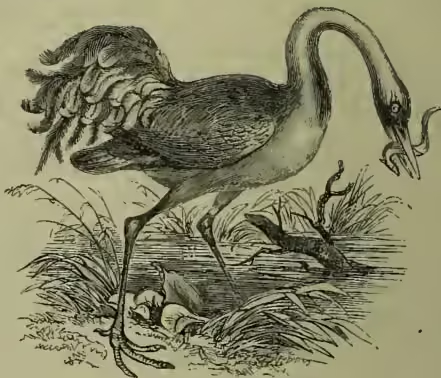
Crane (Grus), a genus of birds in the order Grallatores, the type of the family Gruidae. This family differs from herons, storks, &c., in having the hind-toe placed higher on the leg than the front ones, and in certain characters of bill and skull. The members are also less addicted to marshy places, and feed not only on animal, but, to a considerable extent, on vegetable food. The cranes are all large birds, long legged, long necked, long billed, and of powerful wing. Some of them perform great migrations, and fly at a great height in the air. Some twelve species are known, mostly in the palearctic region, but also in Asia, Australia, and America. Unlike other Grallatores, the young cranes are helpless and require to be fed. Only two eggs are laid.—The Common Crane (G. cinerea) breeds in the northern parts of Europe and Asia, retiring in winter to tropical or subtropical regions. Flocks of cranes periodically pass over the southern and central countries of Europe, uttering their loud harsh cries in the air, and occasionally alighting to seek food in fields or marshes. The crane, when standing, is about four feet in height; the prevailing colour is ash-gray; the head bears bristly feathers, and has a naked crown, reddish in the male; the bill, which is longer than the head, is reddish at the root, dark green at the apex; the feet are blackish; the tail is short and straight. They are very stately birds, though their habit of bowing and dancing is often grotesque. The covering feathers of the wings are elongated, reaching beyond the ends of the primaries, and their webs are unconnected; they are varied and tipped with bluish-black, and are the well-known plumes once much used in ornamental head-dresses. The visits of the crane to Britain are now very rare, although in former times they were comparatively frequent. It feeds on roots, seeds, &c., as well as on worms, insects, reptiles, and even some of the smallest quadrupeds. The flesh is much esteemed. Cranes use their bill as a dagger, and when wounded are dangerous to the eyes of a rash assailant. They may be readily tamed in captivity and exhibit great sagacity.—The Whooping Crane (G. americana) is considerably larger than the common crane, which it otherwise much resembles except in colour; its plumage, in its adult state, is pure white, the tips of the wings black. It spends the winter in the southern parts of North America. In summer it migrates far northwards, but rather in the interior than the eastern parts of the continent.—To the crane family belong also the Demoiselles—e.g. Anthropoides virgo, from southern Europe to central Asia, and the Ethiopian Balearic Cranes—e.g. Balearica pavonina. See Blyth, Natural History of the Cranes (1881).