Crocodile (Crocodylus), a large saurian reptile, the name being originally applied to the crocodile of the Nile only. The term is now used for a whole genus of reptiles, as well as for the small order
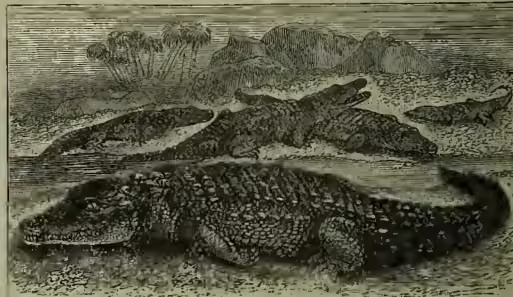
(Crocodilia) to which it belongs. The order includes the largest living reptiles—viz. the crocodiles proper, the Alligators (q.v.), and Gavials (q.v.). The most distinctive characters are as follows :
Externals.—The body, which is provided with a long, laterally compressed, crested tail, is covered with an armature of scales and dorsal bony 'scutes.' The latter exhibit a sculptured appearance. There are four short, strong limbs, with five fingers and four toes, which are webbed in various degrees of completeness. The three inner digits bear claws. Glands with a musk-like secretion are found on the margin of the lower jaw, at the side of the cloacal aperture, and on the posterior margin of the dorsal shields. The musky odour is strongest during the season of love. The nostrils lie close together at the point of the snout, and can be closed by valves; the eyes possess third eyelids, and the pupil is a vertical slit in nocturnal species; the tympanum of the ear is overhung by a fold of skin which closes during diving; the cloaca has a longitudinal aperture.
Skeleton.—Between the skull and the hip-girdle there are always twenty-four vertebrae, and behind the sacrum a large and variable number of caudal pieces. The vertebrae are procœlosus—that is to say, hollow in front—and bear ribs in the neck as well as in the thoracic region. The ribs are provided with two heads for articulation with the vertebrae, and those in the middle of the thorax give off hook-like, backward-turned (uncinate) processes which also occur in Birds (q.v.). A breast-bone, with which the thoracic vertebrae are connected, is always present, and behind this a number of posterior rib-like processes ('abdominal ribs') form a further support. These arise from ossification of septa between the muscles. In the breast-girdle the clavicle is absent; the hip-girdle is normal. In the large skull the chief peculiarity is the formation of a closed bony palate. By the internal union of premaxillæ, maxillæ, palatines, and pterygoids, the roof of the mouth is complete, and the posterior aperture of the nostrils is thus shunted back to the very beginning of the glottis. The development of the skull has been studied by Parker. The mouth-opening is very large, and the jaws bear numerous, usually conical, hollow teeth, implanted in distinct sockets, with reserve germs, at first on the inner side, and afterwards within the pulp cavities of the old ones.
The nervous system calls for no special remark. The peculiarities of nose, eye, and ear have been noted above. The animals have large lachrymal glands, and their 'tears' are proverbial. The tympana communicate with the mouth by three Eustachian tubes, one median and two lateral. As regards the alimentary system, the flat tongue is fixed to the floor of the mouth, the mouth-cavity is bounded behind by two soft transverse membranes. These meet when the crocodile is drowning a victim, and prevent water rushing down the throat. The stomach is in several respects like that of birds. The circulatory system is of importance, since in crocodiles for the first time the heart is four-chambered (see CIRCULATION). The partition between the ventricles is here complete, but as two aortic arches remain, mixed blood still goes to the posterior body. The left aortic arch carries only venous blood to the viscera, whereas in other reptiles it carries mixed arterial and venous. The pulmonary arch carries purely venous, the right aortic arch purely arterial blood. The right and left aortic arches communicate at their roots just outside the heart by a small aperture—the foramen Panizze. The respiratory system presents no special peculiarity except in the backward shunting of the internal opening of the nostrils. When drowning its prey, and with its half-shut mouth in consequence open to the water, the crocodile keeps the tip of its snout on the surface, the glottis is pushed a little forward to meet the posterior open- ing of the nostrils, a complete air channel is thus made, and respiration can go on unimpeded. The air is drawn into the lungs when the ribs expand, and an incipient diaphragm is also of use. The lungs are inclosed in pleural sacs. There is no urinary bladder.
Mode of Life.—Crocodiles are predominantly aquatic animals, and move rapidly by means of their powerful tail strokes. They are clumsy when ashore, and suffer from being stiff-necked. The body drags somewhat on the ground. They feed on fishes, especially in their youth, and on quadrupeds, which they catch by the river-side, and kill by drowning. If the prey cannot be readily torn, it is often buried till it begins to rot. For their shore work they prefer the darkness, but they also like to bask in the sun. They very often float in the water with their snout and upper back above the surface. The eggs, which are firm, though not thick-shelled, are laid in layers in holes on the banks. They are about the size of goose eggs, and the disproportion between the newly-hatched young and the adults is very striking. The females of some species are said to guard their young. Crocodiles are on the whole sluggish animals, and are very remarkable in the long continuance of the slow growth, which hardly seems to reach a limit as in other animals.
The crocodile has acquired in literature a character for deceitfulness which is largely undeserved. The conceit of 'crocodile's tears' (the animals have large lachrymal glands) was common in Shakespeare's time. Spenser describes (Faerie Queene, I. v. 18) the
Cruell craftie crocodile,
Which, in false grieve hyding his harmefull guile,
Doth weepe full sore, and sheddeth tender teares.
Another quotation given by Richardson (see Kitchin's edition of the Faerie Queene, Clarendon Press) is still more libellous, 'as cursed crocodile most cruelly can tole with truthlesse teares unto his death the silly pitieing soule.' Kitchin refers also to the invention of the adjective 'crocodilian' to express a depth of deceitfulness.
Different Forms.—The order of crocodiles includes twenty-five living species, distributed in three families and a doubtful number of genera. They are all found in tropical and warm regions. The three types may be thus contrasted :
| Alligator. | Crocodile. | Gavial. |
|---|---|---|
| Nasal bones form part of nasal aperture. | As in alligator. | Do not. |
| Head short and broad. | Longer. | Very long. |
| Teeth very unequal. | Unequal. | Almost equal. |
| First and fourth lower teeth bite into upper pits. | First into a pit, fourth into a groove. | First and fourth bite into grooves. |
| Union of lower jaws does not extend beyond fifth tooth. | Not beyond eighth. | At least to fourteenth. |
| Neck scutes distinct from back. | Sometimes distinct, sometimes united. | Continuous. |
| South America and south of North America. | Africa, India, North Australia, Cuba, South America. | Ganges, Borneo, North Australia. |
There are altogether a dozen different forms of Crocodile proper, some of which have been dignified as separate genera. The crocodile of the Nile (C. vulgaris) is a well-known species, not now found farther north than Thebes, but occurring abundantly farther south and east. Several varieties are known. It is said sometimes to attain a length of 30 feet, though half that is considered large. It often fatally attacks man, and feeds very largely on smaller mammals. It grows very slowly and continuously, and, with the exception of man, has few formidable antagonists after it has survived its youth. Some two or three score of eggs, with delicate rough limy shells, about the size of those of geese, are laid in sandy cavities in the bank. The young crocodiles are often happily destroyed by the ichneumon, and by a species of lizard. The adult crocodile lives in amiable partnership with a little bird (Pluvianus egyptius). As Herodotus relates, this watcher warns the crocodile by its cry when danger threatens, and it also cleans its body of small animals which fix themselves there. The crocodile was worshipped and even mummified by the ancient Egyptians, and it occasionally bore a part in the Roman gladiatorial combats. It is now hunted for the perfume of its musk-glands, and also for its skin and fat. Crocodile-hide has lately increased in value as an article of commerce. The eggs are esteemed as dainty morsels. The most widely distributed species is C. biporcatus, or porosus. It occurs from the Mascarene to the Fiji Islands, from Farther India to Corea, and also on the north coast of Australia. It lives not only in fresh water, but ventures sometimes into the sea. A very large specimen at South Kensington measures 17½ feet in length. C. frontatus, in equatorial West Africa; C. acutus, in the north-west of South America, in Central America, and in the West Indies; C. cataphractus (often placed in a special genus, Mecistops), from the west coast of Africa, are other important species.
History.—These giant reptiles, like other large forms, have in recent ages been continuously on the wane. They date from the Triassic period (Belodon, Parasuchus, and Stagonolepis—the last from the Elgin sandstones). In the Jurassic age they are very numerous, forty species having been recorded from British strata alone. In the Chalk, the first Crocilia with anteriorly concave vertebrae appear in contrast to the Triassic, the Jurassic, and in part the Cretaceous forms, which had biconcave vertebrae. Among these Cretaceous forms are true Crocilia and Gavials, which are also abundant in Tertiary strata. Professor Huxley has worked out the ‘almost unbroken’ series of gradations from the ancient Triassic forms down to the modern crocodiles, but where this series takes origin among the ancient reptiles is still obscure.
See ALLIGATOR, GAVIAL, REPTILE; also Duméril et Bibron, Erpétologie Générale (Paris, 1834-54); J. E. Gray, Synopsis of Recent Crocodylians (Trans. Zool. Soc. Lond. vi. 1867); A. Heilprin, Distribution of Animals (Inter. Sc. Series, 1887, pp. 327-30); C. K. Hoffman, Bronn's Tierreich, vi.; Huxley, Anatomy of Vertebrates (1879); Journ. Linn. Soc. iv. (1860), &c.; Nature, xxxiii. (1885-86), p. 331; A. Strauch, Synopsis der lebenden Crocodyliiden (Mém. Acad. St Petersburg, x. 1866).