
Cross. The cross was a common instrument of capital punishment among the ancients; and the death of the cross was esteemed so dishonourable that only slaves and malefactors of the lowest class were subjected to it by the Romans. Among the Carthaginians, and probably also among the Phoenicians and allied races, it was employed as an instrument of sacrifice to Baal. Thus the Carthaginian general, Malcus, invested his son, Cartalo, in royal raiment, with a crown on his head, and crucified him to obtain a special favour from Baal. It has been suggested that there may be some allusion to these crucifixions to the sun in Num. xxv. 4; Josh. viii. 29; x. 26. Among the Gauls, as shall be noted later, a cross of equal arms was a solar symbol. It was customary among the Romans to proclaim the name and offence of the person crucified, or to affix a tablet (album) to the cross, on which they were inscribed. Malefactors were sometimes fastened on a simple upright stake, and so left to die, or they were impaled upon it, and to this upright stake the Latin name crux was originally and more strictly applicable; but very generally a cross-piece (patibulum) was added to the stake, to which the arms of the criminal were tied, or to which his hands were nailed. When the cross-piece was fastened at right angles below the summit of the upright stake, the cross was called crux immissa; when the cross-piece was fastened at right angles across the top of the upright stake, the cross was crux commissa; and when it was formed of two beams crossing one another obliquely, it was crux decussata. There was often a projection, on which the body rested, as on a seat. The cross was erected without the gates of towns, but in places of frequent resort. The person crucified often lived for days upon the cross.
The death of Christ by crucifixion led Christians to regard the cross with peculiar feelings of reverence, and to make use of the sign of the cross as a holy and distinguishing sign. The custom of crossing one's self in honour and commemoration of Christ, can be traced back to the 3d century. It was customary, probably from apostolic times, for the Christians to pray with extended arms; and Justin Martyr and Origen explain this attitude as representing that of Christ on the cross. In this manner Christians are represented in the early paintings in the catacombs as praying. The Emperor Constantine, after obtaining the victory over Maxentius, through the influence, as he believed, of the sign of the cross, caused crosses to be set up in public places and upon public buildings; but the so-called cross of Constantine, or Labarum, was not really a cross, but a circle containing the XPI, the first three letters of the name of Christ in Greek, and was merely an adaptation of a symbol of a Gaulish solar deity (see Gaidoz, Le Dieu Gaulois du Soleil), which consisted of a wheel of six spokes, or sometimes of four. After the Invention of the Cross, or finding of the alleged true cross of Christ in Jerusalem, which was supposed to have taken place in a search made on Calvary by the Empress Helena (q.v.) in 326 A.D., a surprising quantity of the relics of the cross were distributed through all parts of Christendom. When a portion of the cross was given to St Radegund by Justin II., emperor of the East, and she desired to have the relic received with honour into the city of Poitiers, the Bishop Maroveus peremptorily refused to allow it. She was obliged to appeal to King Sigebert, and he ordered the Archbishop of Tours to receive the relic. Maroveus left the town rather than countenance what he regarded as a superstitious act. For this occasion Venantius Fortunatus wrote the famous hymn 'Vexilla regis,' and it was first sung on the introduction of the relic processionally into Poitiers, circa 580. Various other protests were made against the extension of the worship of the relics, but in vain. The sign of the cross is made not only by Roman Catholics, but by the members of the Eastern churches also; by the Westerns from left to right, by the Easterns from right to left. It is admitted by the Lutherans as a commemorative sign of the atoning death of Christ, but by many Protestants is rejected as a human invention in worship, and as tending to superstition. It was very generally used during the middle ages, and still is among the less enlightened peasantry in some Roman Catholic countries as a sort of charm, or as affording some security, like an amulet, against all evil, and particularly against evil spirits and witchcraft. The festival of the Invention of the Cross is celebrated on the 3d of May; that of the Elevation of the Cross commemorates the re-erecting of the cross at Jerusalem by the Emperor Heraclius in 628, after it had been carried away by the Persians. See Legends of the Holy Rood, edited by Richard Morris for the Early English Text Society (1871); and the Legendary History of the Cross, by Ashton and Baring-Gould (1887).
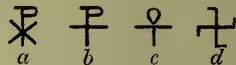
The earliest mention of representations of the crucifixion are by two writers in the 6th century. Gregory of Tours relates that such a picture was in one of the churches of Narbonne, and gave offence because it was nude; and the rhetorician Choricus says that in a church at Gaza was a representation of Christ crucified between two thieves. See CRUCIFIX. As neither of these writers remarks on the novelty of such representations, it may be supposed that they were not infrequent in the 6th century. Early crucifixes were, in contradistinction to that mentioned by Gregory, clothed to the feet. In the treasury of Monza are two such, one given by Gregory the Great in 599 to Adalwald, son of Queen Theodolinda, and another of the 6th century with a Greek inscription. The use of the cross without a figure of Christ is much earlier. As already mentioned, it was employed as a sign made with the hand, or by extension of the arms, at an extremely early Christian epoch; but no crosses are found represented in the catacombs of Rome before the 5th century, excepting the so-called cross of Constantine, a, which is not a cross but a monogram. This symbol is found first in the beginning of the 4th century. It also took the form b. Then it became a plain cross, c. A very complete list of all the representations of the cross in its various forms in the Roman catacombs and other Christian monuments of the first five centuries will be found under the heading 'Kreuz,' in Kraus, Realencyclopädie d. Christlichen Alterthumer (1886).
It appears that the sign of the cross was in use as an emblem, having certain religious and mystic meanings attached to it, long before the Christian era; the crux ansata, or cross with a handle to it, c, is common on Egyptian monuments. It was the symbol of immortality. The cross with equal arms, and the cross with returned arms or fylfot, d, is a symbol found on prehistoric relics in Italy and elsewhere (see Mortillet, Le Signe de la Croix avant le Christianisme, 1866). The Spanish conquerors were astonished to find it an object of religious veneration among the natives of Central and South America, where it was a symbol of the god of rains.
The forms given to crosses in art are endless; but the two leading types are the Latin cross, e, or crux immissa, supposed to be that on which Christ suffered, and the Greek cross, f, both of which are subject to many fantastic variations. The Greek cross forms the well-known cross of St George, which was the national ensign of the English
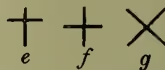
previous to the union with Scotland. The cross of St Andrew, g, differed entirely in form from the Latin or Greek cross. This cross, or crux decussata, consisted of two shafts of equal length crossed diagonally at the middle, as in the annexed cut. According to the legend, this was the form of cross on which St Andrew, the national saint of Scotland, suffered martyrdom (see ANDREW). As the Scottish ensign, it is now blended with the cross of St George in the Union Jack.
The Cross of the Resurrection is a floriated cross; and is usually represented as heading a lance, to which is fastened a banner upon which a cross is depicted. The earliest and finest floriated cross is that in the mosaic of San Ponziano, where, however, the flowers spring from the shaft, and on the arms stand two lighted candles. The idea of the floriated cross seems to have been to connect it with Aaron's rod that budded, and so to signify the eternal priesthood of Christ.
In medieval times a cross, the Rood, stood over the screen between the nave of a church and the chancel. This was always veiled in Lent. The crutched cross, like the letter T, was the symbol of St Anthony the Hermit. Processional crosses are those carried in processions (see CROSIER); pectoral crosses, those worn on the breast by ecclesiastics of rank. Many orders have distinctive crosses. See LEGION OF HONOUR.
The Order of the Cross, originally a spiritual order of knighthood, sprang up in Palestine in the time of the Crusades, and was then called the Bethlehemite Order. Pope Gregory IX. confirmed the order in 1238. Its principal seat was in Bohemia. There is also a Brazilian Order of the Cross.
Sanctuary, Boundary, or Monumental Crosses, as they are called, consist of an upright flat pillar or obelisk, covered with sculptural devices, and set
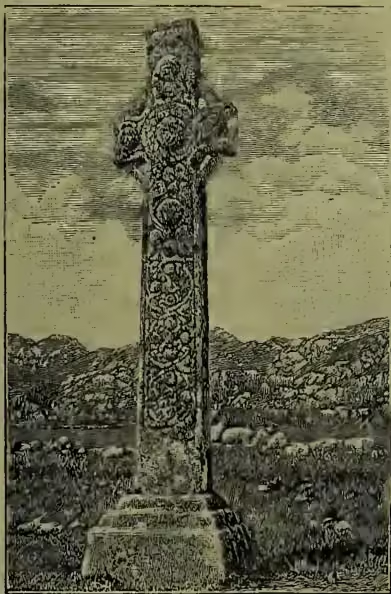
Celtic Cross, most frequently found in Ireland and in the north and west of Scotland. Such crosses vary much, from a cross incised on a flat slab to an elaborate cruciform monument. The majority of the latter seem to belong to the period between the 12th and 15th centuries. One of the best known is that at Iona called St Martin's Cross, standing in the grounds of the cathedral. It is a column of compact mica schist, 14 feet high, 18 inches broad, and 6 inches thick, and is fixed in a pedestal formed out of a massive block of red granite, about 3 feet high. In connection with certain ancient religious houses in Ireland, there were very fine Celtic crosses. For Celtic crosses, and for the Runic crosses of Anglo-Saxon Britain (as at Ruthwell and Bewcastle), Man, and the Western Isles of Scotland, see the articles SCULPTURED STONES and RUNES.
Churchyard Crosses seem to have existed in all churchyards before the Reformation: some still exist, and the remains of others are numerous. In France, in connection with the cemetery cross, in some parts, a perpetual lamp was kept burning, and the contrivance for the lamp remains in some of them.
Many very beautiful crosses exist in England, upon the points of gables of churches, or gravestones, and in other situations, as also in heraldry. Among these, the cross most commonly seen is called the cross crosslet (see below).
Memorial Crosses are such as are erected in memory of a beloved object, or in commemoration of some event of local importance. In England there are some superb crosses of this kind; they are popularly called Norman Crosses. This species of cross resembled a Gothic turret set on the ground, or on a base of a few steps, and was decorated with niches for figures and pinnacles.
The best-known examples are those erected by Edward I. (1290) in memory of his queen, Eleanor; being placed on the spots where the body rested in its funereal progress to Westminster. The crosses at Waltham, Cheapside, and Charing were of the number. That at Charing was removed by the parliament in 1647; a modern reproduction now occupies its site. The Waltham
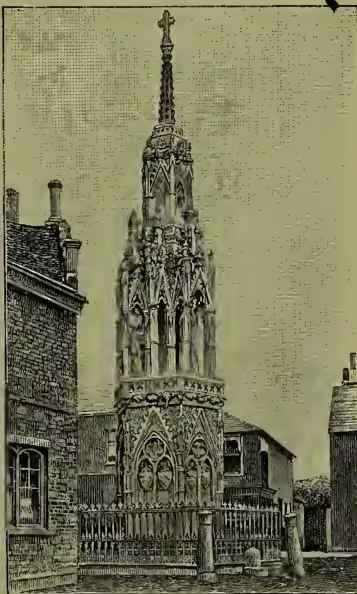
Cross, repaired in 1890, remains as a testimonial of the affection and piety of the greatest of the Plantagenets.
Village Crosses stood in the centre of most villages in ancient times. In the west of England a good many remain.
Town or Market Crosses were erected as stands to approach from, or in commemoration of events regarding which it was deemed proper to evoke pious in a socket level with the ground. Occasionally, they appear to have marked boundaries, but more frequently were monuments over the graves of heroes, kings, bishops, &c. A vast number of extremely rude and early crosses of granite occur in Cornwall and Devon: some of these have apparently been fashioned out of prehistoric monoliths. In some instances, they probably marked the verge of a sanctuary. A characteristic type of cross is the feelings. As these structures were incorporated with or surmounted by a crucifix, the term cross was so indelibly associated with them that it survived the religious character of the fabrics. The earliest examples of this kind consisted, probably, of tall crucifixes of wood, such as are still seen by the waysides in some continental countries. Afterwards, stone shafts would be substituted; and according to the increase of market revenues, or progress of taste, these town-crosses assumed that imposing character which they latterly possessed. The crosses at Cheddar in Somersetshire and at Malmesbury in Wiltshire, are open vaulted structures, with a commodious space beneath as a refuge for market-folks during rain, and surmounted with a kind of Gothic turret. At Chichester, Bristol, and Winchester, the market-crosses, while similar in form, are of a higher architectural quality. Adjoining St Paul's in London stood Paul's Cross, a structure which we read of as early as 1259, in the reign of Henry III. At this preaching-cross, by order of Henry VIII., preachers delivered sermons in favour of the Reformation, and here Queen Elizabeth attended to hear a thanksgiving sermon for the defeat of the Spanish Armada; but in 1643 the cross incurred the displeasure of the Puritans, and was demolished by order of parliament. See The Ancient Stone Crosses of England, by Alfred Rimmer (1875).
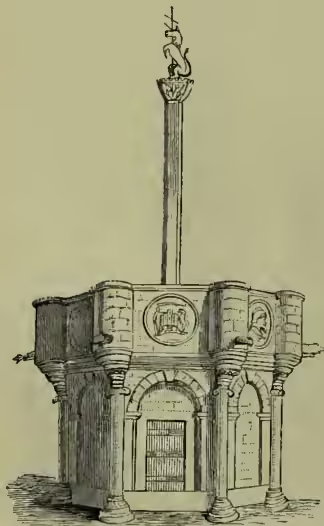
Scotland offers no specimens of memorial or Norman crosses, unless it be the modern Scott Monument, at Edinburgh, which is essentially a Norman cross of a gigantic order. The simpler kind of Scottish market-cross consisted of a shaft of stone, standing on a flight of circular or octangular steps—the grander market-cross consisted of a tall stone shaft, on an imposing circular, hexagonal, or octagonal substructure, 10 to 16 feet high. The top formed a platform, which was surrounded with an ornamented stone parapet, and was reached by a stair inside. Losing their religious character, the dignantly referred to by Scott in Marmion. The shaft, which had been preserved, was re-erected on a similar substructure near the same site in 1885, at the expense of Mr Gladstone.
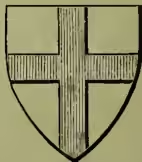
CROSS, in Heraldry, is one of the ordinaries, and is represented with four equal arms, and considered to occupy one-fifth of the field if not charged, and one-third if charged. Argent, a cross gules, is the cross of St George. Like other ordinaries, the cross may be engrailed, invecked, &c. When its central square is removed, it is said to be quarter-pierced; and when it does not extend to the margin of the shield, it is called humetté. But the cross of heraldry is often found varied in other ways, the varieties having each separate names. Thirty-nine varieties are enumerated by Guillim, and 109 by Edmonson. Those most frequently occurring are here mentioned; and it may be remarked that they St George's Cross. have rather the character of common charges than ordinaries not extending to the margin of the shield, and being often borne in numbers as well as singly. The cross moline (fig. 1) has the ends turned round both ways; the cross fleury (fig. 2) has each end terminating in a
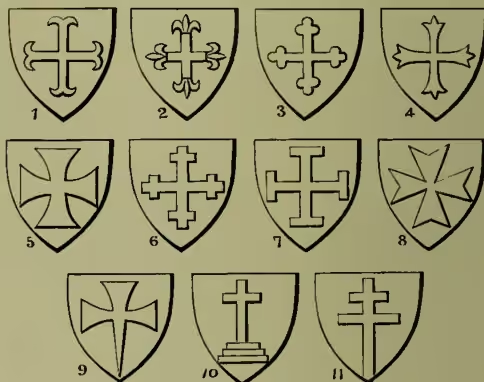
fleur-de-lis; the cross botonée (fig. 3) has each end terminating in a trefoil; the cross patonce (fig. 4) has three points to each limb; the cross patée (fig. 5) is small in the centre, but widens towards the ends; the cross crosslet (fig. 6) is crossed at each end; and the cross potent (fig. 7) is crutch-shaped at each end. The Maltese cross (fig. 8), which converges to a point in the centre, and has two points to each limb, though not frequent as a heraldic charge, derives importance from being the badge of the Knights of Malta and other orders. Any of these crosses is said to be fitchée when the lower limb terminates in a point, as in fig. 9, representing a cross patée fitchée. Besides these and other crosses with equal limbs, there is the cross Calvary (fig. 10), being the cross of crucifixion elevated on three steps, and the patriarchal cross (fig. 11) with two horizontal bars.
CROSS, MARIAN. See ELIOT, GEORGE.
CROSS, SOUTHERN. See SOUTHERN CROSS.
CROSS Bill, a bill of exchange or promissory note given in consideration of another bill or note.
Crossbill (Loxia), a Passerine bird in the finch family (Fringillidæ), well known for the curious way in which the points of the upper and lower bill-halves cross one another. There seems to be no constancy in the direction of crossing, for in different individuals, even of the same species, the upper and lower portions are found variously directed to right or left. This peculiarity is probably for the most part a directly mechanical adaptation to the food-habit of the bird, which consists in tearing up the cones of firs and pines for the sake of the seeds. Bringing the two points together, the crossbill inserts its beak into the cone, then opens it with a strong lateral movement, and with its scoop-like tongue detaches and captures the seed from the loosened cone. In a similar way, the crossbill can soon tear an ordinary cage to bits; or, which is more important, may rapidly do great damage by cutting up the apples in an orchard.
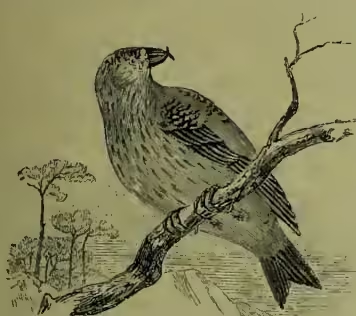
It is interesting to compare two common species, L. pityopsittacus and L. curvirostra, since in the former the crossing of the bill is seen in a much less emphasised degree. The last-named species is of frequent, though inconstant occurrence in Britain, and two other species have been recorded as visitors. Altogether, seven species are known, from the northern regions of both hemispheres, and always found gregariously in conifer forests. The crossbill has become associated with a sacred legend, familiar to many from Longfellow's translation of a German poem on the subject. The bird was fabled to have sought, by pecking at the nails, to free Christ from the cross.