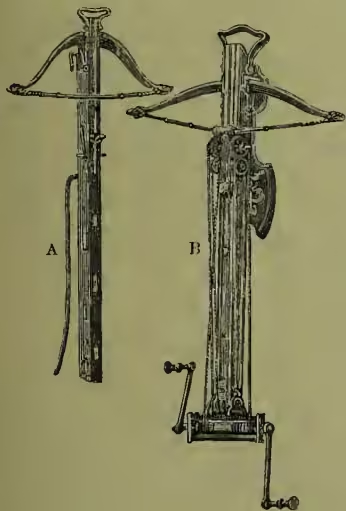
Crossbow, or ARBALEST, a weapon used in war and sport in medieval times. It consisted of a wooden stock, with a bow made of wood, iron, or steel, crossing it at right angles to the end; the bowstring was pulled down towards the other end of the stock by a lever (which in the simpler kinds was worked by hand or foot), and retained in position sometimes in a notch by a catch or trigger. The bolt or 'quarrel' was then laid in a groove on the top of the stock, and the trigger being pulled, it was shot with a considerable amount of power. The latter, of course, depended on the size of the bow, some of the weapons being comparatively small and easily handled, while others were of large dimensions, and required a machine of the nature of a windlass, called a 'moulinet' or 'gaffle,' to enable the bow to be properly bent. The crossbows of the 14th century were almost all thus equipped. The 'quarrels' employed varied with the size of the bow, but generally they were short stout shafts about 18 inches long, winged with horn or leather, and having a metal point, which was sometimes sharp, but often lozenge-shaped, obtuse, and indented at the sides. Some crossbows had a tube or barrel, with a slit for the bowstring, and dis- charged balls of clay, marble, or lead with such force that they were more formidable weapons than the earliest firearms. The larger crossbows were really military engines, which required several men to work them, and threw proportionally heavy missiles (see BALLISTA). The crossbow was used in England chiefly during the 13th century; after that it gave place to the longbow, which was found to be the more convenient and easily handled weapon of the two. Its use, however, was general among the continental nations of Europe after the 12th century; though the Lateran Council of 1139 forbade its use as being too murderous a weapon for Christians to employ against one another.