Crown (Lat. corona). The crown of classical times was a circular ornament of metal, leaves, or flowers, worn on festive and solemn occasions, and as a reward of worth, talent, and military or naval prowess. Among the Greeks the crown (stephanos) was sometimes used as an emblem of office, as in the case of the archons; sometimes as an ornament for the heads of the victors in the public games; and sometimes as a mark of distinction for citizens who had merited well of their country. The Romans made great use of crowns as rewards for valour. The most highly prized was the corona obsidionalis, which was bestowed by a beleaguered garrison or army on the general who rescued them. It was made of grass or wild-flowers, gathered from the place which had been beset by the enemy. Next in order was the corona civica, a garland of oak leaves and acorns, which was given as a reward to any soldier who had saved the life of a Roman citizen in battle; the corona navalis, a gold circle decorated with beaks of ships, was the reward for naval services; the corona muralis, a similar circle surrounded with battlements, was bestowed on him who first scaled the walls of a besieged city; and the corona vallaris, a circle ornamented with palisades, on the first soldier who forced his way into the enemy's camp. There was also the corona triumphalis, bestowed upon a general when he obtained a triumph.
Other crowns were emblematical, such as the sacerdotal, funeral, convivial (of roses, violets, myrtle, ivy, and even parsley), and nuptial crowns. The custom of wearing bridal wreaths or even bridal crowns of metal is not unknown in modern Europe as in Germany and Norway and medieval England; and the bridal wreaths of young brides are still suspended in some Derbyshire churches. (1) Corona sacerdotalis, worn by the priests and bystanders when engaged in sacrifice. (2) Corona funebris or sepulchralis, with which the dead was crowned, a custom which prevailed both among the Greeks and Romans. In Greece, these crowns were commonly of parsley. (3) Corona convivialis, worn by guests on festive occasions.
As the emblem of sovereignty in modern Europe, the crown was borrowed less from the crowns of antiquity than from the diadem, a fillet of silk, linen, or woolen. This decoration was originally oriental. Alexander the Great adopted it from the kings of Persia; and Antony assumed it during his luxurious intercourse with Cleopatra. In modern states, crowns have been of various forms, and undergone various changes. The royal crown of England in the 12th and 13th centuries was a jewelled circlet of gold, heightened with strawberry-leaves or trefoils, sometimes alternately large and small. In the very costly and magnificent crown of Henry IV., the strawberry-leaves, eight in number, alternated with as many fleurs-de-lis, the whole alternating with sixteen small groups of pearls. The same crown was worn by Henry V. in the beginning of his reign, but on undertaking his French campaign he ordered it to be broken up, and the fragments distributed as security for the loan required by him to carry on the war. The crown that succeeded it was probably an arched one; for although no arched crown appears on the Great Seal of any monarch before Edward IV., the arched as well as the unarched form of crown is found occasionally in sculptures and illuminations of the reigns of Henry V. and Henry VI. The crown of Edward IV. (which was probably also worn by Henry V. and Henry VI.) differs from previous crowns in being arched over with jewelled bands of gold, closing under a mound ensign by a cross patée, while crosses patée are substituted for the strawberry-leaves, and roses or fleurs-de-lis for the clusters of pearls. During succeeding reigns down to that of Charles II., the crown underwent various minor changes of form.
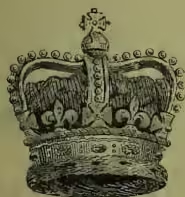
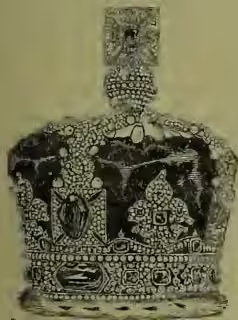
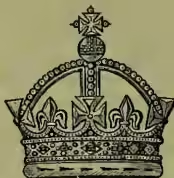
There were sometimes three complete arches, sometimes two as at present, and these were at first very acute, afterwards more and more depressed; but the crown of the first Stuarts (weighing 7 lb. 6 oz., and worth £1110) was broken up in 1649. From the reign of Charles II. till that of William IV., the same actual crown was used, its form being what is still usually known in this country as the imperial crown, and represented in fig. 1. It has four crosses patée and four fleurs-de-lis set alternately on the circlet, while two complete pearl-studded arches rising from within the crosses patée carry at their intersection the mound and cross. A new state crown was made for the coronation of Queen Victoria, differing somewhat from the imperial crown. Its arches rise almost perpendicularly, are elevated rather than depressed at their intersection, and assume the form of wreaths of rose, thistle, and shamrock, formed of brilliants; and the crown itself is covered with diamonds and studded with costly gems (fig. 2). In official representations of the royal arms, they are ensign by the imperial crown, but a graceful modification of that crown is sometimes made use of instead of it with Her Majesty's sanction (fig. 3). For the coronets of the members of the royal family and of the nobility generally, see CORONET.
The crown of Scotland, long lost sight of, was in 1818 discovered, along with the other Regalia (q.v.), in a chest in Edinburgh Castle. Its gold circle, richly jewelled and enamelled, is heightened with ten fleurs-de-lis, alternating with as many crosses fleury, each adorned in the centre with a great diamond between four large pearls put crossways. Four gold arches, added in the reign of James IV., close under a mound, on which rests a large cross patée, with four pearls at the extremities, and as many in the angles. Excepting the arches, the crown is probably of the date of Robert Bruce.
In the crown of the kings of France the circle was heightened with fleurs-de-lis; and from the time of Francis I. it was closed with eight arches,
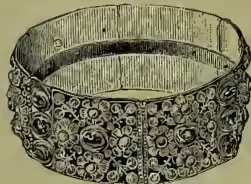
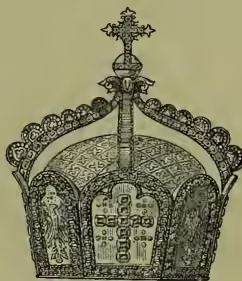
from whose intersection arose a fleur-de-lis. The crown of the former German emperors, now of the Austrian emperors, is cleft in the centre, so as to present an appearance suggestive of a mitre. The adoption of this crown by Charles V. seems to have resulted from the kings of France having, in emulation of the emperors, assumed a close crown. The iron crown of the ancient Longobardic kings (fig. 4)—restored to the king of Italy by the Emperor of Austria in 1866—is alleged to have been bestowed by Pope Gregory the Great on Queen Theodolinda, and with it Henry of Luxemburg and succeeding emperors were crowned. It is a gold circle with enamelled flowers and jewels, within which is a thin fillet of iron, which has been asserted to have been hammered from a nail of the true cross. The crown of the new German empire is shown in fig. 5. The crown with which the king of Roumania was crowned in 1881 was made of bronze from the cannon captured in the Plevna redoubts.
The crown of an English King-at-arms is of silver gilt, with sixteen oak-leaves, each alternate leaf higher than the others. Since 1727 that of the Scottish Lyon King-at-arms is similar in form.
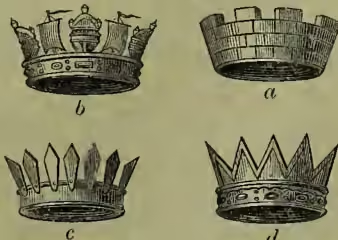
Crowns frequently occur as heraldic bearings; of these there are three of the classical crowns noticed in this article—viz. the crowns mural, a (fig. 6), naval, b, and vallary, c, also the eastern or antique crown, d, a circle with high points rising from it, and the celestial crown, differing from the last in having a star on each point.
THE CROWN is a term often employed to signify the state and the matters under control of the executive authority. Thus, in the interests of the state there are crown-ministers, crown-lawyers, crown-officers, crown-lands, &c.—the term, in no instance, having any special connection with the sovereign personally. In Scotland, certain high crimes are technically called Pleas of the Crown. These are four in number—murder, robbery, rape, and wilful fire-raising—and fall within the jurisdiction of the High Court of Justiciary. Likewise, in Scotland, there is a functionary styled crown-agent. He is a practising law-agent or solicitor, who, under the Lord Advocate and his deputies, takes charge of criminal proceedings. His duty is to receive from the procurators-fiscal of the different counties the precognitions which they have taken, and to lay these precognitions before the lawyers for the crown, that they may determine whether there is ground sufficient to call for a prosecution. He also expedites indictments and criminal letters, and otherwise discharges the duties of an agent in preparing and assisting in the conduct of trials before the High Court of Justiciary. The appointment of the crown-agent is with the Lord Advocate, and ceases with the administration.
CROWN CASES RESERVED, COURT FOR. See APPEAL.
CROWN-SOLICITOR, the solicitor to the Treasury, who, in state prosecutions in England, acts as solicitor for the crown in preparing the prosecution. In Ireland there are crown-solicitors attached to each circuit, whose duties correspond in some degree to those of the Procurators-fiscal (q.v.) and crown-agent in Scotland. In England there are no analogous officers, and prosecutions are consequently conducted by solicitors appointed either by the parish, or by private parties bound over by the magistrates to prosecute. But in cases of great importance to the public, such as unusual or monstrous crimes, it is of frequent occurrence that the Solicitor to the Treasury takes charge of the case and instructs counsel.
CROWN DEBTS.—It is a prerogative of the crown to take precedence of all other creditors, and in England, to recover its debts by a summary process called an extent. By 33 Henry VIII., chap. 39, this preference is given over all creditors who have not obtained judgment (meaning in Scotland, the execution of diligence) for their debts before the commencement of the crown's process; and the Act 6 Anne, chap. 26, extended the law of England in this respect to Scotland, the old writ of extent being abolished in 1856. The rule in Scotland was limited to movable or personal property, and the crown has no privilege over a subject in a competition for heritage. It obtains, however, as opposed to the landlord's Hypothec (q.v.). Mercantile sequestration does not discharge crown debts except with consent of the Treasury; and in a sequestration the crown has a statutory preference for one year's arrears of income and property tax, and assessed taxes. A similar preference is given for local rates. See EXTENT, EXCHEQUER.
CROWN-LANDS must be distinguished from such rights as that in the seashore, which are merely held by the sovereign in trust for the people; and also from that portion of the royal patrimony which consists of such reserved rights as mines, salmon-fishings, &c. The crown-lands are called annexed property in Scotland, and demesne lands in England, and are of course also distinct from the private estate of the person who happens to be sovereign. They are now contracted within narrow limits, having been almost entirely granted away to subjects. King William III. so impoverished the crown in this manner, that an act was passed in 1703 voiding all grants or leases from the crown of royal manors, or other possessions connected with land, for a period exceeding thirty-one years. At a much earlier period (1455, chap. 41) a Scottish statute had rendered the consent of parliament necessary to the alienation of the property of the crown, but the policy adopted of extensive subinfeudation to encourage agriculture had the effect of greatly diminishing the relative value of crown-lands not actually given away; and in Scotland they now consist mainly of a few castles, palaces, and feu-duties. The superintendence of such property as still belongs to the crown is now vested in commissioners appointed for the purpose, called the Commissioners of Woods, Forests, and Land Revenues. See WOODS AND FORESTS. In some British colonies unallotted ground is nominally crown-land. Thus the sale and settlement of land in New South Wales was regulated by the Crown Lands Act of 1884.
Crown, in Architecture, a species of spire or lantern, formed by converging flying-buttresses. Familiar examples in Scotland are the crowns of St Giles's, Edinburgh, and King's College, Aberdeen; south of the Tweed the only old crown is that of St Nicholas's Cathedral at Newcastle.
Crown Imperial. See FRITILLARY.
Crown Pieces of silver, of the value of five shillings, were introduced into the English coinage by Henry VIII. They have a standard weight of 436.56 grains. None were coined from 1861 till 1887, but since then they have again been struck. The name crown is also used as the translation of the French écu, which varied in value from 6 francs (or livres) to 3 francs.
Crown Point, a post-village of New York, on Lake Champlain, near the site of a British fort of the same name surprised and captured by Colonel Ethan Allen in 1775.
Crown-work, in Fortification, is an network consisting of two Bastion (q.v.) fronts connected with the main work by long flanks, so that its plan resembles somewhat the outline of a crown.
Crow's-feet. See CALTHROP.
Crow-stone, the top stone of the gable-end of a building. See CORBIE STEPS.
Crowther, SAMUEL ADJAI, Bishop of the Niger territory, whose native name was Adjai, was born in Ochugu, to the east of the kingdom of Dahomey, in 1812, was carried off as a slave in 1819, and after having been bartered and sold more than once, was taken by a British man-of-war and landed at Sierra-Leone in 1822. He was placed under a missionary for training at Bathurst, and in 1825 professed his adherence to Christianity, assuming the name of a London vicar. He was next placed in charge of a mission school at Regent's Town; was with the first and second Niger expeditions (1841, 1854); visited London in 1842, when, as the result of some further training, he was ordained by the Bishop of London, entered with enthusiasm upon his missionary labours, and was consecrated Bishop of the Niger territory in 1864. A D.D. of Oxford, he translated the Bible into the Yoruba language. He died 31st December 1891. See his Life (1888).
Croydon, a town in Surrey, 10½ miles S. of London Bridge, yet practically a suburb of London. It lies on the edge of the chalk and plastic clay, near the Banstead Downs, at the source of the Wandle, hence its name Croindene (Fr., 'chalkhill') in Domesday. The archbishops of Canterbury had a palace here from the Conquest till 1757. Its Perpendicular hall (1452) and chapel (1633-63) were purchased by the Duke of Newcastle in 1887 and presented to the Sisters of the Church Extension
Association. Addington Park, 3½ miles ESE., has since 1807 been the summer seat of the archbishops. Addiscombe House, at one time the residence of the first Earl of Liverpool, was converted in 1812 into the East India Military College, but was pulled down in 1863. The fine old Perpendicular parish church was destroyed by fire in January 1867, with the exception of the tower, but was rebuilt by Sir Gilbert Scott, and retains the monument of Archbishop Sheldon, with fragments of that of Archbishop Grindal. That of Archbishop Whitgift was restored in 1888 at a cost of £600. Whitgift's Hospital (1596) is a red brick pile, restored in 1860; his grammar-school now occupies buildings of 1871, besides a large Whitgift middle school. A new town hall, with law-courts and free library, was opened by the Prince of Wales in May 1896. Croydon was one of the first towns to grapple effectually with the economical disposal of town-sewage. A system of disposing of sewage by irrigation was inaugurated in 1858, and the corporation now possess two sewage farms, comprising 680 acres. In 1868 new water-works were completed, the water, which is of great purity, being obtained from an artesian well, yielding nearly 3,000,000 gallons per diem; and a further supply of 2,000,000 gallons per diem was introduced in 1888 at a cost of £50,000. The death-rate in 1848, the year before the adoption of the Public Health Act, was 28·16; in 1887 it was 14·71. There are thirteen railway stations. Till the 18th century Croydon was famous for its 'colliers' or charcoal-burners; now its chief speciality is the manufacture of church clocks and carillons. It was made a municipal borough in 1883, a parliamentary one in 1885, and a county borough in 1888. Pop. (1851) 10,260; (1871) 55,652; (1891) 102,697. See J. C. Anderson's Short Chronicle (1882).