Curling, a sport on the ice common in Scotland, where it is played by all classes of people in winter. Frozen-over lakes and rivers answer for the purpose, but under the auspices of curling clubs, artificial shallow ponds are maintained for the sake of this popular national sport; and the bonspiels, or set matches, are contested with great spirit. The sport is regulated by a body of rules issued by a central association called the Royal Caledonian Curling Club, which has grand matches in which hundreds are engaged once, if possible, every winter, and which awards medals to provinces and parishes for competition. The remarkable and pleasing peculiarity of curling is, that it produces for the time a thorough mingling of ranks—peers, peasants, clergymen, farmers, country gentlemen, and tradesmen, all meeting familiarly and hilariously for the
The Rink.
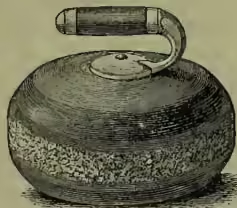
occasion. Latterly, curling has migrated to England, Canada, and other countries where Scotchmen can find ice of sufficient strength and keenness, and in Southport Glaciarium (1878-89) the game was played in summer on artificial ice. Curling is played with flattish round stones, about 9 inches in diameter, prepared by curling-stone manufacturers, each stone weighing from 30 to 50 lb. Each of the players has a pair. The stones are provided with handles, to enable the player to hurl them on the ice with the proper degree of force. As at bowls, the stones are hurled to an assigned point or mark. The game is as follows: Sides are made up, usually consisting of four against four, with a director styled skip for each; after which a certain length of ice is chosen on which to play. This is called the rink. Certain marks are then made at each end of the rink, consisting of several concentric rings, called broughs, and a centre, called the tee. The game is decided by time, or by one party first attaining a certain number of shots, such as 21 or 31; and the keenness displayed by rival sides in competing for victory is perhaps without a parallel in any other pastime whatever. One on each side plays alternately. The chief object of the player is to hurl his stone along the ice towards the tee, with proper strength and precision; and on the skill displayed by the players in placing their own stones in favourable positions or in driving rival stones out of favourable positions, depends nearly all the interest of the game. At a certain distance from each of the tees, a line—the hog-score—is drawn across the ice; and any stone not driven beyond this mark counts nothing, and is laid aside. In country places, a dinner composed of 'beef and greens,' the well-known curler's fare, generally concludes the day's diversion, which, taking place when outdoor labour is suspended, is felt to be no encroachment on rural occupations.
For laws of curling, and general remarks on the game, see The Channel-stane (four series, 1883-84), the last series of which contains an ample bibliography; Descriptive and Historical Sketch of Curling (1828), reprinted as The Kilmarnock Treatise (1883); Curling, Ye Glorious Pastime (1882), a reprint of the Account of the Game of Curling (1811); Curling, by Dr James Taylor (1884). There are, besides, the Annuals of the Royal Caledonian Curling Club, 1839-88. This club in its jubilee year (1888) undertook the preparation of a volume—the Rev. J. Kerr's History of Curling (1890).