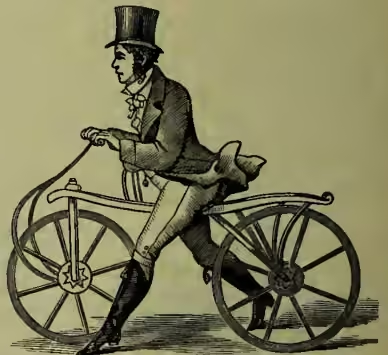
Cycling. The early history of cycling—in which generic term the use of all classes of manu- and pedo-motive carriages is now by general consent included—is, like that of ancient Britain, involved in obscurity. As long since as 1818 something in the nature of a bicycle was introduced into England by Baron von Drais, a Frenchman resident at Mannheim, and was known as the Draisene or Célérifère; while velocipedes or manu-motive machines with three or more wheels were in occasional use in England even before that date, one of the earliest being an invention of Richard Lovell Edgeworth (circa 1767). The Draisene consisted of two wheels, about 30 inches in diameter, running one in the wake of the other, and connected by a beam of wood, upon which, midway from each end, was placed a saddle or perch. At the fore-end of the beam an arm-rest was secured, and this, roughly, completed the apparatus. The mode of propulsion was singularly simple: the rider placed his leg over the beam, got into the saddle, and, resting his arms upon the support referred to, pushed the 'dandy-horse' ahead by kicking the ground with his right and left foot alternately; when a certain impetus was attained, he could, were he a skilful rider, cease the kicking process, and allow the machine to proceed until the momentum was exhausted, when he had to commence de novo. The satire of Cruikshank and his contemporaries effectually killed the quaint and comical hobby-horse of 1818.
The fashioning of the first practical bicycle (circa 1846) is currently credited to Gavin Dalzell, a cooper at Lesmahagow in Lanarkshire. It went by the name of the 'wooden horse,' being constructed chiefly of wood; the saddle was low, and the pedal movements or 'stirrups,' which moved backwards and forwards alternately, were connected by iron rods with the cranked axle of the driving-wheel. But it seems that Kirkpatrick Macmillan, a blacksmith in the parish of Keir, Dumfriesshire, was six years earlier on the road with a hobby-horse completely equipped with cranks and levers.
The next revival of cycling may be said to date from 1867. A few years previous to this it occurred to an inventive genius, one M. Michaux, to fit to the hobby-horse a pair of pedals by which the front wheel might be revolved with the feet. This, of course, meant that the rider must depend for his balance upon some means whereby the relative positions of the two wheels might be varied at will; in other words, some method whereby the base of the machine might be changed at pleasure. To this end, a transverse handle was affixed to the front wheel, which admitted of its being turned even to a right angle. This new-corner was known as the bicycle, but is now irreverently alluded to in all quarters as the 'boneshaker'—probably because it was made of wood, and shod with iron tyres instead of rubber, while springs were often conspicuous by their absence.
The boneshaker craze was a serious one; it affected all classes of society, but chiefly—in consequence of the cost of the article—the middle and upper ranks; in witness whereof, the illustrated papers of 1867–69 contained more than one wood-cut showing the Prince Imperial upon his boneshaker in the Tuileries. One of the earliest of Michaux's bicycles found its way to Mr Charles Spencer's gymnasium in London in 1868. So little was to be gained, and so much was to be lost—particularly in the way of appearances—by 'boneshakerism,' that in a few years it promised to become a lost art, when, happily, the inventive genius of an Englishman, whose identity is open to question, supplied the missing link—the rubber tyre—which, with the suspension wheels and steel framing introduced at a later period, made the modern bicycle. From the bicycle the tricycle was early evolved, chiefly through the instrumentality of James Starley (died 1881), of Coventry; a further impetus was given by the pneumatic tyre, and now the types of machine are practically endless.
The utility of the cycle is proved beyond all question. It is asserted on the best authority that a person of average capabilities can upon it travel at least three, and frequently six, times as far as he can walk in a day, and this with even less fatigue; while the possibilities of the machine in able hands will be admitted, when it is pointed out that a mile has been ridden upon a bicycle in less than two minutes, and that 40 miles have been traversed in an hour, 634 miles in the 24 hours, on the racing track. Edward Hale completed on July 31, 1900, his great record task of riding 100 miles per day, Sundays excepted, for one year, his mileage being 32,479. The ride from Land's End to John o' Groat's—roughly, 900 miles by road—has been accomplished in three days four hours forty-six minutes.
But the utility of the cycle is further proved by facts other than those given; it has become the poor man's carriage, and the rich man's hobby in more senses than one. Royalty disports itself, at any rate in quasi-publicity, upon it, and the nobility and gentry make no secret of their love of the wheel. Clergymen visit their parishioners; medical men their patients; and tens of thousands of the middle classes transact their business or follow their pleasures by its means; while it is next to impossible to pass through any of the streets of our chief towns without seeing that the cycle, in some one of its numerous shapes, is ably ministering to the wants of the community. It was estimated that in 1895–96 the annual British output was about 750,000 machines, while that of America was already over 1,000,000. Cycle-making has become a very important industry.
So general has cycling become, that there are in existence in Great Britain alone at least twenty cycling publications, varying from weeklies to annuals, while roadbooks and handbooks innumerable have already been put upon the market.
As with most other sports or pastimes, cycling is strong in a clubdom of its own. Hundreds of local clubs exist in different parts of the country, while acting in concert with them is the largest of all, the Cyclists' Touring Club, whose headquarters are at 47 Victoria Street, London. The C.T.C., as it is familiarly called, was not the forerunner of the local clubs to which reference has been made, for some of these existed three or four years before it, but it was called into existence in 1878 for the purpose of encouraging and promoting touring, as its name implies. To this end it has appointed at one fixed tariff some hotel—often the leading one—in every town as headquarters. It has also appointed a member in nearly every town to act as consul—in other words, to be a guide to visiting clubmen; in addition to which it has nominated the most competent mechanic the place possesses to repair machines at moderate prices in case of breakage. By the introduction of a specially suitable and durable uniform; by the compilation of roadbooks and maps for the Continent, as well as for Great Britain; by agitating for better roads, for finger-posts and milestones; and in countless other ways it has benefited cyclists and cycling; and that its programme is popular, will be apparent when it is explained that it at present possesses over 56,000 members. It publishes a monthly Gazette, as well as an official handbook with full details of the arrangements made in the different parts of the country for the convenience of its members. The benefits of membership are all obtainable for a nominal sum annually. The C. T. C. is international in its character, nearly a dozen prosperous divisions having already been established in the United States, in Canada, and upon the Continent.
Cycling possesses also a National Cyclists' Union that looks after the legislative side of the sport; that frames and endeavours to uphold the amateur definition; that pledges itself to oppose the introduction of prohibitive restrictions; that holds the amateur championships; and that in many other ways, such as erection of danger-boards and universal lighting, does a large amount of good for wheeldom. The subscription for members not belonging to an affiliated local club is five shillings. There are branches of the N. C. U. in Scotland, and Ireland has its Cyclists' Association: the total membership is about 80,000. The French Touring Club now numbers over 60,000; the League of American Wheelmen is over 100,000.
For many years cycling was practised in England in the face of much ridicule from the general public, and hostility from other sections of the road-using community; while ingress to the parks was denied its votaries. These prejudices have, however, happily been overcome; by the instrumentality of the C. T. C. and the N. C. U. before referred to, nearly all these restrictions have been removed, and, speaking broadly, a cycle is at liberty to enter and use the inclosures to which other public vehicles are given access. Similarly, through the exertions of the C. T. C., the powers hitherto possessed by courts of quarter session and corporations under the Highways Amendment Act of 1878, and the Municipal Corporations Act of 1882, have by the Local Government (England and Wales) Act, 1888, been taken from them. Cycles have been declared to be carriages within the meaning of the Highways Acts, entitled to all the benefits, and subject to all the penalties (tax-paying excepted) applicable to other carriages, while the anomalous and conflicting bylaws hitherto in force were, on 1st April 1889, superseded by a statute law which runs as follows:
Local Government (England and Wales) Act, 1888, sect. 85.—(1) The provisions of sect. 26, sub-sec. 5, of the Highways and Locomotives (Amendment) Act, 1878, and sect. 23, sub-sec. 1, of the Municipal Corporations Act, 1882, in so far as it gives power to the council to make bylaws regulating the use of carriages herein referred to, and all other provisions of any other public or private acts, in so far as they give power to any local authority to make bylaws for regulating the use of bicycles, tricycles, velocipedes, and other similar machines, are hereby repealed; and bicycles, tricycles, velocipedes, and other similar machines are hereby declared to be carriages within the meaning of the Highway Acts; and the following additional regulations shall be observed by any person or persons riding or being upon such carriage: (a) During the period between one hour after sunset and one hour before sunrise, every person riding or being upon such carriage, shall carry attached to the carriage, a lamp, which shall be so constructed and placed as to exhibit a light in the direction in which he is proceeding, and so lighted and kept lighted, as to afford adequate means of signalling the approach or position of the carriage. (b) Upon overtaking any cart or carriage, or any horse, mule, or other beast of burden, or any foot-passenger, being on or proceeding along the carriage-way, every such person shall, within a reasonable distance from and before passing such cart or carriage, horse, mule, or other beast of burden, or such foot-passenger, by sounding a bell or whistle, or otherwise, give audible and sufficient warning of the approach of the carriage. (2) Any person summarily convicted of offending against the regulations made by this section, shall, for each and for every such offence, forfeit and pay any sum not exceeding forty shillings.
Cycle-racing, by both amateurs and professionals, has developed into a fine art, and bids fair to rival in popularity all but horseracing. Cinder-paths specially constructed for the purpose exist in nearly all the more important centres, and amateur race meetings are of frequent occurrence during the summer season; but Leicester, Wolverhampton, North Shields, and Coventry are the places chiefly noted for contests among the professional fraternity.
The practice of camping out under canvas is one which seems to have commended itself to cyclists in a marked degree. The habit originated at the North of England Cyclists' Meet, held annually at Harrogate; and it has been perpetuated not only by Northerners, but by Southerners as well, the latter usually selecting Mid-Surrey as their camping ground.
Apart from the marvellous modern records to which previous reference has been made, some notable distances were covered even upon the earlier and more imperfect forms of machines. Among them should be mentioned the one from London to Bath by David Stanton, who was credited with covering the 106 miles in 8 hours 28 minutes on the 17th August 1874, as also the year's record of Mr E. Tegetmier of the Belsize Bicycle Club, London, who claimed to have ridden over 10,000 miles in a single season.
The development of the pastime of bicycling in all classes of the community, including ladies, was especially marked in 1895-96; and this led to a rapid increase in the number of companies for manufacturing bicycles, or parts of them. In 1896 alone companies with a capital of £11,000,000 were floated in Britain—one of them the Dunlop Pneumatic Tyre Company, with a capital of £5,000,000. This boom was followed by depression and many failures between 1898 and 1901. The Americans, though comparatively late of entering the field, had by 1897 increased their export of bicycles to a value of about £1,000,000 a year. The free-wheel and the rim-brake were being cautiously introduced; bamboo spokes and aluminium machines were no longer novelties; machines constructed on the cantilever principle were in use, and in America the merits of condensed and hardened paper for bicycle tube frames were com- mended. One kind of chainless machine is worked by means of roller-bearing pegs, which engage each other at right angles; another by means of a self-coiling and self-uncoiling band from the driving sheave to the driven sheave (both smooth like belt sheaves), the ends of the band being screwed to the sheaves. The electric tricycle has not yet found favour with the public, owing to the weight involved in carrying a series of accumulators; the oil-driven one is also clumsy. A motorcycle, with motor inside the back wheel, was one of the novelties of 1900-1 (but see TRACTION-ENGINES).
The crypto-dynamic gear manufactured by the Crypto Cycle Company (serviceable on rough roads and on steep gradients) marvellously lightened the labour of cycling in the case of elderly persons and invalids, but as a rule a muscular rider is content with one speed affixed to a light machine, upon which he is able to make even better progress than upon the necessarily heavy crypto-geared article. A simple method of ascertaining how a machine is geared is to multiply the diameter of the driving-wheels by the number of teeth in the lower cog-wheel, and then divide by the number of teeth in the cog upon the main axle—e.g. a 40-inch wheel has twenty teeth upon its lower cog-wheel, and fifteen upon the upper; this gives a gearing of 53 inches.
'Trick riding' is an art which American riders assiduously practise, and in which they naturally excel; so much so, that many 'professors' thereof have from time to time visited Great Britain and continental Europe to exhibit their prowess to the multitude. Trick riding aside, however, it is generally conceded that the typical Englishman makes the most enthusiastic cyclist; partly because the bicycle was first systematically made and ridden here, and partly because he possesses an inbred love of athletics. Coventry, Birmingham, Nottingham, Wolverhampton, London, and to a smaller extent other important places, are interested in the manufacture of machines, while the first named has happily been enabled to substitute for the fast-decaying or depressed industries of ribbon-weaving and watchmaking, for which she was long celebrated, the designing and manufacturing of cycles, which find employment for thousands of hands. The demand for rubber has been enormously increased, but more than half of the supply still comes from the Amazon region.
The types of machines in current use are the ordinary bicycle, the dwarf rear-driven safety bicycle or some modification thereof, the front-steered tricycle, the carrier or tradesman's tricycle, tandem bicycles, both ordinary and dwarf, tandem front-steered bicycles, and invalid pedo- or manu-motive cycles; but numerous machines coming within none of these categories are met with from time to time. The fashion in this respect has necessarily changed with great rapidity, seeing that it is only within the last few years that really skilled and competent engineers and mechanics have turned their attention to the perfecting of the cycle. The numerous improvements, together with the impracticable ideas of the ever-present visionary, are generally shown annually at the Stanley exhibition, a fixture which takes its name from the London club bearing this title.
Among recent developments in connection with the cycle have been its adoption by some of the leading London dailies to convey special editions to the various railway termini, and the use of the cycle by the postal authorities; while pregnant with much greater import to all concerned is the official adoption of the two-wheeled machine by the military authorities. With this object in view, the various volunteer corps at present in existence were in 1887 authorised by the War Office to form cycle contingents within their ranks, while a special cyclist corps, known as the 26th Middlesex, has been called into existence. These various formations can hardly be considered to have as yet won the place they seem destined to occupy, but they have sufficiently demonstrated their capabilities to cause the highest military authorities to entertain a very hopeful opinion of their value in the near future.
In America, where cycling is becoming increasingly popular, there are a large number of flourishing cyclist clubs in the large cities, such as New York, Brooklyn, Philadelphia, Chicago, and Washington; and the club-houses there are more complete and better equipped than in Great Britain. One American cyclist is credited with having ridden 8000 miles in a year, and another 7000 miles. Mr Thomas Stevens, starting from San Francisco on the 22d of April 1884, travelled to Boston, then shipped to England, again embarked for the Continent, and passed through Germany, Austria-Hungary, the Balkan Peninsula, Asia Minor, Armenia, Persia, Afghanistan, India, and China, whence he sailed for his starting-point. This was a ride occupying three years, and involving an enormous amount of endurance, pluck, and energy. Two American students, T. Allen and L. Sachtleben, occupied three years in riding round the world, 15,044 miles. Mr Jefferson rode from London to Constantinople, and did the 4281 miles between London and Moscow in 40 days. J. Foster Fraser, Mr Lunn, and Mr Low started in April 1896 on a tour round the world, and rode through 17 countries, covering 19,237 miles in 774 days. Cycling, if rationally pursued, is so exhilarating and health-giving that leading medical men recommend its adoption by both sexes in nearly all cases where organic disease is absent.
See Cycling, by Viscount Bury and G. L. Hillier (Badminton series; new ed. 1895); Mcreedy and Wilson, Art and Pastime of Cycling (2d ed. 1893); Baudry de Saunier, Histoire Générale de la Vélocipède (1891); Hillier and Bramson, Amateur Cycling (1893); O. Jennings, Cycling and Health (new ed. 1893); A. C. Pemberton, The Complete Cyclist (1897); the four volumes of the C.T.C. Road Books (England, Wales, and Scotland); Bidlake's Cycling (1896); Hillier's All Round Cycling (1896); Erskine's Lady Cycling (1897); Cycle Touring, by A. W. Rumney (1898); Grube's Cyclists' Road Book; Mr and Mrs Pennell's cycle tours at home and abroad; Inglis's Contour Road Books (1896-1900); and J. F. Fraser, Round the World on a Wheel (1899).