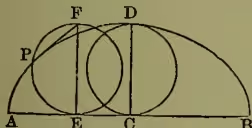
Cycloid (Gr., 'circle-like'). If a circle roll along a straight line in its own plane, any point on the circumference describes a curve which is called a cycloid. This is the most interesting of what are called the transcendental curves, both from its geometrical properties and its numerous applications in mechanics. In dynamics, for example, we find that a heavy particle descends from rest from any point in the arc of an inverted cycloid to the lowest point in the same time exactly, from whatever point of the curve it starts. This is sometimes expressed by saying that the cycloid is the isochronous (Gr., 'equal-time') curve. The body having reached the lowest point, will, through the impetus received in the fall, ascend the opposite branch of the curve to a height equal to that from which it fell, and it will employ precisely the same time in ascending as it did in descending. It is clear that if a surface could be procured that would be perfectly smooth and hard, the cycloid would thus present a solution of the perpetual motion. The line AB, which is called the base of the cycloid, is equal to the circumference of the generating circle; the length of the curve ADB is four times CD, the diameter; the evolute of any cycloid is a similar curve of equal length; and the surface between the curve and its base is three times the area of the circle CD. In any position EPF of the generating circle, AE is equal to the arc EP; PE is the normal at P and = half the radius of curvature; PF is the tangent to the curve at P.