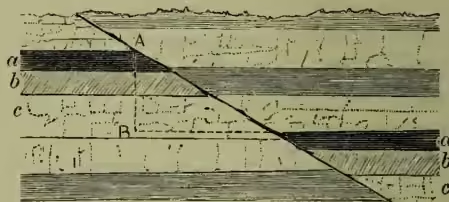
Dislocation, or FAULT, a term used in Geology to characterise certain displacements common among rocks. Rocks have been fractured and displaced, or shifted along the line of breakage. Such faults may occur with or without distortion of the fractured rock-masses. Sometimes the fissure is smooth and close. In other cases the rocks are jumbled and shattered along the line of dislocation, and the fissure (sometimes several yards in width) is often filled with a breccia of blocks and debris forming what is termed fault-rock. The opposite walls of a fault are not infrequently smoothed, polished, and marked with rectilinear striæ, which are called Slickensides (q.v.), and similar markings frequently occur on the faces of the joints that invariably abound in rocks in the neighbourhood of faults. Dislocations are rarely quite vertical, their inclination from the vertical being called their hade. The diagram shows one of the simplest kinds of fault. The amount of vertical displacement of the beds is the amount of the throw, and is measured by protracting a line across the fault, from the truncated end of some particular bed, a, until it is reached by a perpendicular, AB, dropped from the other end of the selected stratum. All normal faults have in the direction of dowlthrow, so that when a miner meets a dislocation, he has only to look at the hade to ascertain at once whether he must seek for the continuation of the displaced seam at a higher or lower level. Thus, if he happened to work the coal-seam, a, shown in the diagram, up to the dislocation at A, he would see from the hade of the fault that the missing seam must be sought for at a lower level, and he would describe the fault as a dowlthrow or dowlcast; whereas, if he reached the fault from the lower level, he would call it an upthrow or upcast. There is another class of faults in which the hade is not in the direction of dowlthrow: these are termed reversed faults. They rarely occur in strata which are not highly folded and plicated, but in regions where the rocks give every evidence of great lateral crushing and squeezing, as in true mountains of elevation, they are of common occurrence. Remarkable faults of this kind have been discovered in the north-west of Scotland. The inclination from the vertical of some of these faults is very great, in fact some approach horizontality, so that the strata on the high side overlie the rocks on the lower side of the fault, like successive strata in a conformable series. One set of rocks belonging to a low horizon has been pushed horizontally over the surface of another set pertaining to a higher horizon for distances of 10 and even 20 miles. The amount of vertical displacement produced by normal faults may vary from an inch or two up to many thousand feet. Thus, the great fault between the Highlands and Lowlands of Scotland has a dowlthrow of not less than 8000 feet, while the similar dislocation between the Lowlands and Southern Uplands of the same country amounts in places to 15,000 feet.