Dislocation consists in the displacement of one bone from another with which it forms a joint (put out of joint being the popular expression). Dislocations are generally the result of sudden accident, but may be the result of disease, or may be congenital. The displacement may be partial or complete; and surgeons classify their cases into simple dislocations, when the skin remains unbroken, and compound, when there is a wound by which the external air may communicate with the joint. Occasionally, in addition to the dislocation, there are fractures of the bones, or lacerations of important blood-vessels in the neighbourhood, or other injuries; it is then termed a complicated dislocation. Dislocation is a rare accident in infancy and old age, because in the former the joint-ends of the bones are very flexible, and yield to violence; while the aged skeleton is so rigid that the brittle bones fracture under force that would drive mature and stronger ones out of their sockets. Dislocations are most frequent between the ages of twenty and sixty. Persons with weak muscles, and lax, long ligaments, or those in whom the latter have been softened by inflammation of the joint, are predisposed to dislocation. The shoulder is far more frequently dislocated than any other joint in the body; in the lower extremity the hip most often suffers.
General Symptoms of a Dislocation.—After a blow, fall, or violent muscular exertion, a limb is found to have lost its natural mobility at the injured joint, though there may be some movement in abnormal directions under examination; there is great pain, and the shape of the part is changed; but soon swelling ensues, and every distinctive mark about it is obscured. If left alone, or merely treated as an inflamed joint, the swelling gradually subsides; but the immobility continues, the limb is crippled for months or years, when at last nature forms a new socket for the end of the bone, and some amount of useful motion is recovered. The proper shape of the part is never restored, but remains an eyesore to the patient, and a disgrace to the surgeon.
The general treatment of dislocations consists in their reduction, or bringing the displaced bone back into its place. Its return is opposed by the muscles attached to it, these being stimulated to contraction by the pain of the operation, and by the ligaments surrounding the joint, which generally fix it in its unnatural position. Sometimes it is necessary to remove this spasm of the muscles, and in former days bleeding from the arm, emetics, the warm bath, &c., were generally made use of; nowadays chloroform or ether attains the same ends, and renders the treatment of dislocations much more simple and humane than before the introduction of anaesthetics.
Till about the year 1870, reduction of dislocations was generally effected by means of extension.
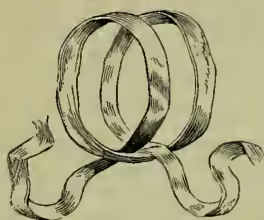
When the surgeon is about to reduce a dislocation in this way, he fastens the part of the limb above the displaced bone or the trunk, so as to afford him counter-extension; he then pulls on the limb either with his hands, or with a bandage or skein of worsted attached to it. This he fixes by making a clove-hitch on it—i.e. two loops in opposite directions laid together (see figure), and slipping it up the limb to the point desired, where a wet bandage has previously been applied to give a firmer hold. In old-standing cases in the larger joints, the hands grew weary before the exten- sion had been kept up sufficiently long; and it was often found necessary to adapt pulleys to draw upon the clove-hitch, as with them the traction could be made as strong as the surgeon desired. Sudden, forcible pulling is useless and hurtful, the main object being merely to tire out the muscles which resist the attempts at reduction; when they are exhausted, the bone will generally slip back into its place with an audible snap.
Of late years, however, reduction by extension has been to a very large extent given up in consequence of the general adoption of reduction by manipulation. This method, known it seems from ancient times, but curiously neglected, consists in executing certain complex movements of the dislocated limb which effect the return of the displaced bone to its socket by ingeniously utilising its unruptured attachments and evading the opposition of the muscles, by fraud rather than by force. It is particularly applicable to the hip, which, as it is commanded by the strongest mass of muscles in the body, always presented the most formidable obstacles to the old method. The first paper on this subject which attracted general attention was by Dr Reid of Rochester, U.S. (1851); and in 1869 Professor Bigelow of Boston published a careful and exhaustive discussion of injuries to the hip, with such full and clear directions for the manipulation method, as to secure its general adoption in the case of this joint by surgeons in this country as well as in America. The method, however, had been described and used in France and elsewhere, though with less care and precision, in the earlier half of the 19th century.
The class of persons called Bonesetters (q.v.) almost invariably give the opinion, in cases of stiff joints brought to them, whether as the result of disease or injury, that 'a bone is out'; and if a regular practitioner has been treating the case, further say that he has failed to detect it. They are almost invariably wrong in this opinion; for there are very few cases of dislocation not easily recognisable, at all events after the swelling following the accident has subsided. When, however, the forcible movements they employ succeed in improving the condition of the joint, their view is naturally adopted by the patient and his friends that they have replaced the 'bone.' In most cases of this kind, what really takes place is the rupture of Adhesions (q.v.) remaining after sprains or bruises in the neighbourhood which limited and rendered painful the movements of the joint.
Whenever a dislocation occurs, the nearest medical man should be summoned, even should the mere displacement be rectified at once, because no such accident can occur without some tearing of the soft parts, and it will depend on the after-treatment whether the joint will ever become useful again or not. It must also be remembered that the sooner a dislocation is reduced the easier is the reduction. Since the introduction of anæsthesia, however, and the subcutaneous division of tissues, many ancient cases may be improved, and many crippled limbs restored to usefulness.