Division of Labour. a conception borrowed from Economics and introduced into Biology by Milne-Edwards, to describe the difference of function exhibited by the individual members of an animal colony, or by the different organs, tissues, and cells of a single organism. The figure of a hydroid colony, Hydractinia, shows how members, primarily and fundamentally the same in structure, become set apart as nutritive, reproductive, sensitive, and protective. The same division of labour or predominance of special functions in different individuals is beautifully illustrated in the Siphonophora—such as the Portuguese Man-of-war (q.v.).
At a much higher level, vivid illustrations of the same fact may be found among the social Ants (q.v.) and Bees (q.v.). But division of labour in some degree is essential to every organism. Even in a single unit mass or cell, it is hardly possible for all the parts to be entirely in the same external and internal conditions; certain portions become more contractile, others more sensitive, others more nutritive, and so on. In a ball of cells, such as Volvox, the inequality in the conditions becomes more marked; the inside cells are not in the same state as their outside neighbours; they thus become seats of different vital processes, and distribution of function or division of labour is the result. The same process may be traced in the gradual evolution of tissues and organs, as also in the development of special 'persons' with limited and preponderant functions in animal colonies. When the predominance of some function has been established, it brings with it difference of structure. This differentiation or, when it concerns a colony, polymorphism is the structural side of the physiological fact of the division of labour. See COLONIAL ANIMALS, DIMORPHISM, HYDROIDS, &c.
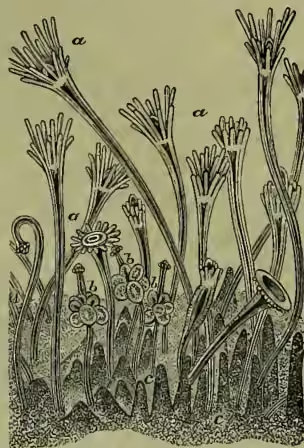
(after Allman): a , nutritive individuals; b , reproductive; c , protective; and d , sensitive individuals.
When the predominance of some function has been established, it brings with it difference of structure. This differentiation or, when it concerns a colony, polymorphism is the structural side of the physiological fact of the division of labour. See COLONIAL ANIMALS, DIMORPHISM, HYDROIDS, &c.