Dock, an inclosure for the accommodation of shipping, and of which there are three principal kinds—wet-docks; tidal docks, which may with more propriety be called harbours or basins; and dry or graving docks; besides floating-docks, which are widely different from the others.
Wet-docks are for the purpose of maintaining a level nearly uniform with that of high-water, so as to keep vessels always afloat, and to avoid straining by taking the ground, also to save them from rubbing up and down the quays with the rise and fall of the tide, and to secure that the quays shall not be sometimes too high and at other times too low for convenience in shipping or discharging cargoes. Wet-docks are generally surrounded by quay or wharf walls of masonry or brickwork, but where they are wanted chiefly for laying up vessels in, and not for loading or unloading, their margin is sometimes only a natural sloping beach. They are of most importance in places where there is a great rise and fall of tide, such as at Bristol or Liverpool, where the range of tide is about 30 feet, or in the Thames, where it is 20 feet; indeed wherever the range exceeds 12 feet they are almost indispensable; while, again, in the Clyde at Glasgow, where the tides are small (about 10 feet at spring-tides), there are no wet-docks strictly speaking, but simply tidal basins excavated to a great depth under the low-water level. Such also is the case along the east coast of North America, where the tides range from 9 feet 6 inches at Boston to 1 foot 8 inches at Baltimore and Galveston. The Queen's Dock at Stobcross, Glasgow, for example, has a depth of 20 feet at low-water, so that the largest vessels are nearly entirely water-borne at the lowest state of the tides. There has, however, recently been constructed at Greenock, where the tide has the same range as at Glasgow, the James Watt Dock of 13½ acres extent, and having a depth on the sill at high-water of 32 feet. Wet-docks are generally entered by means of what is called a Lock (q.v.), having two sets of gates, separated by the length of the largest vessel using the dock, which enables vessels to enter or depart for a considerable time before and after high-water; but frequently, for the sake of economy both in space and in cost, they have only one set of gates, so that vessels can only enter or depart at or very near high-water of the day.
The water in wet-docks is sometimes, by means of pumping or artificial reservoirs, kept up permanently at as high a level as that of the highest tides; but this involves the necessity of locking up or down always except at the highest tides. The tendency to silt up by deposits of fine mud is of common occurrence, and dredging, or some other plan, must be resorted to for the purpose of keeping the dock reasonably clear. In almost all cases, wet-docks require to be occasionally emptied for the purpose of cleaning. Docks must have proper moorings both on the quays and floating in the basin for making vessels fast to. They are also generally provided with sheds to keep goods dry, with cranes for shipping or unloading heavy articles, and with stailths or drops in the case of coal-shipping ports, and now they very frequently have rails laid along them.
Dock-gates, when on a small scale, are opened and shut by means of chains worked by hand, either by winches or capstans; but when on a large scale, and particularly in recent years, they have in most cases been moved by hydraulic machinery.
No docks in the world are on so splendid a scale as those of London, Liverpool, and Birkenhead. Surrounded with substantial stone quays, provided with gates, placed under a proper police, and otherwise managed in a costly manner, these, as well as nearly all other docks in Great Britain, require to be supported by rates levied from the vessels resorting to them; and for levying these rates, powers are taken in the acts of parliament authorising the construction of the respective docks. Sometimes the dock dues or rates are imposed on vessels in bulk according to tonnage, and in other instances, the rates are so much per ton, according to the nature of the goods. The Liverpool dock receipts have in recent years, including Birkenhead, exceeded a million and a quarter sterling. Generally, the dues are complained of as being a heavy burden on commerce; and complaints on this score, along with the high railway charges between Liverpool and Manchester, were the chief reason for the projection of the Manchester Ship Canal. But so enormous is the cost of constructing docks, that when owned by joint-stock companies they do not often yield good returns for the money invested. The most remarkable circumstance connected with English docks is the rapid extension of the dock-system on the Mersey at Liverpool. The original old dock contained an area of 3 acres 1200 yards, and 557 lineal yards of quay space. The total area now covers 324 acres, and the quay space is 21 miles 1496 yards in length. The Birkenhead Docks contain 159 acres, and have a quay space of 9 miles in length. The whole area of the London Docks on the north side of the river, exclusive of Tilbury, is 395 acres, and the area of dock property 940 acres. The Surrey and Commercial Docks, on the south side of the river, have a land and water area of about 330 acres.
The most important of the London Docks are the Royal Albert and Victoria (fig. 1), which form a continuous line of docks across a neck of land between the Bugsby and Gallion reaches of the Thames. The Victoria Main Dock contains 74 acres, and its tidal basin 16 acres, the depth over the sill at high-water being 28 feet; the dock is 1050 feet in width, with jetties on the southern side, which increase the berthage and quay room.
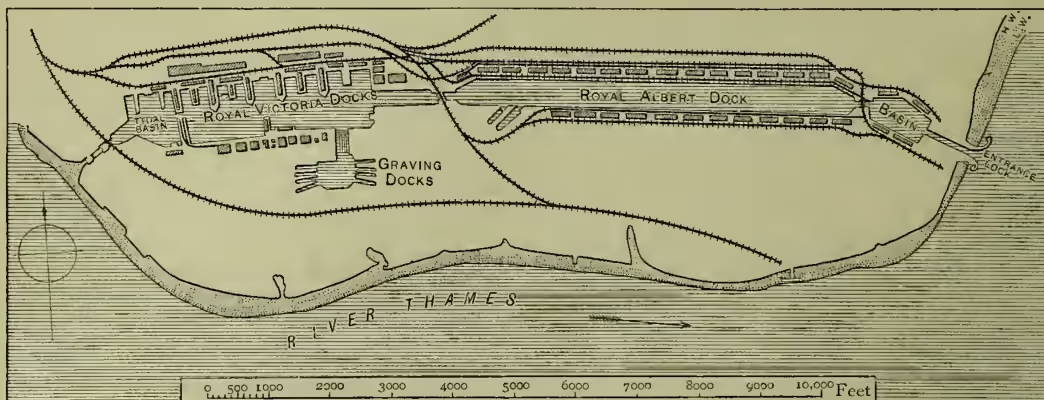
Connected with this dock there is an hydraulic lift and 8 graving-docks. The cost was £706,500. The connecting channel between this and the Albert Dock is 80 feet in width; the dock itself is 6500 feet long and 490 feet wide, and without jetties; the entrance lock is 550 feet long, 80 feet wide, and has a depth of 30 feet at high-water; the area is 84 acres, and the length of quays 3 miles. There are, opening off the dock, two graving-docks, respectively 500 and 400 feet in length, with entrances of 84 and 76 feet. The walls of this dock are built wholly of concrete, and the quays are lighted by electricity.
The Tilbury Docks have the deepest water of any in the United Kingdom. They are situated 26 miles below London Bridge. Next the river is a tidal basin of 19½ acres, with a depth of 46 feet at high-water; from this extends the lock, 700 feet long and 80 feet wide, to the main dock, which has an area of 57 acres, and a depth of 38 feet at high-water.
Fig. 2 shows part of the most important of the
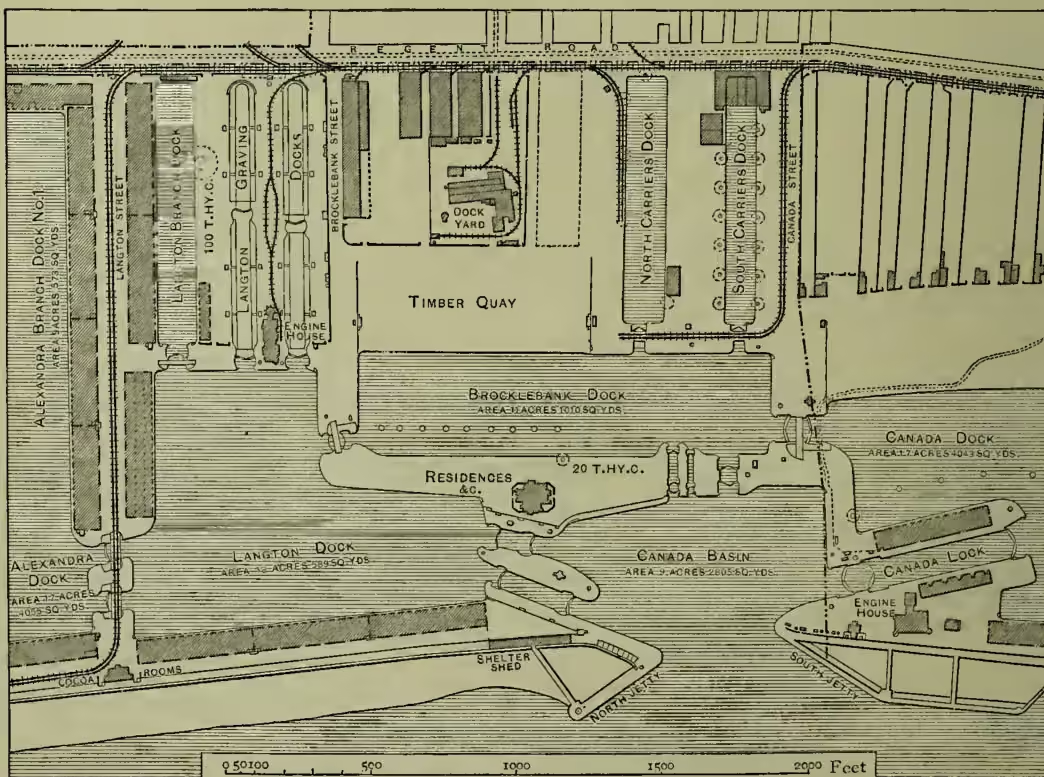
Liverpool Docks. They are approached from what is called the Canada Basin. In the Langton branch there is an hydraulic crane capable of lifting 100 tons, the charge for the use of which is £1 per hour for 100-ton lifts. This dock is remarkable for the extensive sluice arrangements, designed by Mr Lyster, for keeping the entrances to the river free from silt. These sluices are capable of discharging 1,750,000 cubic feet of water per minute, creating an outward current of 10 miles an hour. The area of the whole of the Liverpool Docks, including land and water, is 1075 acres.
In connection with wet-docks, outer or tidal basins are frequently formed between the entrance lock and the river or sea, admitting of a large additional traffic being accommodated; the entrances to these basins are provided with a single pair of sea-gates, which are kept open till half-tide, so that inward-bound vessels may run into them up to that time, and be afterwards passed into the dock by means of the lock; and in like manner, outward-bound vessels can be passed out to the sea long after high-water. As an example of the size of these half-tide basins, it may be stated that at Penarth Dock, which is 18 acres in extent, the half-tide basin is 3 acres, the width of entrance 60 feet, and the depth at high-water springs 35 feet.
The following table gives the dimensions of various docks, with depth over the sill at high-water in ordinary spring-tides:
| Length | Breadth in | Depth. | ||
|---|---|---|---|---|
| in feet. | feet. | ft. | in. | |
| Cardiff—West Bute..... | 4000 | 200 | 28 | 8 |
| " East..... | 4300 | 300 to 500 | 31 | 8 |
| Penarth..... | 2100 | 370 | 35 | 0 |
| Barrow—Devonshire.... | 2500 | 250 | 25 | 6 |
| Avonmouth..... | 1400 | 500 | 38 | 0 |
| Kingston—Victoria..... | 1440 | 378 | 26 | 2 |
| " Albert..... | 3350 | 200 to 430 | 28 | 5 |
| London—Albert..... | 6600 | 490 | 30 | 0 |
| Leith—Albert..... | 1100 | 450 | 26 | 6 |
| " Edinburgh..... | 1500 | 650 | 26 | 6 |
| Belfast..... | 630 | 225 | 22 | 0 |
| Tyne—Northumberland. | 3700 | over 600 | 24 | 0 |
| " Albert-Edward... | 1300 | " 700 | 36 | 0 |
| Antwerp—Kattendyk... | 3000 | " 500 | ||
| St Nazaire—Penhouet... | 3600 | " 750 | ||
| Area. | Length of Quay. | |||
| Liverpool—Canada..... | 17½ ac. | 1272 yd. | 26 | 6 |
| " Langton..... | 18¼ " | 1322 " | 29 | 0 |
| " Alexandra... | 17½ " | 1085 " | 32 | 0 |
| Birkenhead—West Float. | 52 " | 2 m. 210 yd. | 32 | 0 |
| " East Float. | 60 " | 1 " 1506 " | 32 | 0 |
Tidal docks require no particular description; they are merely basins surrounded by quay walls, and having open entrances permitting the free flow and ebb of the tide, as at Glasgow, Greenock, &c., and they have the advantage of requiring no opening or shutting of gates. With small tides they answer very well, and they are sometimes made deep enough to keep vessels afloat at low-water; but with tides of considerable range they are attended with the disadvantage of large vessels grounding at low-water, and from the large volume of water, generally more or less turbid, which enters at every tide, they are much more liable to silt up than wet-docks are. For ridding them of muddy deposits, the plan is sometimes resorted to of letting out a reserve of water with a sudden gush from an inclosure at the inner end, at the time the tide has receded. This is called scouring. Such is the process pursued at Boulogne and elsewhere. Tidal docks or basins have been formed on a large scale at Hamburg, also at Rotterdam; at the former, the harbour quays extend to about 3 miles. Havre, Honfleur, and St Nazaire resemble English ports with docks; Antwerp, Rotterdam, and Hamburg have accommodation on the river quays as important as their docks; at Rouen and New York, quays and wharves suffice.
The Kingston Tidal Dock at Glasgow, made in 1867, has an area of 5½ acres, a quay space of 2490 feet in length, and a depth of 23 to 24 feet at high-water. The Queen's Dock, finished in 1880, has an area of 33½ acres, a quay space of 10,000 feet, and a depth of 27 to 30 feet at high-water. The quays are furnished with powerful hydraulic cranes, the pressure being produced by steam-engines of 175 horse-power acting on an accumulator giving 700 lb. to the square inch. The dock entrance is 100 feet in width. These docks are tidal and unfurnished with gates, and vessels drawing under 20 feet can pass out or in at any time of tide.
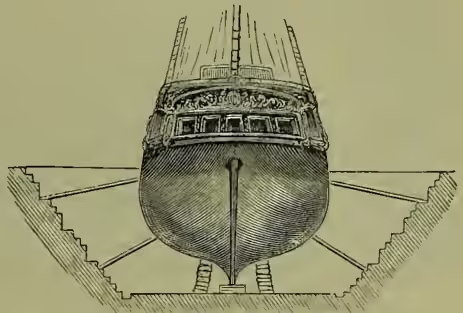
Dry-docks or Graving-docks are used for the purpose of laying vessels dry for examination or repairs. They may have their entrance either from a wet-dock or from a tidal harbour; but the former is by much the better arrangement, as it admits of vessels being docked or taken out at any time of tide, and it keeps a more equal pressure on the gates, thereby making them less liable to leak. They require to be built of good watertight masonry. The entrance has generally a pair of folding-gates, pointing outwards, to exclude the water; but sometimes it is closed by means of a Caisson (q.v.). When the tides are very large, the bottom of the dock may sometimes be placed above low-water, so that it may be run dry without pumping; but generally when the rise of the tide is small, the bottom of a dry-dock for the reception of any but very small vessels is below that level, in which case a steam-engine and pumps, with a well and water-channels leading to it, are required for emptying the dock. The floor is nearly level, and the keel of the vessel to be docked rests on wooden blocks fastened down to prevent them floating, and of such a height as to admit of the shipwrights getting under the vessel's bottom. Side-shores are put in, to keep the vessel in an upright position, and blocks are fitted in under the bilges as soon as possible after the water has been got out of the dock. The sides generally consist of stone steps called altars, for the purpose of fixing the lower ends of the shores, and also for the convenience of supporting the workmen's scaffolds. Dry-docks are frequently made long enough to hold three or four vessels of considerable size at one time, in which case they are placed, not in the centre line of the dock, but obliquely across, so as to give more available length.
The use of the graving-dock is frequently superseded by that of Morton's patent slip (see SLIP). Graving-docks of large dimensions are very expensive works, and the difficulty of making them watertight is, in certain situations, very great. Liverpool has twenty-three graving-docks, having a total length of 12,489 feet of floor, many of them being 600 feet, and some even as high as 768 feet in length. The graving-docks at Birkenhead are the largest in the United Kingdom; there are three of them of the length respectively of 930, 750, and 750 feet, and width of entrance of 60, 50, and 85 feet, with depths of water of 24 feet 9 inches, 27 feet 9 inches, and 27 feet 8 inches, at high-water spring-tides over the sills.
Floating-docks were at first built of timber, in the form of a large box with a flap-door falling down on strong hinges at one end. Such docks are moored in still and shallow water, with a depth just sufficient to allow the vessel to float into them as they rest on the bottom. The flap-door is then raised up, and the water pumped out. These timber docks are incapable of being used in deep water, in consequence of their want of stability.
It was not until the introduction of iron as the material for constructing them, that floating-docks were made capable of working in deep water, and able to take in the largest class of ships. Mr G. B. Rennie's docks are said to be the first of iron columns; and the pontoon, when the vessel has been placed over it, is raised by hydraulic pumps acting on the pontoon by chains.
Fig. 4 is a view of the dock at Saigon in Cochinchina, constructed by order of the French government, and put together nearly in the same way as that at Sourabaya. Its performances proved in every way most satisfactory; it easily lifted, high and dry out of the water, the 70-gun frigate, Perseverante. None of these iron docks have doors or gates for excluding the water. The bottom part is made of sufficient buoyancy to float the vessels clear out of the water, and the equilibrium of the dock is maintained during the time it is under water, for the purpose of admitting a vessel, by the great displacement offered by the hollow sides.
One of the most remarkable of recently constructed floating-docks was that sent out to St Thomas, West Indies, in 1867, and designed by Mr Frederick J. Bramwell. It is 300 feet long, 72 feet wide clear between the sides, and has a double bottom 9 feet 9 inches deep. The sides are open girders, not hollow boxes, as in the Sourabaya Dock, and immense rectangular air-vessels called 'floats' are placed between the side girders, and are capable of being moved up and down by screws in order to preserve the stability of the whole while it is being raised or lowered. By an accident which happened very soon after its arrival at St Thomas, this dock was sunk, and it was only raised to the surface in 1871, after operations which lasted a year and a half. Its lifting power is 8357 tons. A dock sent to Bermuda in 1869 (see BERMUDAS) has a lifting power of 16,700 tons, and is 381 feet long. The docks made by Messrs Rennie for Cartagena and Ferrol have been very notable and successful. The former weighs about 4400 tons, and is credited with a total lifting power of 11,500 tons; while that at Ferrol should sustain a weight of no less than 13,040 tons. See L. F. Vernon Harcourt, Harbours and Docks (2 vols. 1885).