Dolphin, a name applied to various members of the Cetacean family Delphinidae, but especially to the species of the genus Delphinus. This genus is large and heterogeneous, and is split up by some naturalists. The snout is more or less elongated and pointed; the teeth are very numerous, uniform, close-set, and sharp; the fore-limbs are narrow and pointed; there is usually a conspicuous dorsal fin. Like other toothed Cetaceans, the dolphins have a somewhat unsymmetrical skull with many peculiarities, and a single crescentic blow-hole (nostril) on the top of the head. They occur in all seas, and sometimes in rivers, such as the Amazon. None exceed 10 feet in length. They feed principally on fish, but some do not disdain lower animals, such as molluscs, crustaceans, medusæ. In habit they are active, and usually occur in gregarious 'schools.'
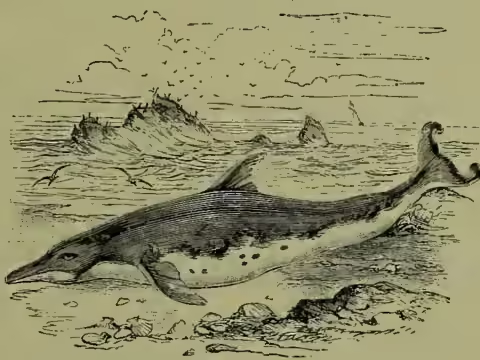
The Common Dolphin (Delphinus delphis) occurs in the Mediterranean and North Atlantic, and is probably identical with forms from the North Pacific and Australia distinguished as separate species. It is usually not more than 6 to 8 feet in length, of a gray or greenish-black colour above, and white below. The moderately long snout is separated by a transverse pad from the slightly arched forehead. The jaws bear on each side twenty-five to fifty small, conical, sharp teeth, curved slightly backwards. The crescent-shaped tail is keeled above and below. The dolphin feeds chiefly on fishes, which it pursues with graceful gambolings. One young one is born at a time, and tended with much affection. The animals have a peculiar lowing cry. Their agile evolutions are much observed and admired by voyagers. The flesh is sometimes eaten by sailors. Like other dolphins, it is often called a 'porpoise,' and the French give it the names of Bec d'Oie (goose-beak) or Oie de Mer (goose of the sea). In ancient times the dolphins were sacred to Apollo, and invested with numerous kindly and marvellous attributes. They drew the car of Amphitrite, and carried Arion upon their willing backs. Its image has been often used as a symbol, from the 'shield of Ulysses' to that of the heir-apparent or Dauphin (q.v.) of France. The anchor and dolphin, the printer's device of Aldo Manuzio, with the motto, 'Festina lente,' was adopted by him, at Erasmus' suggestion, from a silver coin of Vespasian I. The flesh of the dolphin was formerly esteemed for food. The name has been curiously transferred to the little Coryphenes (q.v.); and it is these scamberoids that are meant when reference is made to the 'dying dolphin's changing hues.'
A rarer species off British coasts is the much larger and heavier Tursio (D. tursio), the nesarnak of the Greenlanders. In the North Atlantic, D. albirostris and D. leucopleurus also occur. There is a pure white dolphin (D. sinensis) in the Chinese seas, and a South Sea form (D. peronii) without the usual dorsal fin.
In the same family as the dolphin are many well-known forms: the Narwhal (Monoceros), the Beluga (Delphinapterus), the Porpoise (Phocaena), the Grampus (Orca, &c.), the Caing Whale (Globicephalus), &c. See these articles.