Dredge, a machine used for bringing up from the bottom of lakes, or of the sea, specimens of the organisms and plants which exist there. A rude species of hand dredge appears to have been in use from the earliest times, and is still employed among the peoples of the Pacific islands, an improved form being common in all civilised countries possessing a seaboard. As a means of scientific investigation, the dredge was first used by Müller, who, before 1779, had made systematic investigations into the deep-sea fauna and flora off the coasts of
Norway and Denmark. Other naturalists were not slow to recognise the value of the results thus obtained, and the dredge was extensively employed by the principal scientific men of the period, among whom Forbes especially deserves mention, although it was some time before its full value as a means of investigation was thoroughly appreciated and understood.
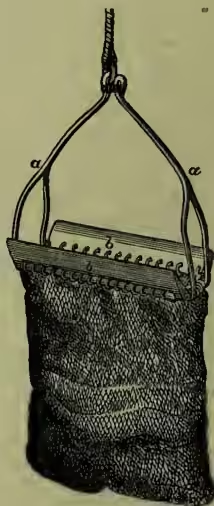
For ordinary purposes, and for use where the water does not exceed 100 fathoms in depth, Dr Robert Ball's dredge (1838) is generally recognised as most useful. With such slight modifications as occur to most dredges, it continues to be employed in preference to other forms. The frame is feet long, with scrapers not more than 3 inches wide, and so placed that the distance across the scraping surfaces is between 7 and 8 inches; these scrapers are connected by the frame-ends, made of bar iron five-eighths of an inch in diameter. Two curved iron arms (a, a in fig.) are fixed to the extremities of the cross-bar by means of 'eyes,' which allow the arms to fall down over the mouth of the dredge. The bag is secured to the thick inner end of the scrapers by means of an iron rod and stout iron rings (b, b in fig.). This bag may be of any depth, but 2 feet will be found very convenient; it ought to be hand-netted from stout twine, and the lower end lined with coarse canvas, to prevent the escape of the more minute animals and plants. All the materials used in the construction of a dredge, the iron especially, ought to be of the very best quality. Captain Calver, of the Porcupine (1869-70), invented the use of hemp tangles (half a dozen tangles fastened to an iron rod attached to the bottom of the dredge), and found them very successful in sweeping the bottom of objects which did not find their way into the dredge.
In the cruises of the Blake (1877-80), a case of stout canvas was used to cover the dredge, with the result that the most delicate organisms were brought up entirely uninjured, even after the machine had been dragged along rough ground for some time; the cover was also found to preserve the net from injury from contact with sharp rocks. When dredging, before the net is let down, the depth of the water should always be ascertained by casts of the lead, when not already approximately known, and, whenever practicable, a deep-sea thermometer ought to be used in conjunction with the lead, and the temperature of the water, which has a more important bearing on the distribution of life than is generally supposed, carefully observed and recorded. The rope attaching the dredge to the vessel ought to be tested before use, as any failure in it may lead to the loss of the dredge and its contents, and must be kept sufficiently slack to prevent its snapping from any sudden jerk. The length let out should be, as a rule, double the depth of water, to avoid danger of breakage from ordinary causes. If, however, the water be under 30 fathoms, the length of rope ought to be three times the depth. The rope thus used should be made from the finest quality of Russian hemp, one inch and a half in circumference, containing about twenty yarns in three strands. The boat from which dredging operations are carried on should always be kept moving, but very slowly. Unless there be some strong wind or considerable current, the use of oars or sails must be called in, as the dredge acts as an anchor to the vessel, but the rate of progress ought not to much exceed one mile per hour.
For further particulars regarding dredges and dredging, see Sir Wyville Thomson's The Depths of the Sea, The Challenger Expedition Report, Narrative, vol. i., and The Three Cruises of the Blake, by Professor A. Agassiz. An account of a very ingenious dredge used by the Prince of Monaco, who has employed the electric light to attract the fish into the net, will be found in the Scientific News, vol. i. p. 98.