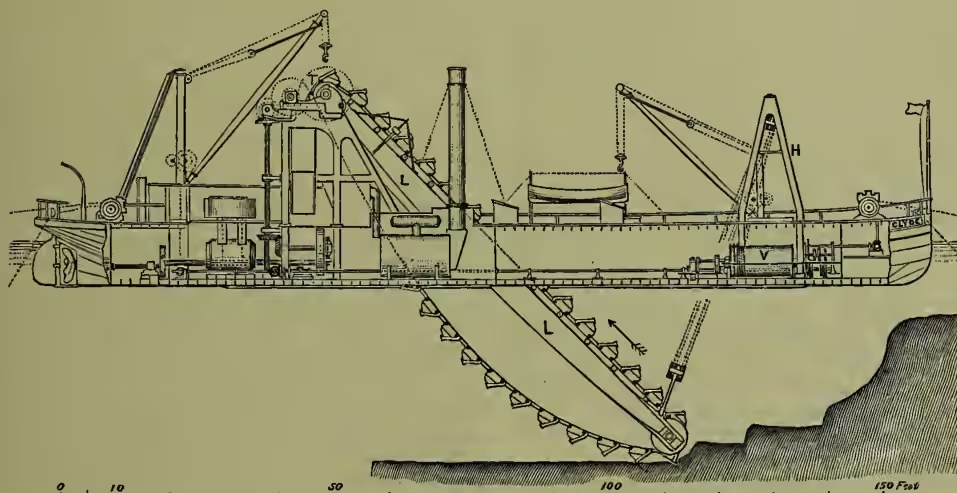
Dredging-machine, a machine for clearing out or deepening the channels of rivers, harbours, &c. Such machines are of four kinds—viz. the single central bucket-ladder machine, the double-ladder machine, the side-ladder machine, and the hopper-dredger. The first named is the most common, and is shown in the figure. The diagram represents a machine made in 1881, for the deepening of the lower portion of the Clyde. It was the largest machine of the kind which had been built at that time. Its length is 164 feet, breadth 30 feet, and depth 10 feet. The engines are of 350 indicated horse-power, and the machine is capable of lifting from a depth of 35 feet 500 tons an hour of ordinary dredgible material. It is fitted with two sets of buckets, one set for soft boulder-clay of 20 cubic feet capacity each, and one for hard clay of 7 cubic feet capacity. The bucket-ladder, L, is 85 feet in length. The upper tumbler, T, which is five-sided, is made to rotate by means of powerful gearing worked by the engine. This gives motion to the bucket-chain to which the buckets are attached, causing them to pass over the upper tumbler at the rate of 15 per minute for soft stuff, and 10 per minute for hard material. The ladder can be raised or lowered at leisure by means of the topping lift, H. The barrel, V, round which the hauling part of the chain tackle passes, is grooved, and of cast-iron, and weighs 13 tons. The vessel is fitted with screw-propeller, so as to shift without the aid of a tug. The cost of the dredger shown is about £19,250.
The double-ladder and side-ladder dredgers are similarly constructed, excepting that the latter has the bucket-ladder projecting over one side in order to permit of its working close up to a quay or dock-wall. These dredgers discharge the dredged material into barges lying alongside by means of shoots.
The hopper-dredger, designed by Messrs Simons of Renfrew, is constructed so as to dispense with the use of barges, the dredged material being discharged into the hold or hopper of the vessel. When this is filled, the vessel is detached from her moorings, and is propelled to the place of deposit, when the stuff is discharged through the bottom by lowering the hopper doors. The bucket-ladder in this machine is made to traverse so that the lower end can be run out before the bow, and so cut a passage for the vessel through a dry bank. This dredger saves the cost of the barges, and works more economically. The barge-loading dredger works more expeditiously, as it lies always at its moorings dredging and filling barges constantly; while in the case of the hopper-dredger, the dredging is entirely suspended while it is steaming away to the place of deposit, and time also is lost dropping and picking up moorings, particularly in stormy weather. But each kind has its proper place depending on the circumstances.
When a dredger is set to work it must be very securely moored by long bow and stern chains; moorings have also to be run out from each bow and each quarter. The system of cross dredging is generally adopted. By this mode the vessel is moored at one side of the bank to be dredged; the ladder is lowered so as to take a cut of about 9 inches, and then the one set of side chains are hove in and the opposite set paid out at a speed, varying according to the nature of the stuff being dredged, of from 10 to 25 feet a minute. When the bank has been crossed, the bow chain is hove in perhaps about 12 feet, and a new cut carried across; and so on until the required depth is reached. The speed of the winding can be increased or diminished according to the nature of the bottom. The tear and wear of dredging-machines is very great, and buckets, links, and pins have to be made of great strength. The barges for conveying the dredgings are usually made to carry from 300 to 500 tons. They are strongly built, and steam when loaded about 9 miles an hour. The engines are 250 horse-power indicated. The hoppers are 60 feet long, 20 feet wide at top, and 9 feet at bottom. The bottom of the hopper is closed by 12 doors, which are held up by strong chains passing round ratchet-wheels. These are suddenly let go when the cargo is to be dropped. The cost of the barges is about £8000 to £9000; and when the place of deposit is 12 to 15 miles distant, three of them are required for such a dredger as has been described.
A dredger capable of removing rock, the Dérocheuse, was constructed for the Suez Canal Company, by Lobnitz & Co., shipbuilders, Renfrew. Forming part of this dredger is a set of Lobnitz's patent rock-breaking rams. These rams, which are in principle simply huge chisel-pointed hammers, weighing four tons each, are raised by hydraulic power, and allowed to fall from 10 to 20 feet. There are five on each side of the well, the ordinary bucket-dredge working between them, and raising the rock broken by the hammers. This dredger is also fitted with Lobnitz's patent guide-wheel, which allows the bucket-ladder to occupy less space in the dredger by bearing up the bag of the bucket-chain. It is also claimed for this guide-wheel that the loss of dredged material is less, the wear and tear is less, and that the revolutions are increased with the same engine-power by its use.