Ear. The apparatus of hearing, as it exists in man and the mammalia, is composed of three parts—the external ear, the middle ear or tympanum, and the internal ear or labyrinth.
The external ear consists of two portions, the auricle or pinna (the part popularly recognised as the ear), and the auditory canal or external meatus.
In man, the auricle, on its outer or more exposed surface, presents various eminences and depressions, resulting from the form of its cartilaginous framework. These have received special anatomical names, to which it is unnecessary to advert further than to mention that the deep capacious central space to which several grooves converge is termed the concha, and that the lowest and pendulous portion of the ear is termed the lobe. The cartilage forming the basis of the external ear consists of one principal piece, in which there are several fissures, which are filled up by fibrous membrane. Several muscles are described as passing from one part of the auricle to another, but they are so little developed in man that they do not require notice; there are additionally three muscles—the attollens aurem (or superior auris), the attrahens aurem (or anterior auris), and the retrahens aurem (or posterior auris), which pass from adjacent parts of the scalp to the ear, and which, though more developed than the previous group, are of little or no real importance in man (at least in his civilised state), but are of considerable use in many mammals. Their actions are sufficiently indicated by their names.
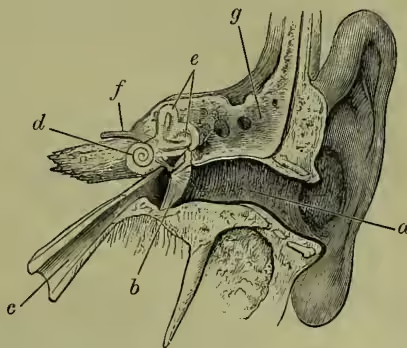
The auditory canal passes from the concha inwards, and a little forwards, for rather more than an inch. It is narrower at the middle than at either extremity; and on this account there is often considerable difficulty in extracting foreign bodies that have been inserted into it. The membrane of the tympanum which terminates it is placed obliquely, in consequence of the lower surface of the meatus being longer than the upper. The canal is partly cartilaginous and partly osseous; the osseous portion consisting in the foetus of a ring of bone, across which the membrane is stretched, and in many animals remaining persistently as a separate bone. The orifice of the meatus is concealed by a pointed process, which projects from the facial direction over it like a valve, and which is called the tragus, probably from being sometimes covered with bristly hair like that of a goat (tragos); and it is further defended by an abundance of ceruminous glands, which furnish an adhesive, yellow, and bitter secretion, the cerumen or wax, which entangles small insects, particles of dust, and other small foreign bodies, and prevents their further passage into the meatus.
The middle ear, or cavity of the tympanum, is a space filled with air which is received from the Pharynx (q.v.) through the Eustachian tube (see fig. 1, b, c), and traversed by a chain of very small movable bones (fig. 2), which connect the membrane of the tympanum with the internal ear. It lies, as its name implies, between the external meatus and the labyrinth or internal ear, and opens posteriorly into the cells contained in the mastoid portion of the temporal bone, and anteriorly into the Eustachian tube. The cavity is of an irregular shape, and is lined by a very delicate ciliated epithelium, which is a prolongation of that of the pharynx through the Eustachian tube.
Its external wall is in great part formed by the membrane of the tympanum, which is nearly oval, and placed in a direction slanting inwards, so as to form an angle of about 45 degrees with the floor of the auditory canal (see fig. 1). The handle of the malleus (or hammer), the first of the chain of ossicles (see fig. 2), is firmly attached to the inner side of this membrane in a vertical direction as far downwards as the centre, and by drawing it inwards, renders its external surface concave.
Its internal wall has two openings communicating with the internal ear, each of which is closed by a delicate membrane. These openings are termed, from their respective shapes, the fenestra ovalis, and the fenestra rotunda; the former leads to the vestibule, and is connected by its membrane with the base of the stapes (or stirrup-bone), the last of the chain of ossicles; while the latter opens into the cochlea.
The ossicles of the tympanum are three—viz, the malleus, the incus (or anvil), and the stapes. We have already explained how the malleus is connected with the membrane of the tympanum by means of its handle. Through this connection, the tension of that membrane may be modified by the agency of a muscle which is attached to this ossicle. This muscle is the tensor tympani, which arises from the under surface of the petrous portion of the temporal bone, and is inserted into the handle of the malleus immediately below the
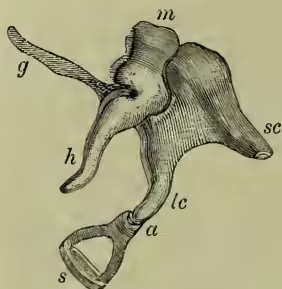
The stapes is attached. sufficiently described by the figure. It has a head, neck, two branches, and a base, which, as has been already mentioned, fits into the fenestra ovalis. A minute muscle, the stapedius, takes its origin from a hollow conical eminence termed the pyramid, which lies behind the fenestra ovalis, and is inserted into the neck of the stapes; its function is probably to act as an antagonist to the tensor tympani.
The Eustachian tube, into which the tympanic cavity opens anteriorly, is about an inch and a half in length, and passes downwards, forwards, and inwards to its opening in the pharynx. It is partly osseous, but chiefly cartilaginous. Its chief use is to allow the free passage of air in and out of the tympanum.
The internal ear or labyrinth is the essential part of the organ of hearing, being the portion to which the ultimate filaments of the auditory nerve (see BRAIN, NERVOUS SYSTEM) are distributed. It is composed of three parts—viz, the vestibule, the semicircular canals, and the cochlea, which form a series of cavities presenting a very complicated arrangement, and lying imbedded in the hardest part of the petrous portion of the temporal bone. They communicate externally with the tympanum by the two openings already described—the fenestra ovalis, and the fenestra rotunda; and internally with the internal auditory canal, which conveys the auditory nerve from the cranial cavity to the internal ear. The very dense bone immediately bounding these cavities is termed the osseous labyrinth, to distinguish it from the membranous labyrinth, which lies within a portion of it.
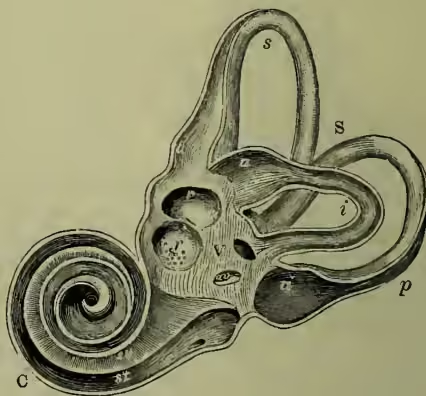
The vestibule is a common central cavity into which the semicircular canals and the cochlea open (see fig. 3, V). It is about a fifth of an inch in height and in length from before backwards, its transverse diameter (from side to side) being somewhat less. On its posterior wall are five orifices for the semicircular canals, one of the orifices being common to two of the canals. Anteriorly, the cochlea enters it by a single opening, partially divided by an osseous partition—the lamina spiralis ossea. On its outer wall is the fenestra ovalis, and on its inner are the maculae cribrosae, containing several minute orifices for the entrance of filaments of the auditory nerve.
The semicircular canals are three in number, and open into the vestibule by means of five orifices, the two vertical canals having at their non-ampullate extremities a common orifice. They vary in length, and notwithstanding their name, each is considerably more than a semicircle, the superior vertical canal being the longest. The average diameter is about a twentieth of an inch, one extremity of each canal exhibiting a dilatation or ampulla. Each canal lies in a different plane, very nearly at right angles to the planes of the other two, hence their names of the superior vertical, the inferior vertical, and the horizontal canals.
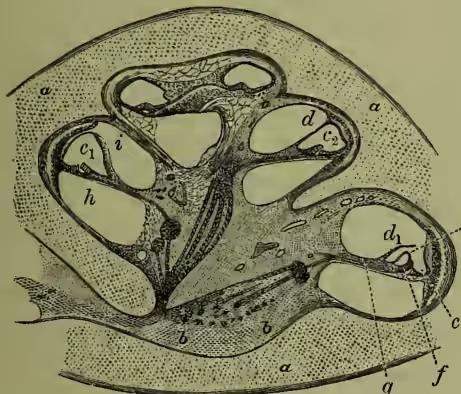
The cochlea, which derives its name from its resemblance to a common snail-shell, forms the anterior portion of the labyrinth. It consists of an osseous and gradually tapering canal, about an inch and a half in length, which makes two turns and a half spirally around a central axis, termed the modiolus, which is perforated at its base for the entrance of the filaments of the cochlear portion of the auditory nerve. This spiral canal gradually diminishes towards the apex of the cochlea. At its base it presents an opening into the vestibule, partially divided into two. In the recent state, one of these openings (scala tympani) does not communicate with the vestibule, but is closed by the membrane of the fenestra rotunda. Its interior is subdivided into two passages (scalae) by an osseous lamina. This is the lamina spiralis, which incompletely divides the cochlea into an upper passage, the scala vestibuli, and a lower one, the scala tympani—i.e. the division is incomplete so far as the skeleton goes, but is completed during life by soft parts afterwards to be described. At the apex these two passages communicate by an opening to which the term helicotrema has been applied.
We now return to the membranous labyrinth. The membranous and osseous labyrinths have the same shape, but the former is considerably smaller than the latter, a fluid, termed the perilymph, intervening in some quantity between them. At certain points recent investigations have shown that the membranous is firmly adherent to the inner surface of the osseous labyrinth. The vestibular portion consists of two sacs, an upper and larger one, of an oval shape, termed the utricle, and a lower and smaller one, of a globular shape, called the sacculus. The membranous semicircular canals resemble in form and arrangement the osseous canals which inclose them, but are only one-third of the diameter of the latter.
It will be remembered that the osseous structure of the cochlea is that of a tube almost but not quite divided into two by the lamina spiralis ossea. The division is completed by the lamina extremity is connected with the saccule through a delicate membranous channel known as the ductus reuniens. Upon the basilar membrane is situated the organ of Corti, which consists of the following parts (to name only those of most importance) from within outwards: (1) a single row of so-called inner hair-cells; (2) the two rods of Corti (known as inner and outer); (3) four or five rows of outer hair-cells. These are again protected by the curtain-like membrana tectoria.
The auditory nerve leaves the medulla oblongata together with the facial, and passing into the internal auditory meatus, divides into two branches, which pass respectively to the vestibule and the cochlea. The former ends in a peculiarly modified epithelium with projecting processes situated in the ampullæ of the semicircular canals and on certain spots within the saccule and utricle, known as the macula acustica. In the latter situation are also found small crystalline bodies, called
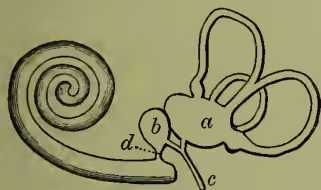
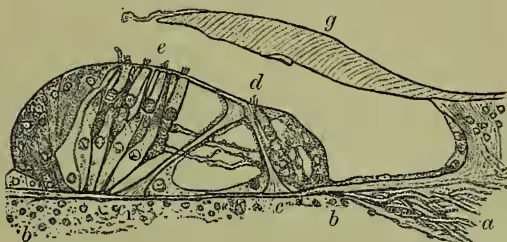
otoliths, which are suspended around the maculae: by exactly what means this suspension is effected is at present unknown. The cochlear branch of the auditory nerve probably terminates in the inner and outer hair-cells of the organ of Corti (see fig. 6). The saccule and utricle communicate with each other and with the interior of the skull through the aquæductus vestibuli, while the aquæductus cochlea connects the perilymph of the scala tympani with the arachnoid space.
PHYSIOLOGY.—(1) Of the External Ear.—A true auricle only exists in the mammalia, and in this class it varies from little more than an irregularly shaped cartilaginous disc with little or no motion, as in man and the quadruped, to an elongated funnel-shaped ear-trumpet movable in all directions by numerous large muscles, as in the horse, the ass, and the bat. The mode in which we see it employed by those animals in which it is highly developed sufficiently indicates that its main function is to collect and concentrate the sounds which fall upon it. But the experimental investigations of Savart, with an apparatus constructed to resemble the tympanic membrane and the external auditory apparatus, show that these parts are also adapted to enter into vibrations in unison with those of the air; and he suggested that the human auricle, by the various directions of different parts of its surface, could always present to the air a certain number of parts whose direction is at right angles with that of the molecular movement of the air, and therefore is the most favourable position for having the vibrations communicated.
(2) Of the Tympanum and its Contents.—Savart's experiments show that the membrane of the tympanum is thrown into vibration by the air, and that it always executes vibrations equal in number to those of the sonorous body which excites the oscillations in the air. He further ascertained that spiralis membranacea (or basilar membrane). From near the junction of the osseous with the membranous lamina springs the membrane of Reissner, which, stretching across to the wall of the osseous cochlea, shuts off a third space known as the ductus cochlea. The cochlear duct terminates blindly at both ends, but near its lower the mallens participates in the oscillations of the tympanic membrane, and that these vibrations are propagated to the incus and stapes, and thus to the membrane of the fenestra ovalis. The mallens has further the office of regulating, through the tensor tympani muscle, the tension of the tympanic membrane: and to allow of the motion necessary for this purpose, we find movable joints between it and the incus, and again between the latter bone and the stapes. The contraction of the stapedius muscle similarly modifies the tension of the membrane of the fenestra ovalis; and as compression or the reverse exercised on this membrane extends to the perilymph, and is propagated through it to the fenestra rotunda, the tension of the membrane of the latter opening is also influenced by the muscle in question. The incus is much more limited in its motions than either of the other bones, and its use seems to be to complete the chain of ossicles in such a manner as to prevent any sudden or violent tension of the membranes, such as we can easily conceive might occur if the conductor between the membranes were a single bone. The presence of air in the tympanic cavity serves a double purpose: in the first place, it preserves a uniform temperature on the outer surfaces of the fenestral membranes, and thus supports a fixed elasticity in them, which would not be the case if they were freely exposed to ordinary atmospheric changes; and secondly, the action of the chain of ossicles as conductors of sound is materially increased by their being completely surrounded by air, as is obvious from the first principles of acoustics; further, were it not for the presence of air within the tympanum, the drum membrane would be arched inwards, and the resulting displacement and change of tension would produce deafness.
(3) Of the Labyrinth.—Sonorous vibrations may be conducted to the labyrinth through the bones of the skull; but during the ordinary act of hearing, the movements of the tympanic membrane are propagated through the chain of ossicles and the labyrinth, and thus perceived by the auditory nerve. A considerable amount of mystery surrounds the functions of the saccule and utricle; indeed, on this subject so little is at present accurately known that no good purpose would be served by discussing it further. The view, until recently accepted, that these parts were concerned in the perception of sounds as distinguished from tones (i.e. notes), has been rendered doubtful by recent researches.
The semicircular canals have been of late years made objects of study by many physiologists. It has now been conclusively demonstrated that they are intimately associated with the maintenance of the body in the erect position. Injury of a semicircular canal tends to produce rotatory movements of the body and eyes, and it has therefore been suggested that the functions of these organs may be connected with the reflex act of listening, as exemplified in the lower animals by pricking the ears and rotation of the head. From experiments on animals, and observations on the human subject in disease, it has now been proved that a lesion of the semicircular canals is followed by giddiness or vertigo, which manifests itself either in involuntary falling, rotation, or in a subjective condition, during the continuance of which surrounding objects seem to revolve round the patient. It is generally believed by physiologists that the cochlea has the special function of analysing sounds. It has been found that the basilar membrane is not equally broad throughout, but that it increases gradually from base to apex. It therefore presents a series of strings of different lengths, and the short ones are assumed to vibrate in the perception of high notes, while the long ones are stimulated to motion by low tones. The lower part of the cochlea is therefore chiefly concerned in the perception of sounds of high pitch, while the upper parts respond to those of low pitch. Some observers, however, do not accept this view—e.g. Voltolini and Rutherford, but believe that sounds are analysed in the auditory centre, which, according to the investigations of Munk and Ferrier, is located in the temporal lobe. For the hearing of birds, reptiles, &c., see BIRD, REPTILES, &c.
THE DISEASES OF THE EAR.—It is manifestly impossible to attempt any account of the various individual ear diseases in an article like the present. Since aural surgery has become an exact science, the medical profession have come to realise that such phrases as a 'cure for deafness,' or a 'treatment for earache,' are not only inexact but absurd. Deafness—varying in degree from a slight impairment of hearing up to total inability to perceive sounds—may be due to a great variety of causes, and any of these causes may produce not only deafness, but noises in the head. Thus the auditory canal may be blocked by wax, the products of skin eruptions affecting its lining membrane, tumours, masses of fungus, the results of inflammation, &c. The tympanic membrane may be displaced or thickened, the ossicles may be impeded in their movements by the presence of exudation, or by fibrous adhesions or swelling of the mucous membrane within the tympanum. Then again these parts may be injured either by disease or by violence. The auditory nerve may be affected in any part of its course from the auditory centre to the labyrinth, and thus deafness may result. We have only indicated some of the pathological causes of impaired hearing, but enough has been said to show that before deafness can be prescribed for with any hope of success, an examination of the ear must be made by a competent medical man.
Turning now to earache, let us consider some of its causes. Sometimes it is due to the presence of boils in the auditory canal, or the whole lining membrane of the passage, including the outer layer of the membrana tympani, may become inflamed. Perhaps the most common cause of earache is inflammation of the drum-cavity. Such inflammation often stops before the inflammatory products have taken on a purulent character. This mild form is very common in children, and often sows the seeds of deafness in after-life if appropriate treatment be not applied. Occasionally earache is altogether due to the presence of a diseased tooth, which need not necessarily be tender or painful. By far the most dangerous form, however, is that which arises in connection with a so-called 'running ear.' The general meaning of this symptom in such cases is an accumulation of decomposing matter and sometimes diseased bone in close proximity to the brain, and a fatal result is by no means uncommon. Vertigo, or giddiness, is a very frequent symptom of ear disease, and can often be relieved or cured by attention to this organ.
A feeling of fullness in the head, and disinclination for mental effort, is far from uncommon. Rarer or less important symptoms of aural affections are (1) anomalies of taste, owing to involvement of the chorda tympani nerve on its way through the drum-cavity; (2) paroxysmal cough and sneezing; (3) neuralgia of the head; and (4) epilepsy; the last named being fortunately extremely uncommon. We should not be justified in omitting to mention that nasal diseases, especially in children, are often the causes of deafness. This is all the more important, because such cases when taken early can almost always be cured.
From what has been said, it will be obvious that any remarks we could, without unduly extending this article, make with regard to treatment would be useless. We feel it, however, to be our duty to warn those who suffer from ear disease from consulting unqualified quacks. This resort to empirics is all the more uncalled for as there are now numbers of respectable highly-qualified practitioners who devote attention to aural maladies.
There are, however, a few points of general interest and of great importance which may be touched upon.
It is a common delusion that it is a dangerous thing to cure a discharge from the ear. Now this is by no means true; indeed it may be at once stated that life is never safe so long as a chronic putrid discharge issues from the ear. In all such cases it is not only safe but necessary to syringe the meatus with a warm disinfecting solution, such as boracic lotion, or water to which some Coudy's fluid has been added. The ear should then be dried by carefully introducing a wick of absorbent cotton-wool. The origin of the superstition ancient the danger of stopping a discharge is easily explained. If the putrid matter be present, it is better that it should find its way out. Now, if in such a case some physical obstacle prevents its exit, a fatal result is apt to supervene. It had thus been noticed that in many cases the 'running from the ear' stopped before dangerous symptoms set in, and hence the delusion. Another point as to which much misapprehension exists, is the danger caused by the presence of a foreign body in the ear. It has been observed by a noted specialist that 'the point of a dagger in the meatus is less likely to do harm than unskilled efforts to remove it.' No endeavour should ever be made to remove a foreign body which is not seen, and all probing in the dark is to be absolutely avoided. Most extraneous objects can be removed simply by means of warm water and a syringe used by a skilled hand. If the object be a pea, bean, or any other body which is likely to swell from absorbing moisture, it is better not even to attempt syringing, and to wait until skilled advice can be obtained.
Should an insect get into the ear, it can almost invariably be syringed out with warm water, or if a syringe be not at hand, the ear may be filled with warm oil or even water.
Deafness occasionally runs in families, and the symptom is then usually due to chronic thickening of the tympanic structures. Persons in whom this hereditary tendency exists should, on the first indication of ear trouble, seek advice.
It need hardly be said that picking the ears ought to be avoided. This habit may lead to the 'ear pick' being driven through the drum membrane. Should the ear be made to bleed, and should there be any doubt as to whether the drum membrane be wounded, scrupulous care should be taken to prevent the entrance of fluid. If the tympanic membrane be accidentally perforated, syringing, or instilling ear drops is almost certain to be followed by inflammation. After fifty the hearing tends to fall off a little, but except possibly in extreme old age, marked deafness for conversation is always abnormal. It is a curious fact that elderly people who require a watch to be put quite close to the ear, can often hear conversation well. This is explained by the fact that after middle life the auditory nerve is less sensitive, and the power of readily perceiving high-pitched tones is then less acute.
According to the writer's experience, almost complete deafness in one ear, while the other is perfect, does not necessarily endanger the sound organ. Others, however, take the opposite view. It must be remembered that in most cases, impairment of hearing is bilateral, and this is always the case when deaf persons have to be addressed in an elevated voice.
The instruction and training of children who have been born deaf is dealt with in the article DEAF AND DUMB.
EAR-TRUMPETS, &c.—The number of ear-trumpets now advertised makes any detailed account of them impossible. The application of one of three principles exists in most, if not all, to wit: (1) a tube with a suitable ear-piece at one extremity, and a more or less conical mouthpiece at the other; (2) a bell-shaped sound-collector, with an ear-piece for insertion into the auditory canal; (3) appliances for tilting the auricle forwards. There can be no doubt that a person who desires to purchase an ear-trumpet will best gain his end by carefully testing a large number of instruments, and choosing that which suits him best.
As a rule small invisible instruments are useless. Poitzer has constructed a small tube made of vulcanite and flesh-tinted, the object of which is to prolong the tragus backwards; in a very few cases this is found to be an exception to the above rule. The same authority has attempted, by a special appliance, to conduct the vibrations of the auricle directly to the tympanic membrane. The Audiophone (q.v.) and dentiphone are only useful in a few cases; in both the object is to convey sonorous vibrations through the teeth and the auditory nerve. The so-called fonifero is a rod for connecting the larynx of the speaker with the teeth of the auditor. In some cases—those in which the drum membrane is destroyed—the introduction of an artificial drum is useful. This fact has been taken advantage of by unscrupulous quacks, who sell for several pounds an appliance not differing in its essentials from 'Toynbee's artificial tympanum,' which can be had for a shilling or two.
Ear-cockles. See WHEAT.
Earl, a title of nobility now the third in the peerage of the United Kingdom. Among the northern races of Europe a jarl or eorl was one of the noble class, as opposed to the ceorl, who was the mere freeman (see also THANE). Of the noble class, a certain number, under the name of ealdormen, were made governors and judges over particular districts, and were sometimes designed in Latin phraseology comites, sometimes duces. William the Conqueror rewarded his chief followers by granting them the lands and also the offices of the Saxon nobles. The office of ealdorman, so long as Norman-French continued to be spoken in England, was, as on the Continent, called count, and its holder was considered the comes of the sovereign (see COUNT); and though the designation earl was afterwards reintroduced, the French term continued to give a name to the district (county) over which the earl presided, and the title of countess to his wife. After, as before the Conquest, each earl, besides having supreme authority under the crown in his own county, had a fixed revenue from it, consisting of the third penny of the pleas. When Geoffroy de Mandeville was made Earl of Essex, the Empress Maud, besides giving him and his heirs the third penny of the shrievalty of the pleas as an earl ought to have within his county, made him and his heirs in direct terms 'hereditabiliter' earls of Essex. In other cases, however, down to the reign of King John, an earl was so constituted by a grant of the third penny of the pleas, of which the earldom was assumed to be a pertinent, the words being added, 'unde comes est,' or 'ut sit inde comes;' and the newly-created earl was invested with his dignity by girding on the sword, a ceremony which was a survival from Saxon times.
William the Conqueror, by making earldoms hereditary, probably took the first step to convert a title of office into one of dignity. Deputies, vice- comites, or sheriffs had necessarily to be appointed when the earl was a minor, or otherwise incapacitated from discharging his duties, and by degrees the office itself passed to the deputy. In the reign of King John a fixed sum, payable from the profits of the county, began to take the place of the third penny, and the words 'unde comes est' were supplanted by the words 'sub nomine comitis,' showing that the official power had ceased, and the dignity only survived. In the reign of Edward III. earldoms began to be created by charter or patent, certain lordships or lands being generally erected into a comitatus to descend with the newly-created dignity. But the girding on of the sword as a solemnity of investiture still continued, to which the imposition of a cap of dignity or golden circlet was added in the reign of Edward VI. In 1615 these ceremonies were declared unnecessary, and in the reign of Queen Anne it became the practice to insert a clause in patents expressly dispensing with them.
Until late in the reign of Edward III. earldoms were limited by the charters constituting them to heirs-general, and an heir-female often succeeded, her husband generally obtaining the title of earl; but in the case of more co-heirs than one, the lands were divided, and the dignity, which could not subsist without them, reverted to the crown. So inseparable at that period were the lands from the dignity, that there seem to be one or two instances where the title was taken away on the ground of poverty. But in fact the will of the crown at times diverted the succession from its regular channel, and occasionally the rights of the heir were suspended for a time and then recognised.
Towards the end of the 14th century it became the rule for patents of earldom to be limited to the heirs-male of the body of the grantee, the title on their failure merging in the crown; and there are a few occasional instances of the dignity being conferred for life. The title of countess, more than any other degree in the peerage, has from time to time been conferred for life on females. The idea of earls being territorial officers has been so entirely departed from that the designation bestowed on them is occasionally (as in the case of Earls Grey, Nelson, Spencer, Russell, and Cairns) their own surname with the prefix earl.
In Scotland the earl was the successor of the Celtic mormaer or great steward, who was first a tributary king, and afterwards a hereditary judicial officer placed over a certain territory. In the reigns of Alexander I. and David I. the mormaers gradually assumed the title of earls or comites, while vice-comites or sheriffs were appointed, who, if they did not at once supersede them, at least exercised a concurrent jurisdiction with them. Seven earls are enumerated by their names, not titles, in the foundation charter of the abbey of Scone in 1114; and during the 12th century there existed a body called the Seven Earls, with whose sanction the king acted. With the introduction of feudalism, the earls passed into the position of feudal lords, holding the lands with which their connection had at first been judicial as an earldom of the crown. The creation of additional earldoms formed a part of the feudalising process; and though the earldoms continued to be spoken of as seven, those enumerated were not always the same. The coronation of Alexander II. (1214) is the latest date at which the earls are specified as seven in number; and their functions as advisers of the sovereign were afterwards merged in those of the 'communitas.'
Earldoms continued territorial much longer in Scotland than in England. From the beginning of the feudal period down nearly to the 17th century, the title was usually conferred by the erection of certain lands into an earldom, the charter but rarely making specific mention of the dignity of earl. In 1578 the practice first became general of introducing the title of earl into the charter; and from that date till 1600 half the charters of earldom in the Register of the Great Seal (they are eighteen in all) make special mention of it. Patents of the dignity of earl after the English fashion were first introduced in 1600, the earliest being that of the Earl of Winton. The older earldoms, like lands and other heritable subjects, passed to heirs of line; and in the case of co-heirs the lands were divided, the dignity with the principal messuage passing to the eldest. The husband of a countess was often, though not always, designed by the courtesy title of earl.
In 1889 there were in the peerage of the United Kingdom one hundred and twenty earls, with one countess in her own right; there were forty-four earls in the peerage of Scotland; and sixty-four earls in the peerage of Ireland. For the coronet of an earl, see CORONET. His mantle is scarlet with three doublings of ermine. He is styled the 'Right Honourable,' and in formal documents the sovereign usually designs any peer of the degree of an earl as 'Our trusty and well-beloved Cousin,' an appellation which originated in the reign of Henry IV., who was either by descent or alliance related to every earl in the kingdom. An earl's eldest son takes as a Courtesy Title (q.v.) one of his father's inferior titles. The younger sons take 'The Honourable,' with Christian name and surname added, and the daughters 'Lady,' with Christian name and surname. See ADDRESS (FORMS OF).