Eclipses. An eclipse is an obscuration of one of the heavenly bodies by the interposition of another, either between it and the spectator, or between it and the sun. The causes of eclipses, as suggested in this definition, are so simple and familiar that it is difficult for us to imagine how deeply eclipses affected men's minds before the dawn of astronomical science. To the ancients they were without the order of nature—terrible presages of dire events; and at Rome, at one time, it was blasphemy, and punished by law, to talk publicly of their being due to natural causes. So strong a hold had this superstition on the popular mind that even after it came to be generally believed that eclipses of the sun were caused by the moon coming betwixt us and that orb, eclipses of the moon were still referred to supernatural agency. When the moon was in eclipse, the people turned out and made a great noise with brazen instruments—the idea being that by doing so they gave her ease in her affliction. According to some, Luna, when in eclipse, was in the pains of labour; according to others, she was suffering from the arts of wicked magicians. Similar notions have prevailed among all barbarian tribes. The Chinese populace, as is well known, imagine eclipses to be caused by great dragons trying to devour the sun and moon, and accordingly they beat drums and brass kettles to terrify the monsters into letting go their prey. Several stories are told of these popular super- stitutions being turned to good account by knowing persons; among which are those which represent Thales as bringing about peace between the Medes and Lydians, and Columbus, when in a great strait, procuring provisions from the natives of Jamaica through the prediction of eclipses.
Stars, planets, and the satellites of planets, may suffer eclipse. The principal eclipses, however, are those of the sun and moon, called the solar and lunar eclipses. The transits of the lower planets over the face of the sun are partial solar eclipses; but solar eclipses, properly so called, are those caused by the interposition of the moon between the sun and earth. Regarding solar eclipses, it is observed that they happen always at the time of new moon, when the sun and moon are in conjunction—i.e. on the same side of the earth. In a partial eclipse, the sun's disc suddenly loses its circular form; it becomes indented on one side, the indentation slowly increasing for some time, and then diminishing until it disappears altogether. In a total eclipse, the indentation goes on increasing till the whole orb for a time disappears; after a short interval, the sun reappears again, passing through the same phases of obscuration in an inverse order. In an annular eclipse, the whole orb is obscured except a ring or annulus. Lunar eclipses, again, it is observed, happen always at full moon, or when the sun and moon are in opposition, or on opposite sides of the earth, and are caused by the moon passing through the earth's shadow. Such eclipses are sometimes partial, and sometimes total, but never annular, and in their general phases they resemble those of the sun.
In speaking of eclipses, we shall have occasion to use certain terms, which we shall now define. The duration of an eclipse is the time of its continuance, or the interval between immersion and emersion. Immersion or incidence of an eclipse is the moment when part of the luminary begins to be obscured; emersion or expurgation is the time when the luminary begins to reappear or emerge from the shadow. When the quantity of an eclipse is mentioned, the part of the luminary obscured is intended. To determine this part, it is usual to divide the diameter of the orb into twelve parts called digits; and the eclipse is said to be of so many digits, according to the number of them contained in that part of the diameter which is obscured.
Having given this general explanation of the facts of observation on which the theory of eclipses turns, and of the language employed in speaking of them, we now proceed briefly to explain the theory itself, and how it is possible to predict the time of occurrence, and the duration and quantity of eclipses.
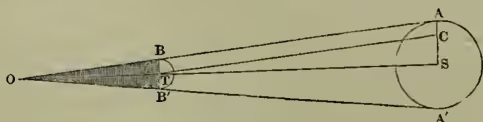
(1) Eclipses of the Moon.—It has been said that these are caused by the moon passing through the earth's shadow. Before this explanation can be accepted, it must be shown that that shadow extends as far as the moon. This is easily done. Supposing the earth to have no atmosphere, then the shadow is the cone marked in shade in fig. 1, whose apex is at O; and the question is, whether the distance OT from the apex to the earth's centre exceeds the moon's average distance from the earth. Drawing TB, SA, from the centres of the earth and sun respectively, perpendicular to the line OBA, touching both spheres, and the line TC parallel to the line OBA, we have from the similar triangles OTB, TSC, the proportion . Now, we know that TS, the (mean) distance of the sun, is equal to about 23,000 times TB; also, from the construction, ; and we know that times TB, whence it follows that times TB. The above proportion then gives times TB, since nearly. But the moon's average distance is only 60 times TB (the earth's radius). Hence it appears that the length of the earth's shadow is between three and four times the average distance of the moon, and that the moon can enter it. Further, it is clear that, should it do so, it may be totally obscured; for it must enter at a point much nearer T than half the distance OT, which is nearly 109 times TB; and everywhere within that distance it might be shown the breadth of the shadow is much greater than the moon's disc. But one consideration now remains to be stated to complete the proof of the theory of lunar eclipses. It was mentioned that they only occur at full moon, and we know that to be the only time when the earth is between the sun and moon, and so has a chance of throwing her shadow upon it. Why they do not occur every full moon will be explained in treating of the prediction of eclipses.
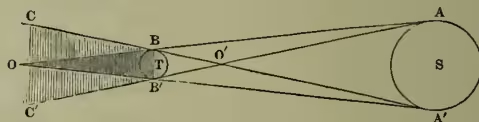
In the foregoing explanation, we proceeded on the assumption that the earth has no atmosphere. If the assumption were correct, the earth's shadow would be darker and narrower than it is, and the phenomena of eclipses shorter in duration, but more striking. The effect of the atmospheric refraction (see REFRACTION) is to bend the rays which are incident on the atmosphere in towards the axis of the cone of the earth's shadow, those which pass through the lowest strata of the air being most refracted, and converging to a point in the line OT (see fig. 1), at a distance equal 42 radii of the earth from the earth's centre. Accordingly, the moon, which, as we have seen, crosses the shadow at a distance of about 60 radii, never enters that part of it which is completely dark; thus, she never loses her light entirely, but appears of a distinct reddish colour resembling tarnished copper—an appearance caused by the atmospheric absorption, in the same way as the ruddy colour of the clouds at sunset. There is another reason why the phenomena of a lunar eclipse are less striking than, from the explanation given relative to fig. 1, might be expected. Every shadow cast by the sun's rays necessarily has a penumbra, or envelope, on both sides of the true shadow. In the case before us (fig. 2), suppose a cone having its apex O' between the sun and earth, and enveloping each of them respectively in its opposite halves, CO'C and AO'A' (fig. 2). It is clear that from every point in the shaded part of the cone CO'C, and without the shadow BOB', a portion of the sun will be visible—and a portion only—the portion increasing as the point approaches either of the lines CB, C'B; and diminishing as it approaches the lines BO, B'O. In other words, the illumination from the sun's rays is only partial within the space referred to, and diminishes from its extreme boundary lines towards the lines BO, B'O. When, then, the moon is about to suffer eclipse, it first loses brightness on entering this penumbra, so that when it enters the real shadow, the contrast is not between one part of it in shade and the other in full brilliancy, but between a part in shade and a part in partial shade. On its emersion, the same contrast is presented between the part in the umbra and the part in the penumbra. What we should expect on this geometric view of the earth's shadow actually happens. From the breadth of the penumbra, it happens that the moon may fall wholly within it before immersion in the umbra commences; and so softly do the degrees of light shade into one another, that it is impossible to tell exactly when any remarkable point on the moon's surface leaves the penumbra to pass into the umbra, or the reverse. Also, even when the moon is wholly within the penumbra, it is impossible by the eye to discover any diminution of her light. This is only appreciable over a part of her surface when she is just about to enter on the shadow.
(2) Prediction of Lunar Eclipses.—We said that lunar eclipses only happen at full moon. They do not happen every full moon, because the moon's orbit is inclined at an angle of nearly to the ecliptic, on which the centre of the earth's shadow moves. Of course, if the moon moved on the ecliptic, there would be an eclipse every full moon; but from the magnitude of the angle of inclination of her orbit to the ecliptic, an eclipse can only occur on a full moon happening when the moon is at or near one of her nodes, or the points where her orbit intersects the ecliptic. An eclipse clearly can happen only when the centres of the circle of the earth's shadow and of the moon's disc approach within a distance less than the sum of their apparent semi-diameters, so that their edges touch; and this sum is very small; so that, except when near the nodes, the moon, on whichever side of the ecliptic she may be, may pass above or below the shadow without entering it in the least. The moon's mean angular diameter is known to be , and from the Nautical Almanac we may ascertain its exact amount for any hour—its variations all taking place between the values and . As for the diameter of the circle of the shadow, it is easily found by geometric construction and calculation, and is shown to vary between and ; to its value for any time astronomers usually add as a correction for its calculation proceeding on the assumption that the earth has no atmosphere. Starting from these elements, it is a simple problem in spherical trigonometry—which may be solved approximately by plane trigonometry by supposing the moon and the earth's shadow to move for a short time near the node in straight lines—to fix the limits within which the shadow and moon must concur to allow of an eclipse. Recollecting that the earth's shadow on the ecliptic is at the opposite end of the diameter from the sun, and that therefore as it nears one node the sun must approach the other—the sun and shadow being always equidistant from the opposite nodes—we find, from the solution of the above problem: (1) That if, at the time of full moon, the distance of the sun's centre from the nearest node be greater than , there cannot be an eclipse; (2) if at that time the distance of the sun's centre from the nearest node be less than , there will certainly be an eclipse.
If the distance of the sun's centre from a node be between these values, it is doubtful whether there will be an eclipse, and a detailed calculation must be resorted to, to ascertain whether there will be one or not. If, also, at full moon, the moon is more than from her node, there can be no eclipse. Into the nature of the detailed calculation of eclipses we shall not attempt here to enter; suffice it to say that, knowing from the Nautical Almanac the true time of the sun and moon being in opposition, the true distance of the moon from the node at the time of mean opposition, with the true place of the sun at that time, as well as the moon's latitude, we may, by means of these elements, combined with the obliquity of the moon's path and her motion relative to that of the sun, not only fix whether there shall be an eclipse or not, but predict its exact magnitude, duration, and phases. It may here be mentioned, that before the laws of the solar and lunar motions were known with anything like accuracy, the ancients were able to predict lunar eclipses with tolerable correctness by means of the lunar cycle (see SOLAR CYCLE) of eighteen Julian years and eleven days. Their power of doing so turned on this, that in 223 lunations the moon returns almost exactly to the same position in the heavens. If she did return to exactly the same position, then, by simply observing the eclipses which occurred during the 223 lunations, we should know the order in which they would recur in all time coming. As it is, eclipses do recur in the same order during several such successive periods, and so can be predicted fairly well. Lunar eclipses, however, change their phase at each return. They appear at first as partial and very small, increasing at each cyclical return as the small defect of exactness in the period accumulates. Becoming at last total, they again diminish until gone. This process requires a considerable time. A lunar eclipse, beginning some centuries ago, was total in 1692, and last returned, as one of only th of the moon's disc, in 1872. Solar eclipses recur similarly, but as the point of the moon's shadow touches at each return a different place on the earth, their returns are not so noticeable. A series of remarkable total eclipses occurs in 1850, August 7, 4h. 4m. P.M., in the Pacific Ocean; 1868, August 17, 12 P.M., in India; 1886, August 29, 8 A.M., in Southern Africa; and 1904, September 9, noon, in South America.
All lunar eclipses are universal, or visible in all parts of the earth which have the moon above their horizon, and are everywhere of the same magnitude with the same beginning and end; and this universality of lunar eclipses is the reason why it is popularly thought, contrary to the fact, that they are of more frequent occurrence than solar eclipses. The eastern side of the moon, or left-hand side as we look towards her from the north, is that which first immerses and emerges again. The reason of this is, that the proper motion of the moon is swifter than that of the earth's shadow, so that she overtakes it with her east side foremost, passes through it, and leaves it behind to the west. It will be readily understood, from the explanations above given, that total eclipses and those of the longest duration happen in the very nodes of the lunar orbit. But from the circumstance of the circle of the shadow being much greater than the moon's disc, total eclipses may happen within a small distance of the nodes, in which case, however, their duration is the less. The farther the moon is from her node at the time, the more partial the eclipse is, till, in the limiting case, she just touches the shadow, and passes on unobserved.
(3) Eclipses of the Sun, so called, are caused, as we have stated, by the interposition of the moon between the earth and sun, through which a greater or less portion of the sun is necessarily hid from view.
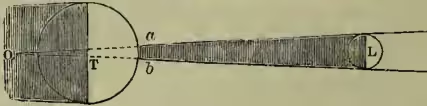
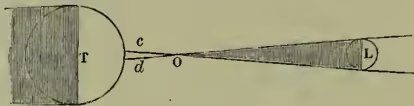
By a process similar to that used in ascertaining the length of the earth's shadow, it can be shown that the greatest value of the length of the moon's shadow is 59.73 semi-diameters of the earth; at the same time, we know that the least distance of the moon from the earth is about 55.95 semi-diameters. It follows that when a conjunction in line of the sun and moon happens at a time when the length of the shadow and the distance of the moon from the earth are, or are nearly, equal to the values above stated, the moon's shadow extends to the earth and beyond it. In this case there will be a total eclipse of the sun at all places over which it moves (fig. 3). If be the moon, the earth, and the moon's shadow cast by the sun, there will be a total eclipse of the sun at every point that is completely within the portion of the earth's surface. Again, the smallest value of the length of the moon's shadow may be shown to be 57.76 semi-diameters of the earth, and the greatest distance of the moon from the earth is 63.82 semi-diameters. So that in reality the point of the shadow at may be as much as 15,500 miles beyond the earth, or fall short of it more than 23,000 miles. In the latter case, the sun cannot be altogether hid from any point of the earth's surface; but this case, or one approximate to it, is that in which there will occur an annular eclipse. In fig. 4, suppose to be the apex of the shadow which falls short of the earth, and conceive the cone of the shadow produced earthwards beyond into a second cone ; then, from every point within the section of the earth's surface, the moon will be seen projected as a black disc on the bright disc of the sun, the portion unobscured forming a ring or annulus of light. While in the two cases just described the eclipse is total or annular at places within or , it will be partial at other places; the moon will appear projected against a portion of the sun's disc, making a circular indentation. To ascertain the places at which the eclipse will be partial, we have merely to form the cone of the penumbra of the moon's shadow in the manner explained in treating of lunar eclipses; at all places on the earth's surface within that cone there will be a partial eclipse. A simple calculation shows what is the observed fact, that the cone of the penumbra is not nearly large enough to embrace the whole of the face of the earth directed to the sun; in other words, solar eclipses are not universal, like those of the moon—i.e. they are not seen from all places that have the sun above their horizon at the time of the eclipse, which is the reason that though they are of more frequent occurrence than lunar eclipses, the latter are commonly supposed to occur more frequently.
If one could take up a position in space from which he could command a view of the whole face of the earth turned to the sun during a lunar eclipse, the phenomena which he would observe would be somewhat as follows. Marking the point of the earth first touched by the penumbra of the moon's shadow, he would observe the obscuration spreading therefrom over a wide and wider area as the penumbra advanced, till at last, supposing him to be viewing the case of a total eclipse, there appeared the umbral cone marking the earth with a dark spot. By-and-by, the whole penumbral shadow would be on the earth. The black spot would then appear to travel onwards with the motion of the shadow, and in its centre, in a course determined by the composition of the proper motion of the shadow or moon, and the motion of rotation of the earth. Part of the globe would be free from the affection, and, in the course of time, the umbral spot would progress over different portions of the earth in succession, till at last it passed off the earth's surface, drawing after it the penumbral shadow. Could the spectator mark on the globe the various places affected by the shadow, with their degrees of shading, he would have a perfect chart of the course of the eclipse. The small belt of the globe traversed by the umbra would mark all places at which the eclipse would be total, while the degrees of shading over places adjoining that belt on both sides would indicate the magnitude of the partial eclipse as seen from them. The breadth of the belt traversed by the umbra, when the sun's distance is greatest and the moon's least, is estimated at about 180 miles; and in the same case the penumbra is estimated to cover a circular space of 4900 miles in diameter, the eclipse happening exactly at the node. If the eclipse does not happen at the node, it is clear that the axis of the shadow must be inclined to the plane of the ecliptic, that the shadow will be cut obliquely, and therefore that the part of the earth in shade will be oval. It may here be stated that astronomers usually calculate beforehand the motion of the shadow over the earth's surface, and prepare charts to exhibit its motion. Such a chart an observer from a position outside the earth would have it in his power to make from observation.
Of the commoner phenomena attending an eclipse of the sun, as regards the appearance of that luminary, nothing need be said; they are perfectly analogous to those of lunar eclipses, except in the case of the eclipse being annular. There are other appearances, however, attending an eclipse of the sun, especially when it is total, that are very remarkable. The almost instantaneous darkening of the orb of day, more particularly when it is unlooked for, is calculated to impress a spectator with vague terror; even when expected, it fills the mind with awe, as a demonstration of the forces and motions of the mechanism of the universe. The sudden darkness, too, is impressive from its strangeness as much as from occurring by day; it resembles neither the darkness of night nor the gloom of twilight. The cone of the moon's shadow, though it completely envelops the spectator, does not, as we have explained, inclose the whole atmosphere above his horizon. The mass of uninclosed air accordingly catches the sunlight, and reflects it into the region of the total eclipse, making there a peculiar twilight. Stars and planets appear, and all animals are dismayed by the dismal aspect of nature. Mr Warren De la Rue, speaking of the total eclipse of July 1860, as witnessed in Spain, says: 'When the sun was reduced to a small crescent, the shadows of all objects were depicted with great sharpness and blackness, reminding one of the effects of illumination with the electric light. The sky at this period assumed an indigo tint, and the landscape was tinged with a bronze hue.' At totality, there was still light enough to enable the observer to draw without the aid of his lamp, while the sky near the sun presented a deep indigo, and thence passed through a sepia tint to red and brilliant orange near the horizon. It must be said, however, that the strange appearance here recorded is exceptional, and probably not such as could ever occur in our latitude. There is one set of phenomena attending total eclipses of the sun which are at once strange and invariable, and the causes of which cannot be said to be yet fully understood. As long as the total eclipse lasts, there appears round the sun and moon a luminous corona as in fig. 5, while at its base, and projecting beyond the dark edge of the moon, appear very brilliant prominences, generally of a red colour. These may be referred to in an observation noted by Firmicus in
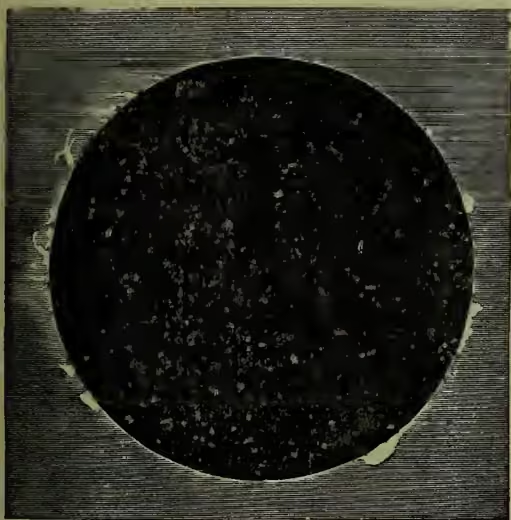
334 A.D. They were first certainly referred to by Captain Stannyan in 1703. They are found to be constant attendants on eclipses, and methods have been invented of rendering them visible at any time without the interposition of the moon. The spectroscopic shows that they consist mainly of hydrogen gas in an incandescent state, and a comparatively narrow belt of the same colour and substance runs round the whole circumference of the sun. The prominences are sometimes seen to shoot up like flames, in wild fantastic shapes, with incredible velocity, and to the height of tens of thousands of miles. See the subject discussed at SUN.
(4) Prediction of Solar Eclipses.—The period of 18 Julian years 11 days, referred to in treating of the prediction of lunar eclipses, applies to solar eclipses equally with lunar; but the ancients, who understood that fact, could find no law of recurrence of solar eclipses within that period, so as to predict them. The reason of the failure is obvious; for though solar eclipses recur in a fixed order within the cycle, they are not visible at the same places on their recurrence as when first observed. By modern methods similar to those applied in the case of lunar eclipses, however, eclipses of the sun may be predicted, with all their circumstances of time and places of observation, with the most perfect certainty. At the time of a solar eclipse the sun and moon are in conjunction; they are also in or near the same node; and no eclipse can happen if they are farther than from the node, or if the latitude of the moon, viewed from the earth, exceeds the sum of the apparent semi-diameters of the sun and moon. When within these limits, it is a problem of numbers and of spherical trigonometry to ascertain the nature of the eclipse, if any, which will happen.
The number of eclipses of the sun and moon together in a year cannot be less than two, or more than seven; the most usual number is four, and it is rare to have more than six. The explanation of the limitation of the number of eclipses is connected with the fact that the sun passes by both nodes but once in a year, except in the cases of his passing one early in the year, in which case, owing to the recession of the moon's nodes, he will again pass it a little before the end of the year. From the sun's thus passing each lunar node usually every year, it results that eclipses occur at particular periods, called eclipse seasons. In 1887 these occurred in February and August. They come about twenty days earlier every year, and last thirty-six days for solar, and twenty-three days for lunar eclipses. Their annual change of date is due to the motion of the lunar node (see MOON). From the smallness of the cone of the moon's shadow, total solar eclipses are extremely unfrequent in any one place, compared with the frequency of their actual occurrence. At Paris there was only one total eclipse of the sun in the 18th century, that of 1724, and there will not be another till near the close of the 19th century. In London, not one total eclipse was witnessed during the 575 years, 1140 to 1715. For eclipses of the satellites, see SATELLITES.