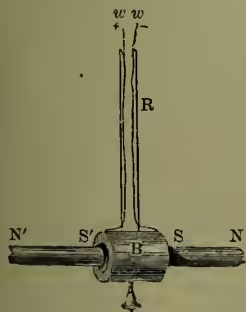
Electric Clocks. Electric clocks may be divided into two classes—those in which the impulse is given to the pendulum directly by electric power, and those in which it is given by a weight or spring alternately liberated and restrained by electricity. Of the first kind, that invented by Bain (1840) is best known. In the ordinary clock, it is the clock that moves the pendulum; in Bain's clock, it is the pendulum that moves the clock. As the construction of the pendulum is the only part of it connected with electricity, we shall confine our notice to a general description of the pendulum action. The lower part of the pendulum arrangement is shown in the fig. The bob, B, consists of a bobbin of insulated copper wire, and is hollow in the centre; the wires w, w from both ends run along each side of the pendulum rod, R (the lower part of which alone is seen), and are in metallic connection respectively with the two springs from which the pendulum hangs. Two magnets or bundles of magnetic rods, NS, N'S', are fixed at either side of the bob, and are of such dimensions that the hollow bob in its oscillation can pass a certain way over each without touching. The magnets have their like poles turned towards each other. The two springs of the pendulum rod are in connection with the two poles of a galvanic battery. In the connection between one of these springs and the battery there is a break (not shown in the figure) worked by the pendulum rod. When the pendulum is made to move, say, towards the right, it slifts a slider, so as to complete the connection between the poles of the battery. The current thereupon descends one of the wires of the pendulum, passes through the coil of wire forming the bob, and ascends by the other. In so doing, it converts the bob into a temporary magnet, the south pole towards the right, and the north pole towards the left. In this way, the south pole of the bob is repelled by the south pole, S, of the right-hand magnet; and its north pole is attracted by the south pole, S', of the left-hand magnet, so that from this double repulsion and attraction both acting in the same direction, the bob receives an impulse towards the left. Partly, therefore, from this impulse, and partly from its own weight, the pendulum describes its left oscillation; and when it reaches the end of it, it moves the slider so as to cut off the battery current, and then returns towards the right, under the action simply of its own weight. On reaching the extreme right, as before, it receives a fresh impulse; and thus, under the electric force exerted during its left oscillation, the motion of the pendulum is maintained. So long as the electricity is supplied the pendulum will continue to move. The current required is exceedingly weak; but the imperfection of the battery originally used by Bain led to a strong prejudice against these clocks—stronger, certainly, than they merit. It has been found, however, by those who have employed them for astronomical purposes, that little dependence could be placed on them, and that the proper conditions of pendulum motion were, from the unsteady supply of electricity, interfered with. Hence the efforts of late in electric clock-making have aimed at rendering the pendulum independent of the irregularities of the motive agent.
A very important application of Bain's pendulum was made by Jones of Chester (1857). Shortly after the invention of Bain's clock, Professor Wheatstone suggested that any number of such clocks could be made to move simultaneously by the same current of electricity. Jones turned this idea to account in the following way. A standard clock of the usual construction is made, by regulating the flow of a galvanic current, to control the action of any number of copying clocks, likewise of ordinary construction. The pendulum of the standard clock, itself in no way under electric control, on passing towards the right, touches a spring placed at the side, thereby completing the battery connection, and a current is transmitted to the copying clocks in a certain direction. On passing to the left side, the same takes place, but the current this time is sent through the circuit in the opposite direction. The pendulums of the copying clocks are made on Bain's principle, but have, of course, no break to move, as the primary pendulum performs that function. Let us suppose, at first, that all the pendulums are at rest; in this case no current is transmitted. Let the standard pendulum now be moved to the right, the right spring is touched, and a current at the same instant circulates through the bobs of the copying pendulums, and they thereby receive a simultaneous impulse towards the left.
All the pendulums move then to the left; and on reaching the extremity of this oscillation, the standard pendulum touches the left spring, and the secondary pendulums are now impelled to the right. The motion of each secondary pendulum soon increases, until it reaches its proper extent. The pendulums once set a-going are, however, not intrusted solely to the stimulus of the electricity, but are moved by their own weights, as in ordinary clocks, so that if the electricity ceased to be sent to them, they would go on without it.
In the second class of electric clocks, the electricity is not charged immediately with the maintaining of the pendulum motion, but draws up the weight, or liberates the spring which discharges that function. This is the same principle as holds in what is known in horology as the 'remontoir' escapement. Ritchie of Edinburgh successfully combined the principles of Bain's and Jones's clocks, effecting the almost perfect control, by one standard clock, of a number of subordinate others. The pendulums of these controlled clocks vibrate by electro-magnetic action alone, and they consequently require no winding up.