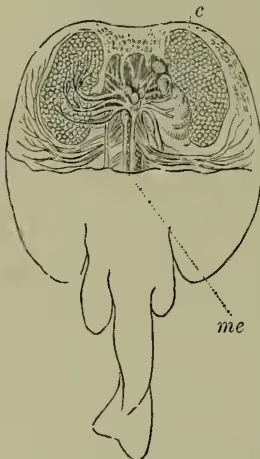
Electric Fishes. Electric organs are found in a few fishes; peculiar structures arising rudimentary electric organ in the common skate.
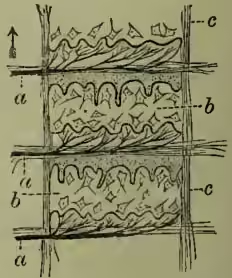
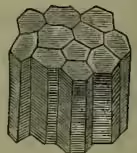
Structure.—It may now be regarded as demonstrated that all these electric organs are modified muscle-tracts. The associated nerve-endings are comparable to the ordinary terminations of a motor nerve on a muscle. The organs consist of a large number of rounded chambers or prismatic columns, separated by longitudinal and transverse partitions of fibrous connective tissue. In these partitions there are blood-vessels and nerves with very thick sheaths. The nerves lose their thickness, branch greatly, and finally fuse with 'electric plates,' or discs of modified muscular substance. Besides the essential electric plate, the compartment may contain a jelly-like substance or a fluid. Partitions, nerves, and the 'electric plate' form in all cases the principal structures.
Arrangement.—The electric organs not only occur in a well-developed state in three very widely separated fishes, but the arrangement in each case is different. (a) In the Gymnotus, which is abundant in the fresh water of Brazil and the Guianas, they replace the lower muscles along the sides of the tail. This is also the position of the weakly developed organs in the Rays (except Torpedo) and in the bony fishes already mentioned.
As Gymnotus may measure 6 feet in length, and has a very long tail, there is little wonder that its electric discharge is emphatically dangerous. The whole apparatus is supplied with more than 200 spinal nerves; one inch in length contains over 200 chambers (Günther). (b) In the African cat-fish, which is not uncommon in tropical Africa, and is represented by M. electricus in the Nile, the organ is more diffuse. It forms a sheath almost round the body, lying between the skin and muscles, but is thickest along the lower sides. The innervation is remarkable, for there is but one enormous nerve for each side. This arises from a giant cell high up on the spinal cord, and distributes branches throughout the body. The fish is again very long, measuring about 4 feet, and ranks second in the series. (c) In the Electric Rays (Torpedo), which occur in the Atlantic and Indian oceans and in the Mediterranean, the organs are broad, bounded by the gills, the pectoral fins, and the head. The prisms, of which there are many hundreds in each battery, lie vertically, not longitudinally as in the two preceding cases; and the nerves, instead of coming from the spinal cord, arise directly from the brain. Four of the five principal nerves on each side 'are each as thick as the spinal cord.' It is noteworthy that the above electric fishes have all smooth skins.
Function.—How the 'electric plates' come to be charged with electricity is not yet elucidated. The currents have all the usual characteristics of electricity: 'they render the needle magnetic, decompose chemical compounds, and emit the spark' (Günther). 'The side of the electric plate on which the nerve branches out is negative at the moment of discharge, while the opposite side is positive, and from the different arrangements of the parts the electric shock passes in different directions in the three fishes—in Malapterurus from the head to the tail, in Gymnotus in the contrary direction, in Torpedo from below upwards' (Wiedersheim and Parker). The activity of the organ is wholly dependent (a) upon nerve stimulus from the brain, and (b) upon a certain degree of freshness in the structure itself. If the connection with the brain be severed, no discharge can be produced, except of course by the artificial stimulus of the severed nerves. Or if numerous rapidly repeated discharges have been already evoked, the organ is exhausted, and requires rest and recuperation before it becomes again functional. Humboldt's graphic story of the capture of electric eels by letting them first exhaust themselves in attacking horses has never been confirmed. In natural life the strength of the shock varies with the degree of development reached by the organ, with the size, health, and humour of the fish, and with the amount of reserve energy within the structure. A ray measuring 2 to 3 feet in width is 'able to disable by a single discharge a full-grown man,' and yet the ray is the least powerful of the three. To receive the shock the
object must complete the circuit by a double contact with the fish either directly or through some intervening substance. When well developed, the organ may be useful to the fish in two ways—in paralysing or killing other fishes used as food, and in warding off the attacks of enemies.
The electric ray and eel were known to the ancients, and were used for curative purposes, 'the earliest electric machines employed by mankind.' Scientific research on the electric organs really began with Walsh's demonstration (1772) of the genuinely electrical character of the discharge. The subject has been much worked at by some of the ablest anatomists and physiologists, and certainly is not yet finished. The origin of the organs, useless when incipient, and the connection between this peculiar development and the ordinary electrical properties of muscle and nerve are unsolved problems.
See MUSCLE, NERVOUS SYSTEM; Günther's Intro. to the Study of Fishes (1880); and the works on comparative anatomy by Gegenbaur (trans. 1878) and Wiedersheim (1886).