Elm (Ulmus), a genus of trees of the natural order Ulmaceæ, natives of temperate climates, with serrated leaves unequal at the base, and small flowers growing in clusters appearing before the leaves, and containing 4-12 stamens and one germen. The fruit is a samara, or compressed one-seeded little nut, winged all around. Elm is a remarkably variable genus, so much so that botanists are greatly divided in opinion as to which are species and which varieties among the numerous forms comprised in it. There are two well-marked types common to Britain, and having a wide distribution in Europe and Western Asia and Northern Africa. These are the English Elm (U. campestris), which is the most common in English woods and pleasure-grounds; and the Scotch or Wych Elm (U. montana), which, though more common in Scotland and in Ireland, is more sparingly distributed also in England and on the Continent.
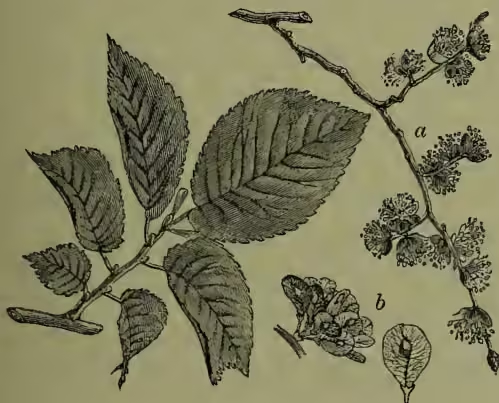
a, flower; b, fruit.
The English elm often attains a height of from 70 to 90 feet, with a diameter of from 5 to 6 feet, before it is one hundred years old—an age that the elm-tree rarely much outlasts; it may even exceed 100 feet in height. Both species have been productive of many varieties, some of which are so distinct as to be by some considered species and by others as merely well-marked sub-species or varieties. The fact that no reliance can be placed on the progeny of any of these forms, when reared from seed, having the features and attributes of the parent appears to corroborate the latter view. In consequence of this peculiarity in elm it is necessary, if we wish to perpetuate any specially desirable or meritorious kind, to propagate it by budding, grafting, or layering. Varieties of the English elm are numerous. All are not alike valuable as timber-trees. For forest planting, seedlings of the type and other well-marked kinds are selected. Besides the typical form, varieties known to nurserymen as the Broad-leaved English Elm (U. c. latifolia), the Red English Elm (U. c. stricta), and the White English Elm (U. c. alba) are preferred to any others as the seed parents, their progeny proving almost invariably valuable timber producers. Of this species there are some interesting and beautiful varieties, much esteemed for their effect in ornamental grounds and garden scenery. The most distinct are the typical form with silver variegated leaves, and also with yellow variegated leaves, and U. c. viminalis, of which there is also a silver-leaved form, both of them being remarkable for the small, twiggy character of their shoots, and their light, elegant appearance. The Twisted Elm (U. c. tortuosa) is a very singular variety of French origin. Its trunk marked with alternate protuberances and hollows gives it a very remarkable appearance in old trees. Its timber is preferred in France above all others by wheelwrights, particularly for spokes, its fibre being exceedingly tough, twisted, and interlaced together. The Dutch Cork-barked Elm (U. c. major) is a well-marked variety or sub-species of the English elm, which was introduced by William III. when the Dutch style of gardening was fashionable. Its rapid growth and adaptability to being clipped into the stiff, formal shapes essential to that style of gardening led to its being much used while the fashion prevailed; but when Dutch gardening disappeared, the cultivation of this variety of elm almost ceased, as its timber is comparatively worthless. The bark of the younger branches is rough and cork-like. The Cork-barked English Elm (U. c. suberosa) is a very handsome and well-marked sub-species, growing with greater vigour and to a larger size than the type, having also larger leaves and the bark of the branches distinctly lined with corky wings.
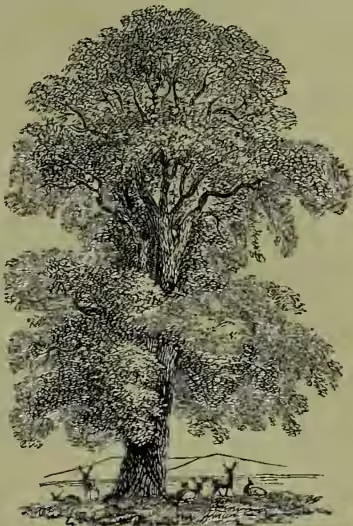
(Ulmus campestris).
The wood of the English elm is highly valued for its great strength, toughness, and closeness of texture. It is less liable to split than almost any other timber, and powerfully resists the decomposing action of water; it is therefore much in request for keels of ships and boats, naves and spokes of wheels, foundation piles, and wet-planking. The large bosses or knots with which the trunk is frequently covered are much prized in cabinet work and in turnery for their beautiful appearance when cut up and polished. The bark is used in dyeing and in sugar-refining, and in times of scarcity has been used in Norway for grinding into meal and mixing in bread. The inner bark is used medicinally in cutaneous diseases; it is mucilaginous, and has a bitter astringent taste. In Persia, Italy, and the south of France galls are frequently produced on the leaves, often of large size, containing a clear fluid called eau d'orme, which is sweet and viscid, and is used to wash wounds. Towards autumn these galls dry up, leaving a residue of a yellow or blackish balsam called beaume d'orme, which was formerly in great repute for diseases of the chest. The seeds of the elm are eagerly eaten by pigeons and common poultry. A peculiar vegetable principle called ulmin, or ulmic acid, was first discovered in the substance which often spontaneously exudes from the bark of the English elm. It is a dark-brown substance, without smell or taste, insoluble in cold, sparingly soluble in boiling water, which it colours yellowish-brown, and soluble in alcohol and in alkaline solutions.
The typical form of Scotch elm is easily distinguished from the English by its less upright trunk, more spreading branches, and larger, broader leaves. The tree is generally considered more picturesque in style than the English elm. Its timber, though more liable to crack, is quite as much esteemed for its durability and toughness, and is used for nearly every purpose for which that of the English elm is in demand. The enormous bosses which frequently occur on the trunk are highly valued in cabinet-making. The varieties of this species are numerous, and some of them are important both as timber and as ornamental trees. The Smooth-leaved Wych Elm (U. m. glabra) is so distinct in its upright growth, smaller and smooth leaves, and other even more important characters, from the typical Wych Elm, that some are disposed to regard it as a species. It is certainly well marked, and from it have sprung the Huntingdon Elm, the Chichester Elm, and the Scampston Elm, all of which have a strong resemblance to each other, and are remarkable for their great rapidity of growth and their value as timber-trees. Of ornamental and curious varieties, the Wych Elm is the parent of several, the more remarkable of which are the Weeping Wych Elm (U. m. pendula), the Exeter Wych Elm (U. m. fastigiata), and the Variegated Wych Elm (U. m. variegata), the leaves of which are silvery striped. U. effusa is a continental species with a large spreading head and smooth bark, distinguished also by the long stalks of its flowers and its ciliated fruit.
The American or White Elm (U. americana), which abounds in the Mississippi basin, and attains its loftiest stature between 42° and 46° N. lat., is a magnificent tree, sometimes 100 feet in height, the trunk reaching 60 or 70 feet before it separates into branches, and the widely diffused pendulous branches floating gracefully in the air; but the timber is not much esteemed. Slippery Elm (U. fulva) is also common in the basin of the Mississippi as far south as 31° N. lat., and in the western parts of Canada. It attains a height of 50 or 60 feet. The wood is more valuable than that of the last species, but much inferior to the English elm. The leaves and bark yield an abundant mucilage, which is bland and demulcent, and esteemed a valuable remedy in catarrh, dysentery, and other complaints. The Wahoo or Winged Elm (U. alata) is a small tree, found from 37° N. lat. to Florida, Louisiana, and Arkansas, remarkable for the branches being furnished on two opposite sides with wings of cork. The wood is fine-grained, compact, and heavy. Both the English elm and the Wych elm have been introduced into the United States. U. chinensis is a Chinese species of elm, the leaves of which bear galls used in tanning and dyeing.
The name Spanish Elm is given in the West Indies to a valuable timber-tree also called Bois de Chypre, Cordia Gerascanthus, of the natural order Cordiaceæ; also to Hamelia ventricosa, of the natural order Rubiaceæ, the timber of which is known to cabinetmakers as Prince-wood.