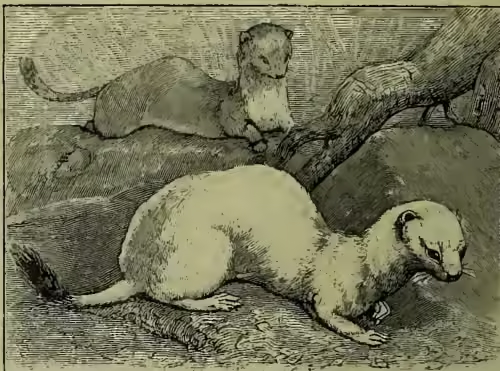
Ermine, or STOAT (Putorius erminea), a well-known carnivore in the marten family (Mustelidae), belonging to the genus which includes pole-cat, weasel, ferret, mink, &c. The body is long and slender, and the legs are short, as in the more familiar weasel. The length of the body is about 10 inches, to which 3 or 4 inches of tail are added. The colour of the stoat is ruddy brown in summer, yellowish beneath; but in winter, in the more northern parts of its distribution, the ermine changes its fur into a beautiful white. That this change occurs in direct association with the lowered temperature seems certain, though the physiology of the process is not understood. Observations seem to show that not only is the new growth of hair at the beginning of winter white, but persistent old hairs may also change. The end of the tail always remains black, and the change is sometimes only partial. The protective value of the white fur in snowy regions is obvious. Like related species, the ermine is a very lithe, restless, brave, and blood-thirsty animal; it moves rapidly, and can both climb and swim well; it is terrestrial in its general habit, and finds a home among rocks and stones, in walls and the like. It sucks the blood of small mammals and birds, and, while valuable in destroying rats and mice, is sometimes a troublesome poacher on the poultry-yard. It breeds at the end of the winter season.
The ermine occurs in Britain, especially in the north, is generally distributed in the northern parts of Europe, Asia, and America, but is common as far south as the Pyrenees and the Italian Alps. The white fur, which has long been used for trimming or lining the robes of dignitaries, is not so much prized as it used to be. The skins are usually imported from Norway, Lapland, Siberia, and the Hudson Bay Territories. The yellow and black tails are inserted to contrast with the white fur. Ermine is the fur of most frequent use in Heraldry (q.v.). See FERRET, MARTEN, POLECAT, WEASEL.