Heraldry is in its original and more comprehensive sense the knowledge of the whole multifarious duties of a Herald (q.v.); in the more restricted signification in which the term is used by most modern writers, and that assigned to it in the present article, it is a knowledge of the laws that regulate armorial insignia—i.e. the devices that appear on shields, with their attendant crests, supporters, and badges. After occupying for ages the attention of the learned, and forming an important branch of a princely education, this study fell for a time into neglect and disrepute, and was abandoned to coach-painters and undertakers, a degradation owing in part to the endless tissue of follies and mystifications with which it had been interwoven. Modern criticism has rescued heraldry from these pedantries and absurdities, and imparted to it a new interest as a valuable aid to historical investigations.
Instances occur in remote times of nations, tribes, and individuals distinguishing themselves by particular emblems or ensigns—e.g. the standards of the twelve tribes of Israel, of the Egyptians and Assyrians, and the Roman eagle and cohort ensigns. Figures, symbolical and ornamental, singularly like some of those of heraldry, are found mixed with other emblems in Egypt, China, India, Japan, on Etruscan vases, and on Greek coins; and shields decorated with devices are described by both Homer and Æschylus. Yet there is exhaustive negative evidence that nothing that can be properly called armorial devices were used either on shields or banners before the middle of the 12th century. The shields of the French knights in the first crusade presented a plain face of solid metal, nor is there any certain evidence of armorial bearings having been in use in the second crusade, 1147 A.D. The representation of the Norman invasion and conquest of England on the Bayeux Tapestry (q.v.) contains on the shields of both Saxons and Normans figures of a semi-armorial character, including dragons, crosses, roundles, irregularly arranged, also striped banners; but there is no attempt to individualise the arms of the different heroes of the fight. Yet the rude devices on these shields seem to have been the precursors of systematic armory; and in the later half of the 12th century similar figures began to assume the permanent or hereditary character which is essential to the idea of armorial ensigns. Their use began with the French and Germans, and soon spread from France to England. The other nations of Europe followed; and their nearly simultaneous adoption seems to have been in part the result of the intimate intercourse which the crusades brought about between the chief sovereigns and warriors of Europe. Tournaments helped to bring arms into fashion, and before long the bearing of hereditary arms on shields and banners became one of the most prominent features of medieval life. Some sort of armorial insignia were certainly depicted on the shields borne in the third crusade, which took place in 1189; and in the same century originated the fleurs-de-lis of France, and the lions or leopards of England. In the 13th century the practice was introduced of embroidering the family insignia on the surcoat worn over the hauberk or coat of mail, whence originated the expression coat-of-arms. Arms were similarly embroidered on the jupon, cyclas, and tabard, which succeeded the surcoat, and also enamelled or otherwise represented on furniture, personal ornaments, and weapons. Sealing had, before the introduction of heraldry, become a legal formality necessary to the authentication of a deed, and from the 13th century onwards the seals of all persons of noble or gentle birth represented their armorial ensigns (see SEAL). Those seals, appended to charters, are among the most valuable materials for tracing the history of heraldry, though they labour under the disadvantage of not indicating colours, as the arms on painted windows do.
Among important adminicles for the study of English heraldry are certain extant rolls or records of arms of the times of Henry III., Edward I., Edward II., Edward III., and also of later reigns, in the British Museum, Heralds' College, and elsewhere—a good many of which have been published or privately printed. The earliest of these, of date 1240 to 1245, show that heraldry had at that date been reduced to a systematic shape. In most cases the arms on these rolls are verbally described; in a few instances they are drawn. Along with the rolls of arms may be classed a heraldic poem known as the Roll of Caerlaverock, in which are recited in Norman-French the names and arms of the knights-banneret who were present at the siege of that fortress in 1300. It was edited by Sir Harris Nicolas (1828), and by Thomas Wright (1861). Only a little later in date is a manuscript armorial of all Christendom, the work of a Flemish herald of the middle of the 14th century, preserved in the Royal Library at Brussels, in which the shields are beautifully illumined in colours, with, in many cases, the addition of helmets and crests; it has been reproduced in fac-simile by M. Bouton. A valuable Swiss roll of the same century has been fac-similed in the same way by the Antiquarische Gesellschaft of Zurich. Authentic materials of this kind enable us to trace the steps by which the usage of arms reached the still more systematised form which it assumes in the works of the established writers on heraldry. In the hands of these authors, the earliest of whom wrote at the end of the 14th century, the historical part of the subject had been obscured by a tissue of fictions, which had a very misleading effect down to a quite recent time. The arms assigned to our forefathers Adam and Noah, to the old Jewish and pagan worthies, and to the Apostles, have long ceased to be believed in; but till a very recent date the coats of Edward the Confessor and of William the Conqueror were regarded as thoroughly historical. No less spurious than the arms of Edward the Confessor are those given by George Rüxner, herald to the Emperor Maximilian I., in his Thurnierbuch to knights of Germany of the 10th century, and his Leges hastiludiales of Henry the Fowler, who flourished two hundred years before the earliest germs of heraldry, one of which laws made it imperative for the combatants in tournaments to have borne 'insignia gentilitia' for four generations. These laws of Henry the Fowler have imposed not only on the German armorialists of last century, but on Mr Ellis, who in his ingenious plea for the antiquity of heraldry, appeals to them with full faith in their genuineness. Modern German critics, however, reject them as a palpable forgery.
In the infancy of heraldry every knight seems to have assumed what arms he pleased. Animals, plants, imaginary monsters, things artificial, and objects familiar to pilgrims and Crusaders, were all fixed on; and whenever it was possible, the object chosen was one whose name bore sufficient resemblance in sound to suggest the name or title of the bearer of it. The charge fixed on was used with great latitude, singly or repeated, in any way which the bearer of the shield chose, or which the form of his shield suggested. But as coats-of-arms multiplied, different knights occasionally fixed on the same symbol, and the confusion which arose from the similarity of coats-of-arms could only be obviated by a restraint being placed on the bearer's fancy, and regulations being introduced regarding the number, position, and colour of the charges, and the attitudes of the animals represented. As heraldry became more and more consolidated into a system, the true origin was lost sight of, and the fertile imagination of the early armorialists led them to invest the most common charges with mystical meanings, and to trace their original adoption to the desire of commemorating the adventures or achievements of the founders of families. The legends ascribing an origin of this kind to early armorial bearings have, wherever it has been possible to investigate them, proved fabrications. For the first few centuries of the existence of heraldry a very large number of the insignia, both of families and of kingdoms, were, as already remarked, armes parlantes, though the allusion can now in many cases be traced with difficulty. The lion of Leon and Louvain, the castle of Castile, the bear of Berne, the column of the Colonna family, are well-known continental examples; and in England we have three fountains for Wells, a whirlpool (gurgles) for Gorges, a calf for Vele. At the same time commemorative heraldry, which became common in later times, was not absolutely unknown in the 14th century, one of the earliest instances being the heart introduced into the Douglas coat, in memory of the pilgrimage of the good Sir James with the heart of his royal master, found on the seals of the Douglas family as early as 1356.
As no two families in the same kingdom were allowed to bear the same arms, the right to bear a particular coat sometimes became a matter of fierce dispute. It lay in England with the constable and marshal, as judges in the Court of Chivalry, to decide questions of this kind, with a right of appeal to the king; and one of the most famous contests before them was that between the families of Scrope and Grosvenor, in 1385, for the right to bear the coat azure, a bend or; when John of Gaunt was one of the witnesses examined, and the undifferentiated coat was adjudged to Scrope.
In course of time the right to use a coat-of-arms became, like the jus imaginum, the distinctive privilege of the noble, the word being used here in the continental sense, analogous to the English Gentleman (q.v.); and the privilege transmitted to all his descendants in the male line. When a prince made a plebeian noble, as it was competent for him to do, the patent of nobility defined what arms he was to bear.
In England a proclamation of Henry V. restrained the private assumption of armorial insignia, by prohibiting all who had not borne arms at Agincourt to assume them, except in virtue of inheritance or a grant from the crown. On the establishment of the Heralds' College (see HERALD) in 1483, the regulation of matters armorial was to a large extent delegated to the kings-of-arms and heralds acting under the Earl Marshal. Periodical visitations of the different counties were directed to be made to take cognisance of the arms, pedigrees, and marriages of the nobility and gentry of England. These visitations went on at varying periods from 1528 down to 1704, and are the principal source of evidence as to the hereditary right to bear arms in England. Among the functions exercised by the English kings-of-arms (the chief of whom is Garter King-of-arms) are the assigning of appropriate insignia to persons who have acquired a social importauce that entitles them to take their place among the gentlemen of coat-armour of the country. Lyon King-of-arms, besides being a judicial officer having cognisance of all questions regarding the right to arms, exercises by direct delegation from the crown similar functions in the case of Scotsmen in the way of granting arms to novi homines; as does Ulster King-of-arms in the case of Irishmen. The wrongful assumption of arms is still in Scotland, if not in England, an act for which statutory penalties can be enforced against the assumer.
While there is nowhere on the Continent an institution similar to the English Heralds' College, there still exists in Prussia, Austria, Bavaria, Russia, Holland, and Belgium, and some other continental countries, a direct supervision of armorial insignia, which takes place through the chancery of the orders of the kingdom. In Sweden and Norway the abolition of titles of nobility has made the administration of armorial matters more lax, though the preservation of the orders of knighthood implies a chancery or office of regulation so far as they are concerned. In France there is now no juge d'armes; and spurious heraldry figures largely on carriages and elsewhere in Paris. In the United States the stars and stripes are said (erroneously, it would appear; see FLAG, Vol. IV. p. 665) to be derived from the arms of Washington; and it is not unusual for individuals and families to trace their descent from old-world houses, and to assume the arms proper to their name. So in the British colonies.
Not only families, but kingdoms, feudal lordships, towns, episcopal sees, abbeys, kings-of-arms in their official capacity, and corporations may by heraldic usage bear arms. The arms of two or more states ruled by one sovereign prince are marshalled together quarterly or otherwise in one escutcheon; and it has been the practice of many sovereigns to marshal along with their own arms of dominion, arms of territories of which they are not in possession, but to which they claim a right. Thus, England bore the arms of France from the time of Edward III. till 1801; and the kings of Naples and of Sardinia were in use to bear the arms of Cyprus and of Jerusalem. Similarly it has been the practice of the Dukes of Athole and Earls of Derby, as having been lords of Man, to quarter the arms of that island; and feudal coats are borne quarterly and en surtout by various peers of Scotland. As to honourable additions to arms granted by sovereigns, see AUGMENTATION.
While family arms transmit in the male line to the descendants of the bearer of them, to be borne by cadets with recognised differences, an heiress in the heraldic sense—i.e. a daughter who represents her father, conveys her arms to her husband (provided he be himself a gentleman of coat-armour) to be marshalled in accordance with certain rules with his own. Occasionally the arms of a great heiress are allowed altogether to supersede the paternal coat; and sometimes a successor who is a stranger in blood has been empowered to assume adoptive arms to fulfil the wish of a testator.
Heraldry is thus, in one of its aspects, a faithful chronicler of the history both of royal dynasties and of private families. Every change in the hereditary succession of a kingdom, every union of two houses by marriage, occasions a corresponding change in the coat-of-arms; the position which the members of a house occupy in the family tree is duly indicated, and an armorial shield is thus a record whose nice distinctions indicate to all who understand its language, a number of material facts regarding the owner of it. Heraldry is in this way an aid to the study of history, general and local. It has often afforded the key to questions of disputed succession; and seals, baronial and monumental carvings, and shields in church windows, have all been recorded in courts of law as evidence in obscure questions of marriage and descent.
The Shield.—A coat-of-arms is composed of charges depicted on an escutcheon representing the old knightly shield. The word 'escutcheon' is derived from the French écusson, which signified a shield with arms on it, in contradistinction from a shield generally. The forms of the shield represented in heraldry, as in war, differed at different times. The actual shields of the 11th and 12th centuries were in shape not unlike a boy's kite.
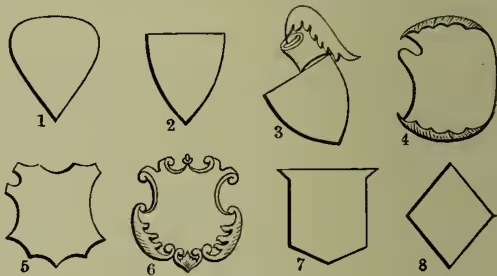
They were curved to encircle the body, and in some early seals are so represented; but, after heraldry began to be systematised, we generally find them engraved on seals and monuments as if flattened, to let the armorial design be fully seen. The pear-shape (1, fig. I.) represented in a few early shields, was soon followed by the flat-iron or heater-shape (2), which prevailed in the 12th and 13th centuries, with an increasing tendency to bulge towards the base, more especially after the introduction of the practice of quartering. When helmet, or helmet and crest, were represented, the shield was often placed in the position called couché (3), as if suspended from the helmet by the sinister chief angle. Towards the end of the 15th century appeared such forms as 4 and 5, where the notch is meant to represent a rest for the knightly lance. In the 16th century the forms used became more florid (6), but with considerable variety. The forms in use in the 17th and still more the 18th century, became gradually more and more tasteless and unmeaning, the least offensive being perhaps the vair-shaped shield (7). In France and Germany the shield most in use is very wide at the base, so as to afford sufficient room for the display of quarterings or small charges. In Spain the favourite type of shield has always been one with rectangular sides and a segment of a circle for the base. The shield of an unmarried lady or widow is of a lozenge-shape (8).
To facilitate the description, or as it is called blazoning of arms, the different points or positions on the escutcheon have received technical names. English heralds generally enumerate them as nine: A (fig. II.), the dexter chief point; B, the middle chief; C, the sinister chief; D, the honour or collar point; E, the fess point; F, the nombril or navel point; G, the dexter base; H, the middle base; and I, the sinister base point. To these may be added K, the dexter flank, and L, the sinister flank. It will be observed that the dexter and sinister sides of the shield are so called from their position in relation to the supposed bearer of the shield, not of the spectator.
Tinctures.—Coats-of-arms are distinguished from each other not only by the charges or objects borne on them, but by the colour of these charges, and of the field itself. The field may be of one colour, or of more than one, divided in various ways to be noticed below. Tincture is the more proper armorial expression than colour, as the surface of a shield or of an armorial figure may be of a metal, or a fur, as well as of a colour strictly so called.
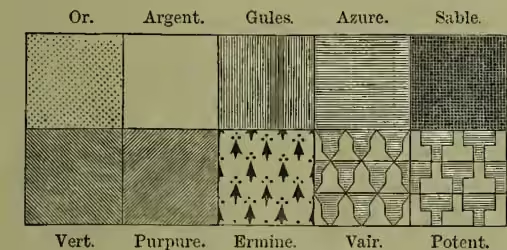
The nomenclature of these three classes of tinctures, as of heraldry generally, is an adaptation of Norman-French. The metals in use are two—gold, termed or, and silver, argent, often represented in painting by yellow and white. The colours are five—red, blue, black, green, and purple, known as gules, azure, sable, vert, and purpure. A charge represented not of any of these conventional heraldic tinctures, but of its natural colour, is said to be proper. In uncoloured heraldic engravings, it has been found convenient to have a mode of representing colours and metals by hatched lines and dots, which is shown in fig. III.; an invention not older than the 17th century. Or is represented by dots; for argent, the field is left plain; gules is denoted by perpendicular, and azure, by horizontal lines; sable, by lines perpendicular and horizontal crossing each other; vert, by diagonal lines from dexter chief to sinister base; and purpure, by diagonal lines from sinister chief to dexter base. The original furs in use were ermine and vair. The former is represented by black spots resembling those of the fur of the animal called the ermine, on a white ground. Vair, said to have been taken from the fur of a squirrel, bluish-gray on the back, and white on the belly, is expressed (at least in the more modern heraldry) by blue and white bells or panes in horizontal rows, as shown in the figure. As the number of coats increased, various modifications of these furs were introduced, including ermines, or ermine with the field black and the spots white; erminois, with the field gold and the spots black; erminites, with a red hair on each side of the black spots; pean, with the field black and the spots gold. Potent is a crutch-shaped form of vair, as represented in the figure, and it also has occasional varieties which need not be noted at length. When vair is composed of any other tinctures than argent and azure, it is blazoned very of these tinctures, and is more strictly a field divided by partition-lines than a fur.
Charges.—Everything depicted on the field of the escutcheon is called a charge, and is supposed to stand out in relief on it; and as a general rule, a shield-of-arms has one or more charges. A few exceptional cases occur in continental heraldry of an uncharged shield of one of the metals, colours, or furs; and even in British heraldry there are, as will be seen, cases where a field consisting of metal and colour divided by partition-lines is uncharged. It is an established rule of heraldry that metal should not be placed on metal, nor colour on colour. A remarkable transgression of it occurs in the arms of the kingdom of Jerusalem founded by the Crusaders, which are argent, a cross potent between four crosses or. A recognised exception exists wherever a charge lies over a field partly of metal and partly of colour, or where an animal is (see infra) armed, langued, attired, unguled, beaked, membered, crowned, collared, or chained of a different tincture from that of his body. One charge of colour may surmount—i.e. partly cover, another of colour on a field of metal, and the same may happen in case of two charges of metal on a field of colour.
Armorial charges are usually divided into three classes: (1) Honourable ordinaries, figures of simple outline and geometrical form, conventional in character, which in some of the oldest coats are the only charge; (2) Subordinaries or subordinate ordinaries, which differ from the above chiefly in not being generally the recipients of charges, while honourable ordinaries may be and often are charged; (3) Common charges, representations of objects of all kinds, animals, plants, and the whole range of things natural and artificial.
Ordinaries.—The enumeration of the honourable ordinaries by different armorialists is not absolutely identical, some classing as subordinaries figures which others regard as belonging to this class. It may be predicated generally of the ordinaries that they may be borne either simply, along with other charges, charged with other figures, bounded by any of the forms of irregular partition-lines to be noticed below, or combined with each other. Also that they have in most cases their diminutives, which (except in the case of a canton as the diminutive of a quarter) cannot be charged. Taking as our test for admission to this more honourable class the capacity of receiving charges, they may be accounted thirteen in number:
The Chief (1, fig. IV.), lying horizontally along the upper part of the shield, and (as also the Pale and Fess) supposed to occupy a third of it. The Pale (2), a vertical band in the middle of a shield. It has a diminutive, the Pallet, seldom used singly, and a smaller diminutive, the Endorse. The Fess (3), a horizontal band in the middle of the shield. The Bar is a narrower fess, never used singly, and there are further diminutives, the Closet and Barrulet. The Bend (q.v.) (4), a band crossing the shield from dexter chief to sinister base; when charged it occupies one-third, and when plain one-fifth, of the field. It has for diminutives the
Bendlet, the Cotise or Cost, and the Ribbon. The ribbon is sometimes couped or cut short so as not to touch the edges of the shield. The cotise sometimes accompanies the bend in pairs on each side, when it is said to be Cotised, and the same term is sometimes applied with less propriety to a fess or chevron accompanied by a pair of its diminutives. The Bend-sinister (5), a band crossing the shield from sinister chief to dexter base. Its diminutive, the Baton-sinister (q.v.), couped, and borne over all is a mark of illegitimacy. The Chevron (6), a figure composed of two bands or limbs issuing from dexter and sinister base, and meeting about the honour point. Its diminutives are the Chevronel, which never appears singly, and the Couple-close, which sometimes accompanies the chevron in pairs, one on each side. The Cross (7), of the form of the Greek cross, with equal limbs.
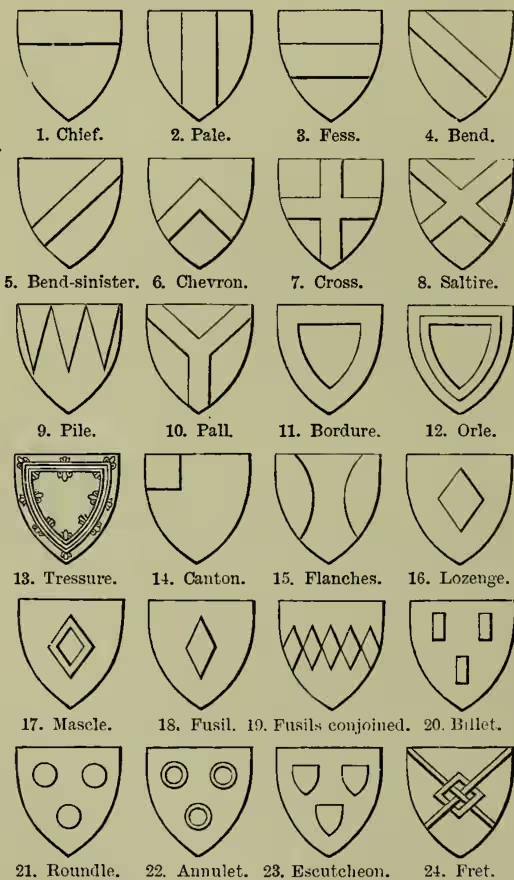
It has numerous varieties, most frequently borne in numbers or with other charges, for which see CROSS. Any of them is said to be fitchée when its lower limb terminates in a sharp point. The Saltire (8), a St Andrew's Cross, or combination of the bends dexter and sinister, often borne along with a chief in the heraldry of Scotland. The Pile (9), a triangular wedge-shaped figure, issuing usually from the chief with point downwards. Three piles are often borne together. The Pall (10), the upper part of a saltire combined with the lower part of a pale. A variety of it, couped and pointed at the extremities, occurs in Scotland under the name of a Shake-fork. The Bordure (11), a border surrounding the shield, sometimes used as a principal figure, sometimes as a difference. The Orle (12) and the Tressure (13) are sometimes classed as its diminu- tives. The former is a narrower bordure detached from the edge of the shield. The latter, borne double and flowered and counterflowered with fleurs-de-lis, occurs in the royal shield of Scotland, and is a bearing greatly esteemed in Scottish heraldry. The Quarter is the upper dexter fourth part of the shield, cut off by a vertical and a horizontal line meeting in the fess point. The Canton (14), of more frequent occurrence, is a smaller figure like it, and also in dexter chief, unless otherwise specified. The half of a canton parted per bend is called a Gyron, chiefly known in British heraldry as giving its name to the field Gyronny. Flanches (15), borne in pairs, are projections from each flank of the shield bounded by a segment of a circle. Their diminutives are Flasques and Voiders.
Subordinaries.—The subordinaries (excluding those here included in the category of honourable ordinaries) are: The Lozenge (16), a rhombus with the acute angles at top and bottom. The Masele (17), a lozenge deprived of the middle part. The Fusil (18), an elongated lozenge. Several fusils are sometimes conjoined en fess (19), as in the coat of Percy. The Billet (20), an oblong figure placed perpendicularly. The Roundle (21), a circular disc or knob. Roundles have, in English heraldry, specific names in respect of their tinctures. A roundle or is called a Bezan; argent, a Plate; gules, a Tortean; sable, a Pellet or Ogress; vert, a Pomme. The Annulet (22), sometimes regarded by armorialists not as a ring but as a pierced roundle. The Escutcheon or Inescutcheon (23), a representation of a shield—the latter name being generally used when there is only one. It is difficult to see on what principle these last two charges are conventional enough to be ranked among the lesser ordinaries. The Fret (24), consisting of two narrow bendlets dexter and sinister in saltire, interlaced with a masele.
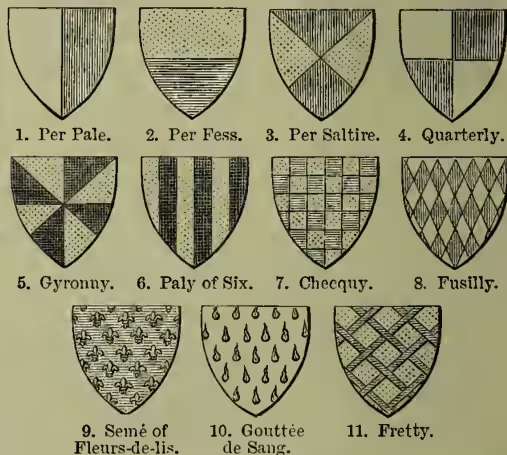
Parted Fields.—The field of an escutcheon (and sometimes an ordinary or other charge) may be of two or more different tinctures, divided by one or more partition-lines, and the consideration of partition-lines has here been postponed to this point, as the nomenclature of many of them is derived from that of the ordinaries and subordinaries. When divided by a partition-line in the direction of one of the ordinaries the shield is said to be 'parted (or party) per that ordinary,' or simply 'per that ordinary.' Thus we may have a shield parted per pale (1, fig. V.), fess (2), bend, cherron, or saltire (3). A shield divided in the direction of a cross is said to be quartered or parted quarterly (4); parted both per cross and per saltire it is called Gyronny of eight (5), the well-known bearing of the Campbell family. A shield divided into any number of parts by lines in the direction of a pale, bend, bar, or chevron, is said to be Paly, Bendy, Barry, or Chevronny, the number of pieces being specified, as in the example (6), paly of six or and sable (Athole). A field divided into square or oblong panes or pieces by vertical and horizontal lines is said to be chequy, as the ancient coat of Warren, chequy or and azure panes (7). A field divided into lozenge-shaped, mascle-shaped, or fusil-shaped panes is described by the term lozenzy, mascally, or fusilly. Fusilly argent and gules (8) is the coat of the Grimaldis, princes of Monaco.
A field strewed with an indefinite number of small charges so as to produce the effect of a pattern is said to be semé (sometimes aspersed or powdered) of that charge, as France ancient, azure, semé of fleurs-de-lis or (9). When bestrewed with an indefinite number of bezants, billets, cross crosslets, or drops, it is called bezanty, billety, crusilly, or goutté. English heraldry attaching a specific term to drops of separate tinctures—i.e. goutté d'eau (water, tinctured argent), de sang (blood, gules, 10), de larmes (tears, azure), de poix (pitch, sable), &c. Fretty (11) is when a field is covered with a pattern of interlaced fillets placed diagonally, and leaving open spaces between them.
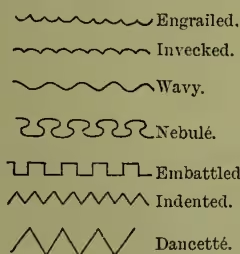
Irregular Partition Lines.
Partition-lines are not always straight. Fig. VI. represents the commonest forms of irregular partition-lines in this form. Dancetté differs from indented by the partition-line having larger and fewer indentations.
Common Charges.—These are representations, more or less conventional, of familiar objects. The knights, in the early days of heraldry, ransacked the animal and vegetable kingdom and the whole range of objects, natural and artificial, for charges that would be distinctive; of which only a few of the most frequent, and those whose nomenclature or treatment is somewhat technical, can be here noticed.
Of beasts which occur in coat-armour, the most important, both in earlier and in later heraldry, is the Lion. Its earliest known occurrence is on the seal of Philip I., Duke of Flanders, in 1164; and before long the king of beasts was borne by a large number of the potentates of Europe. The lion is made to assume a variety of positions, a few of which are represented in fig. VII. Its original and normal attitude is rampant (1)—i.e. in an erect position with the left hind-leg resting on the ground, the head in profile, and the tail elevated over the back. Rampant gardant (2), the same with the head affrontée (looking out of the shield); regardant (3), the same looking backwards. Passant (4), walking, three paws resting on the ground, the dexter forepaw elevated, the head in profile looking forward, and tail elevated over the back; passant gardant (5), as the last, but with the head affrontée. A lion salient (6) has both hind-legs on the ground, and the fore-legs elevated, as if to spring; and a lion sejant (7) is rising to prepare for action. The lion passant gardant is often blazoned as the lion of England; and in times when terms of blazonry were comparatively few, it was known as the leopard; there has, in fact, been much controversy as to whether the animals in the escutcheon of England are lions or leopards. Two-headed, bi-corporate, and tri-corporate lions occur in heraldry, as also lion-drags and lion-poissons. There is likewise the celebrated winged lion of St Mark adopted by the republic of Venice, and the two-tailed lion of Bohemia and of Simon de Montfort, Earl of Leicester. In British heraldry lions and other animals always face to dexter unless otherwise blazoned. Two lions placed face to face are called combatant, and back to back, addossé. Some of the above-mentioned names for the attitudes of the lion are applied to other heraldic animals. Lions and other beasts of prey are said to be armed or langued of any tincture, when their teeth and claws or their tongue are of that tincture, and in modern English blazon a lion is always presumed to be armed and langued gules unless either himself or the field be gules, in either of which cases he is armed and langued azure. A demi-lion (8) is the upper half of the body of a lion with the extremity of his tufted tail. Lions are often crowned, or gorged (collared) with a crown of some sort. Bears, bulls, boars, stags, goats, dogs, foxes, horses, and hedgehogs, and occasionally elephants, camels, moles, apes, bats, and mice occur as heraldic animals. A stag when in easy motion is said to be trippant (9); he is at gaze (10) when a lion would be statant gardant, and he is attired of any tincture when his attires—i.e. his antlers, are of that tincture. Animals that possess horns and hoofs are said to be armed and unguled in respect of them. The heads and limbs of animals are often borne as charges, and may be either erased, like the lion's head (11)—i.e. cut off with a jagged edge; or couped (12)—i.e. cut straight off. A leopard's face (13) shows none of the neck, and fronts the spectator. A stag's head borne full faced, with none of the neck seen, is said to be cabossed (14). Boars' heads (15) are not unfrequent, and bears' heads (16), which are usually represented muzzled. Animals in heraldry sometimes assume a conventional form differing widely from the realistic type of the same creature—e.g. the antelope, which has a stag's head, a unicorn's tail, a tusk issuing from the tip of the nose, a row of tufts down the back of the neck, and similar tufts on the tail, chest, and thighs.
Among birds, far the most prominent is the Eagle (q.v.), most commonly represented in the conventional attitude known as displayed (17), with wings expanded. Being the king of birds, it became, next to the lion, the most favourite bearing of royal personages, and was adopted by the German emperors. The imperial eagle had at first but one head; the two-headed eagle (18) appeared in the middle of the 13th century, and occasionally occurs in English heraldry. The allerton and martlet, originally an eagle and a swallow respectively, became in time unreal birds, the one without claws or beak, the other without legs or beak. The falcon, the pelican, the swan, the cock, the raven, the ostrich, the heron, and the parrot or papingoe are all armorial birds. The pelican is generally depicted pecking her breast, and when represented in her nest feeding her young with her blood, she is said to be in her piety (19). A peacock borne affrontée with his tail expanded is said to be in his pride. Birds having the power of flight are, in respect of their attitude, close, rising, or volant.
Fishes and reptiles occur as charges; the former are said to be naiant, if drawn in a horizontal, and hauriant (20), if drawn in a vertical position.
The dolphin, whom naturalists do not acknowledge as a fish, is in heraldry the king of fish, and is very conventionally drawn most usually embowed (21)—i.e. with the body bent. It is best known in this attitude as the allusive bearing of the dauphin. The escallop shell (22) is a favourite charge, having been the pilgrim's ensign in crusading times. Serpents occur in various attitudes, bowed, erect, &c., and in one famous instance (the coat of the Visconti) vorant (devouring) a child (23).
Of purely fantastic animals, we have the dragon, griffin, wyvern, cockatrice, unicorn, mermaid, and others.
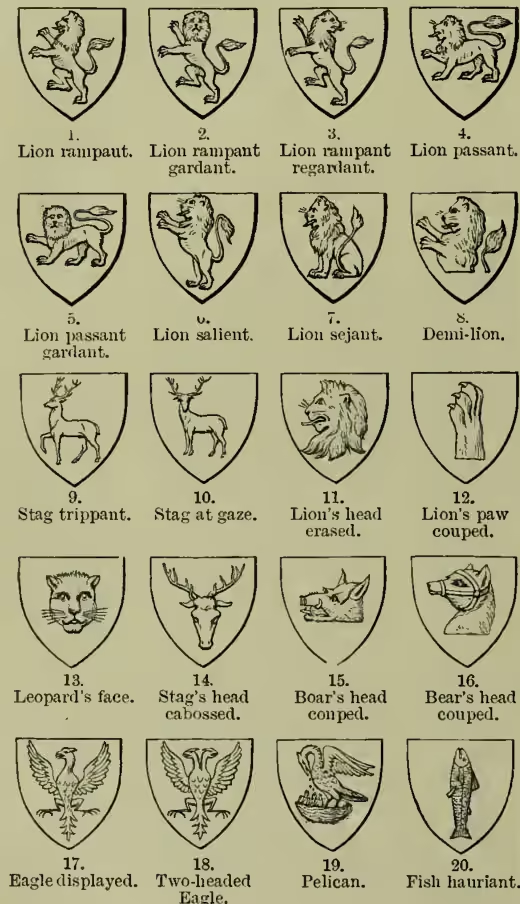
Man in whole and in his parts also occurs in armory. Argent, a naked man proper, is the coat of the Scottish family of Dalzell, and we have Moors' (generally represented as blackamoors) heads, Saracens' heads, men's hearts, arms, legs, and hands, also that strange heraldic freak, the three legs conjoined (24), carried in the escutcheon of the Isle of Man.
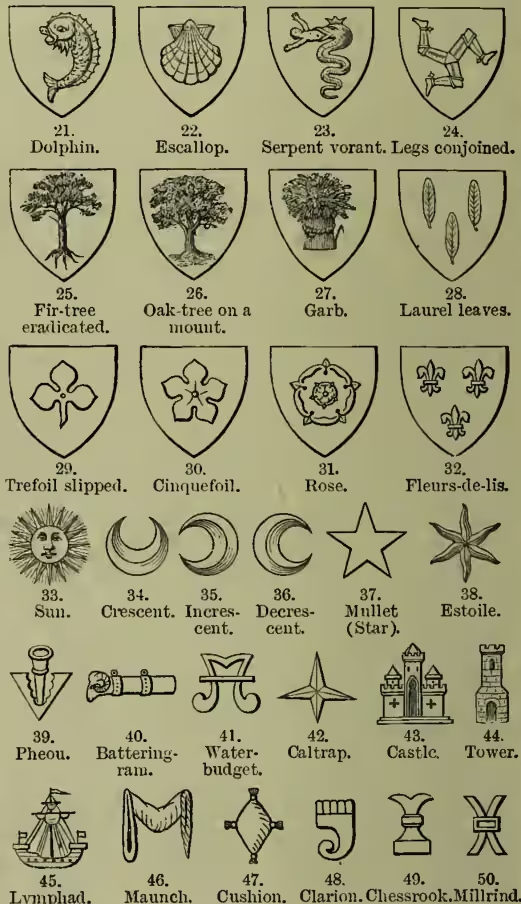
To pass to the vegetable kingdom, trees, plants, leaves, and flowers are all usual heraldic charges. Trees are often eradicated (25), or torn up by the roots, sometimes placed on a mount (26), and occasionally fructuated of a different tincture. Garbs (27), representing sheaves of wheat, are well known as the arms of the Earls of Chester, of the Grosvenors, and of the Scottish family of Cumyn. Leaves, as of the laurel, are often borne, like many other charges, in threes (28). A trefoil, with three leaflets and a stalk, is said to be slipped (29); in the quatrefoil and cinquefoil (30) the syllable foil means a petal. The rose (31) has obtained a prominence in English heraldry from having been the badge of the rival houses of York and Lancaster, and in the conventional representations of it, it has five petals, barbs between them to represent the calyx, and seeds in the centre. It is generally without a stalk, its tincture being either gules or argent, and it is usually barbed and seeded proper—i.e. the barbs are green, and stamina yellow or gold. But of the floral devices of heraldry the most famous is the fleur-de-lis, generally identified with the iris, adopted as a badge by Louis VII. of France in 1150, and borne by his son in the form of semé of fleurs-de-lis (9, fig. V.), which became the royal coat of France, till the flowers were reduced to three in number in the reign of Charles VI. (32).
Such charges as swords, scimitars, bows, arrows, helmets, battle-axes, horseshoes, mitres, crossiers, &c. explain themselves. The sun surrounded by rays is said to be in his splendour, and generally has a human face (33). A crescent (34), representing the moon, has both horns pointed upwards. If the horns are turned to dexter it is called an increment (35); if to the sinister a decrement (36). The five-pointed star (37), in the heraldry both of the Continent and of Scotland, represents the heavenly body so called, though not distinguishable from the mullet or spur-rowel, except that the latter is sometimes pierced. In modern English heraldry this figure is always styled a mullet, and the estoire (38) or star has six or more wavy points. A pheon (39) is the head of a dart barbed and engrailed on the inner side. A battering-ram (40) is furnished with an actual ram's head. A water-budget (41) represents the bags in which water was stored up and carried across the desert in crusading times. Caltraps (see CALTROP) or chevaltraps (42) are military instruments for galling the feet of horses. Castles (43) and towers (44) are not unfrequent, the former very generally triple-towered. An ancient one-masted galley, called a lymphad (45), is characteristic of the West Highlands of Scotland. Of charges derived from dress one of the most remarkable is the maunch (46), a 12th-century sleeve, borne by the Hastings family. Cushions (47) have become famous in Scotland from being borne by Bruce's gallant nephew, Randolph or Ranulph, Earl of Moray, and his descendants. The clavon (48) or war-trump is an early English bearing. The chessrook (49) or castle in chess is somewhat conventionally drawn. The millbind (50) is the iron affixed to the centre of the millstone.
Like medieval architecture, heraldry attained its greatest beauty and purity in the 13th century and first half of the 14th. From that date its early simplicity was gradually departed from: a variety of charges came to be accumulated in one shield, and there was a growing tendency to pictorialism. Trees are represented issuing out of a mount or little green hillock in base (26), and we have also animals walking on a base—i.e. a line cutting off the lower part of the shield. In Wales we have combinations such as a cradle with a child under a tree guarded by a goat, and sometimes in Spain and Italy two animals rampant against a tree, or such scenes as a bloodhound in the act of strangling a boar, or a serpent vorant a child (23). In the second half of the 18th century the heraldry of England entered on a singularly degraded and debased stage, far beyond the pictorialisms alluded to, shields being loaded with representations of sea-fights, fortresses, and landscapes, with medals and decorations granted to the bearer of them, setting all heraldic conventionalities at defiance, and dealing in details hardly discernible on the closest inspection. Such charges were habitually granted by way of chiefs of augmentation to the heroes of the old wars. It is to be hoped that the revival of a measure of taste in coat-armour has put an end to them for ever.
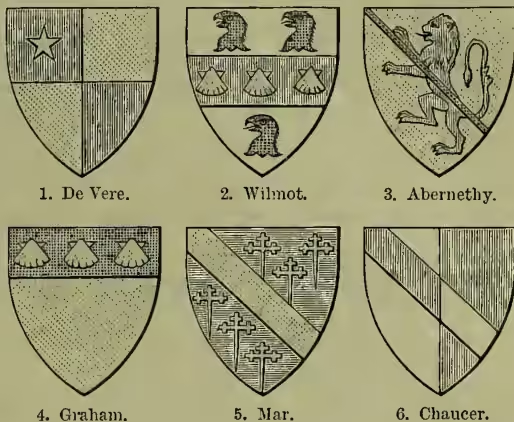
Blazonry.—To blazon a coat-of-arms is to describe it in words so precise as to enable any one who has an ordinary knowledge of heraldry to depict it correctly. The following are the principal rules of blazonry. The field must first be named; it may be of one tincture, or an arrangement of more than one (see ante—Parted Fields). The charges follow, beginning with those of most importance and nearest the field, their name, number, position, and tincture. An ordinary or a diminutive of an ordinary, except it be a chief, bordure, or canton, generally claims the precedence. When the principal charge is not in the centre of the shield, its position must be described, as De Vere, Earl of Oxford (fig. VIII. 1), quarterly gules and or, in the first quarter a star (mullet) argent. When two or three of the same charge occur, it is understood, unless otherwise specified, that two are placed in pale—i.e. one over the other; and three are disposed, two above and one below; and it is also understood that in case of a fess or a bend between six charges of the same kind, there are three in chief and three in base. In other cases the disposition of the charges must be specified, as in bend, in cross, in saltire, in orle; three, two, and one: four, three, two, and one, &c. If the ordinary, which is the principal charge, be itself charged, and there are also other charges in the field, the order of the words of blazon will be understood by the following example—Wilmot, Earl of Rochester (2), argent, on a fess gules, between three eagles' heads erased sable, as many escallops or. An exception to the rule that an ordinary or its diminutive is first named, occurs where it deburises or surmounts another charge—e.g. Abernethy (3), or, a lion rampant gules, surmounted by a ribbon sable. Generally speaking, a chief, bordure, or canton is mentioned last. When a bordure surrounds a chief, the bordure is named last of all, the reverse being the case when the chief covers the bordure. A bend may surmount a chief, in which case it is mentioned last.
Avoidance of repetition is one of the principles of blazonry. When any tincture has to be repeated, it is on the second occasion described as of the first, of the second, of the last, or of the field—e.g. Graham (4), or, on a chief sable, three escallops or of the field. Repetition may also be avoided by naming the tincture only the second time—e.g. Mar (5), azure, a bend between six crosslets fitchée or, where the tincture or applies to both bend and crosslets.
When the field is of a metal and colour separated by any of the lines of partition, and the charge on it is said to be counterchanged, this means that the part of the charge which is on the metal is of the colour, and vice versa, as in the coat borne by the poet Chaucer (6), per pale, argent and gules, a bend counterchanged.
Differencing.—With the advance of the science of arms it became necessary not only to distinguish different families, but to distinguish the different members and branches of a family from each other and from their chief. The head of the house had alone the right to use the pure paternal coat; the cadets had to wear it with a brisure or differnce. There is great variety in the early brisures. A change of tincture, the substitution of one ordinary for another, the deburising of the paternal coat by a bend, the surrounding the arms with a bordure, uncharged or charged, and the addition of part of the coat of an heiress, were all in use as modes of differencing. The differenced coat became an independent heraldic composition, sufficiently like the original arms to indicate the family to which its owner belonged, and also often suggestive of events in the history of the cadet line.
The name of marks of cadency has been given to certain small figures which, by a conventional arrangement, indicate the order of descent of the different sons of a family. As systematised about the reign of Henry VII., and in use in modern English heraldry, the marks of cadency are, the label (1, fig. IX.) for the eldest son, the crescent (2) for the second, the mullet (3) for the third, the martlet (4) for the fourth, the annulet (5) for the fifth, the fleur-de-lis (6) for the sixth, the rose for the seventh, the cross moline for the eighth, and the octofoil for the ninth. The difficulties are obvious of carrying out a system of this kind through all the ramifications of a family for successive generations, even by such devices as charging a crescent with a mullet for the third son of a second son, &c., and the consequence of the supercession in England of all other differences by these figures has been that differencing is much neglected, and remote cadets are often found bearing the arms of the head of their house undifferenced. With the sons and daughters of the royal house of the United Kingdom another usage prevails. They all bear their arms differenced by a label of three points argent. That of the Prince of Wales is plain, those of the younger princes are variously charged.
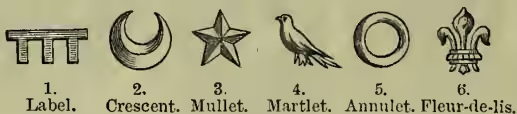
The label of the Duke of Edinburgh is charged with a St George's cross in the centre point, and in each of the other points with an anchor azure. The Duke of Connaught substitutes for the anchor a fleur-de-lis azure, and the Duke of Cambridge two hearts in pale gules.
In Scotland, owing perhaps to the wider ramification of the principal feudal families, differencing has been considered of more moment, and is the subject of a separate treatise by the Scottish herald Nisbet. The modern marks of cadency are less in use. The modification of the paternal coat by an additional charge, the engrailing, invecking, &c., of a chief or a partition-line has never fallen out of use. Differencing by a bordure has also been much in favour, a plain bordure of the tincture of the principal charge in the case of a second son, which may be engrailed, invecked, wavy, &c., for cadets branching off in the same generation, and for sub-cadets, parted in different ways, or charged with figures from the maternal coat. With cadets of a later generation the bordures will be of a different colour. Some such system, more or less rigidly observed, runs through the differencing of Scottish coats, which is under the direct supervision of the Lyon Office. For difference designed to illegitimate children, see BATON-SINISTER.
Marshalling of Arms.—Marshalling is the proper arrangement of such coats as are to be combined in one shield. In the earlier heraldry it was not the practice to exhibit more coats than one on a shield, but the arms of husband and wife were sometimes placed accollée, or side by side in separate escutcheons; or the principal shield was surrounded by smaller ones, containing the arms of maternal ancestors; and we not unfrequently find maternal descent or marriage indicated by the addition of some bearing from the wife's or mother's shield. Then followed dimidiation, when the shield was parted per pale, and the two coats placed side by side, half of each being shown. By the more modern practice of impaling (1, fig. X.), the whole of each coat is exhibited, a reminiscence, however, of the older practice being retained in the omission of bordures, and occasionally treasures, on the side bounded by the line of impalement. The most common case of impalement in English heraldry is where the coats of husband and wife are conjoined, the husband's arms occupying the dexter side of the shield, or place of honour, and the wife's the sinister side, the impaled coat being personal, and non-descending to the children.
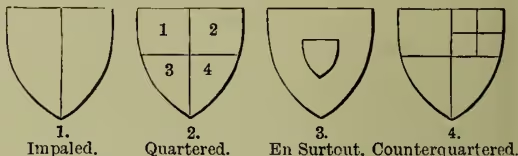
The arms of states are sometimes impaled, as were those of England and Scotland in the first and fourth quarters of the achievement of Great Britain from the accession of Queen Anne to the Irish Union. Bishops, deans, heads of colleges, and kings-of-arms impale their arms of office with their family coat, giving the dexter side to the former. This practice in Scotland, as far as bishops are concerned, belongs only to the post-Restoration episcopacy, as the Scottish sees had no arms till then.
The husband of an heiress (in the heraldic sense) is entitled, according to the more modern usage of British heraldry, to place her arms on a small shield, called an escutcheon of pretence, in the centre of his shield, instead of impaling, and in the next generation the arms of the heiress are transferred to one of the quarters of the shield. The escutcheon of pretence is, however, not to be confounded with a small shield of the same kind, called an escutcheon en surtout (3), much in use in German, French, and Scottish heraldry, which takes a permanent place in the achievement, and may contain either the paternal arms (as in the Tweeddale branch of the Hay family), some feudal coat, or the coat of an heiress in some past generation, whose memory it has been thought desirable to preserve. It has been the practice for an elected king to place his arms in an escutcheon en surtout, the old German emperors placing their family arms on the breast of the imperial eagle.
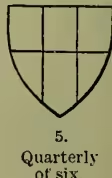
Quartering, or the exhibiting of different coats on a shield divided both horizontally and vertically, originated in the 13th century, but was little practised till the 14th. The divisions of the shield are called quarters, and are numbered horizontally, beginning at the dexter chief (2). Arms are quartered on various accounts: (a) To indicate dominion. A sovereign quarters the ensigns of his different states. On the tomb in Westminster Abbey of Eleanor, daughter of Ferdinand III., king of Castile and Leon, and first wife of Edward I., is the paternal shield of that princess, in which the castle of Castile occupied the first and fourth quarter, and the lion of Leon the second and third. The received rule regarding the quartering of the ensigns of different states is that precedence is given to the most ancient, unless it be of inferior importance. The kings of England, owing to their supposed claim to the French throne, long bore France in the first and fourth quarter, and England in the second and third. In the arms of the United Kingdom, as now borne, England occupies the first and fourth quarter, Scotland the second, and Ireland the third—the relative positions, however, of England and Scotland being reversed on the official seals of Scotland. Feudal arms are sometimes quartered by subjects. Some of the peers of Scotland bear arms of this description. (b) Arms of augmentation or special concession accorded to a subject by his sovereign by way of honour, are sometimes granted to be borne quarterly with the paternal coat. These sometimes include a portion of the royal insignia, and have precedence of the paternal coat. (c) The most usual reason for quartering is to indicate descent from an heiress who has married into the family. Where there is but one heiress, her coat occupies the second and third quarters of the shield, and the paternal arms the first and fourth. When there are more than one, they are marshalled in the successive quarters in the order of the intermarriages. Where more than four coats have to be marshalled, the number of vertical lines is increased, and the divisions, though more than four, are still called quarters (5). Where there is an odd number of coats, the last quarter is usually filled up by repeating the first. One of the quarters may itself be quartered, when the heiress was entitled to bear a quartered coat; the shield is then said to be counterquartered (4), and its primary quarters are called grand quarters. In the course of generations a shield may thus sometimes be inconveniently crowded by the accumulation of coats, including the coats to which each heiress may, in a similar way, have become entitled; and in Germany sometimes above twenty coats (generally coats of dominion) are found marshalled in one escutcheon; but, in British heraldry, families entitled to a number of quarterings usually select some of the most important. A quartered coat may be surrounded by a bordure (for difference), in which case it is treated as one coat.
In the heraldry of the Highlands of Scotland, which is not older than the 16th century, a system of quartering prevailed quite irrespective of family alliance, the quarters being changed under different modifications, with figures partly borrowed from the old monumental sculpture of the country, including the eagle, the fish, the hand with the red cross, and the one-masted galley of Lorne.
The expression 'quarterings' is sometimes loosely used for descents in cases where there is no right to quarter from representation. The eight or sixteen quarterings which in former days were on the Continent essential for the holder of nearly every public office, which were, till lately, often found ranged round the Scottish funeral escutcheon, and which are still important for many purposes in Germany and Austria, have no reference to representation, but imply purity of blood for four or five generations—i.e. that the father and mother, the two grandmothers, the four great-grandmothers, and also, in the case of sixteen quarterings, the eight great-great-grandmothers, have all been entitled to coat-armour.
Other modes of marshalling are in use on the Continent, as the division of a shield per saltire, or into three parts. The marshalling of a coat en pointe, or on a triangular figure issuing from the base of the shield, used to be familiar from the escutcheon of Hanover, borne first in the fourth quarter of our royal achievement, and afterwards en surtout, where we have Brunswick impaled with Lüneburg, Saxony in base, and over all the crown of Charlemagne, as belonging to the office of arch-treasurer of the empire.
External Ornaments.—Over and above the shield of arms there are certain accessories in use to be represented along with it, and which together with it constitute an achievement of arms. These include the helmet, the crest, the motto, the mantling, the supporters, and the crown or coronet.
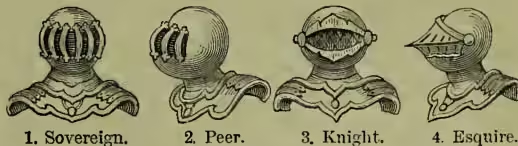
Before the beginning of the 14th century a helmet began to be placed above shields of arms, the shield being represented in the position called couchée—i.e. suspended from the sinister chief angle. After the couchée attitude was abandoned, the helmet resting on the shield began to vary according to the rank of the bearer, the forms adopted being both unbecoming and fanciful. The following are the forms in use in modern British heraldry: (1) that assigned to the sovereign and royal family, which is full faced, of gold, lined with crimson, and with the visor divided by six projecting bars; (2) the helmet of peers, exhibited in profile, with five bars, of which three or four are shown. The helmets of dukes and marquises are entirely of gold, those of earls, viscounts, and barons of steel, with the bars of gold; (3) the helmet of baronets and knights, of steel, full faced, with the visor thrown back, and without bars; (4) the helmet of esquires and gentlemen, in profile, of steel, and with the visor closed. A helmet is never placed over the arms of any woman except the sovereign.
The Crest (q.v.) is an ornament of the head rising above the helmet. Crests first appear occasionally on seals and monuments of the 13th century, the earliest being a radiant ornament somewhat like a displayed fan. Originally a special mark of honour worn by heroes of great valour or holding a high military command, the crest became eventually, in English heraldry at least, an inseparable adjunct of the coat-of-arms. An extraordinary number of crests are sometimes accumulated in German achievements, each on its separate helmet. In our modern heraldry the crest is generally placed on a wreath of two pieces of silk of the livery colours—i.e. the first metal and first colour of the shield, but occasionally on a cap of maintenance or a ducal coronet. In the achievement of the sovereign the helmet is placed immediately above the shield, the crown rests on the helmet, and the royal crest rises from the crown. In the achievements of peers, on the other hand, the helmet rises from the coronet, which is placed immediately over the shield.
The motto is placed within an escrol either over the crest or below the shield. It bears in many cases an allusion to the family name or arms, or to the crest.
The mantling or lambrequin is an appendage hanging down from the helmet and passing behind the escutcheon. It is considered to be derived either from the contoise, an ornamental scarf represented in seals and monuments of the 13th and 14th centuries, or from the military mantle or robe of estate. Its comparatively irregular shape in more modern instances has been explained as indicative of the tattered condition to which it has been reduced in the field of battle. Tassels are sometimes appended, and when treated as a robe of estate the bearings of the shield are occasionally repeated on it. In British heraldry the mantling of the sovereign is of gold, lined with ermine; that of peers of crimson velvet, lined with ermine. Knights and gentlemen have either the livery colours of the shield, or, as the practice is in Scotland, crimson velvet lined with silver.
The Crown (q.v.), Coronet (q.v.), and Mitre (q.v.) are adjuncts to the shields of those whose dignity or office entitles them to be thus distinguished.
Supporters.—These figures placed on each side of an armorial shield, as it were to support it, were at first purely decorative, generally, however, having allusion to the arms or descent of the bearer; but they soon came to be considered indicative of his being the head of a family of eminence or distinction. The most usual supporters are animals, real or fabulous; but men in armour are not unfrequent, as also naked men or savages, often carrying clubs, and wreathed about the head and middle. On early seals a single supporter occasionally occurs, and there are instances of the escutcheon being placed on the breast of an eagle displayed. The dexter and sinister supporters are often, and almost always in continental heraldry, alike. In British heraldry, however, the two supporters are in many cases different; and where the bearer represents two families, a supporter is sometimes adopted from the achievement of each. The rules restricting the right to supporters are different in different countries. In England their use is confined to the royal family, peers, knights of the Garter, and knights Grand Cross of the Bath (with the last the right does not transmit to descendants), the heads of a very few families out of the peerage, who derive their right from an old patent or early usage, and the chief mercantile companies of London. In Scotland the right extends to the chiefs of important clans, and the representatives of minor barons who had full baronial rights prior to 1587, the date of the act which finally excluded the minor barons from parliament. Baronets of Nova Scotia have as such no right to supporters, though many of them bear them in respect of their baronial qualifications. It is considered to be in the power of the Scottish King-of-arms to confer them ex gratia, a right which has been sparingly exercised, except for the period between 1790 and 1820.
Any collar and badge of an order to which the bearer may have a right forms properly a part of his achievement, the collar surrounding his shield, and the badge being suspended from it. The badge of Nova Scotia is suspended by an orange-tawny ribbon from the shield of baronets of Scotland; and other baronets have the arms of Ulster in a canton or an inescutcheon (see BARONET). Certain officers of state accompany their shields with marks of their rank. The Duke of Norfolk as Earl Marshal places saltirewise, behind his shield two truncheons, tipped above with the arms of England and below with his own arms. The Lord Justice-general of Scotland in like manner places two swords saltirewise behind his shield.
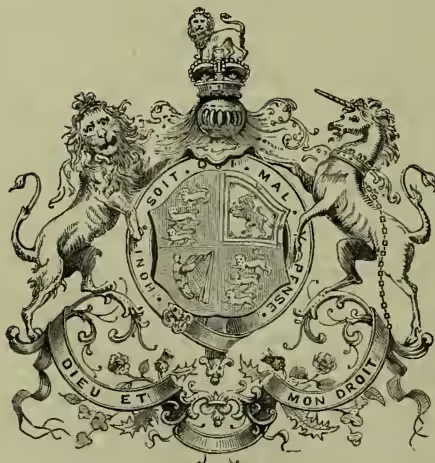
The full achievement of the sovereign of the United Kingdom of Great Britain and Ireland is shown in fig. XII. Its full blazon is: Quarterly, first and fourth gules, three lions passant gardant in pale, or, for England; second, or, a lion rampant within a double tressure flory-counterflory gules, for Scotland; third, azure, a harp or, stringed argent, for Ireland; all surrounded by the Garter. Crest.—Upon the royal helmet, the imperial crown proper, thereon a lion statant gardant or, imperially crowned proper. Supporters.—Dexter, a lion rampant gardant or, crowned as the crest. Sinister, a unicorn argent, armed, crined, and unguled proper, gorged with a coronet composed of crosses patée and fleurs-de-lis, a chain affixed thereto passing between the fore-legs, and reflexed over the back, also or. Motto.—‘Dieu et mon Droit,’ in the compartment below the shield, with the Union rose, shamrock, and thistle engrafted on the same stem.
This article may appropriately conclude with a short account of the various ways in which the royal arms of England, Great Britain, and the United Kingdom have been borne. The Great Seal of Richard Cœur-de-Lion, made after his return from the third crusade, had the three lions passant gardant (or leopards) in pale, as they have ever since been depicted. In 1340 Edward III., in virtue of the supposed right of his mother, assumed the title of king of France, and quartered the arms of France (azure, semé of fleurs-de-lis or) with those of England, giving the precedence to the former. Richard II. sometimes bore the reputed arms of Edward the Confessor (azure, a cross flory between five martlets or) impaled with his quartered coat, giving the former the precedence. In conformity with the practice in France, the fleurs-de-lis were in the later part of the reign of Henry IV. reduced to three in number. No further change took place in the royal escutcheon until the time of James I., except that Mary, on her second Great Seal, made after her marriage with Philip II., impaled the arms of Spain and England.
James VI. of Scotland, on succeeding to the throne of England as James I., quartered the arms borne by preceding sovereigns with those of Scotland and Ireland, the first and fourth quarters being counterquartered France and England, the second quarter being the lion rampant of Scotland; the third, the harp of Ireland. The royal arms were borne similarly by all the sovereigns of the House of Stuart until the reign of Anne, except that William III. bore en surtout the coat of Nassau: azure, semé of billets, a lion rampant or. In the reign of Anne the legislative union with Scotland brought about a further change; England impaled with Scotland was placed in the first and fourth quarter, France in the second, and Ireland in the third. The accession of George I. displaced England and Scotland from the fourth quarter, to make way for the arms of Hanover (see ante—Quartering). In 1801 George III. laid aside the titular assumption of king of France, and abandoned the French fleurs-de-lis. The arms of England were now made to occupy the first and fourth quarter, Scotland the second, and Ireland the third, while the arms of Hanover were placed en surtout. These last were finally abandoned on the severance of Hanover at the accession of Queen Victoria, when the royal escutcheon assumed its present arrangement.
The lion passant (or statant) gardant as the crest of England first appears on the Great Seal of Edward III. The supporters borne in former times by the kings of England varied much, particularly during the early period when these appendages of the shield were invested with more of a decorative than an armorial character, and perhaps often left to the fancy of the engraver. When the arms of any of the English sovereigns from Richard II. to Edward IV. are represented with supporters, the animals chosen are almost indifferently lions, antelopes, or white harts, and occasionally their place is supplied by angels. Edward IV.’s shield is sometimes supported on one side by a black bull, and that of Richard III. in one instance by white boars. During the reigns of Henry VII., Henry VIII., Edward VI., Mary, and Elizabeth, the lion, red dragon, and greyhound were the animals most in vogue; the herald or engraver generally choosing as it suited him two out of the three. James I. for the first time clearly defined the royal supporters, adopting the lion of England and unicorn of Scotland as they have ever since been borne.
At the union of 1603 a different mode of marshalling from what has been described was allowed in Scotland, the arms of that kingdom occupying the first and fourth quarter, and England being relegated to the second. The Act of Union of 1707 contains no provision for the continuance of a special mode of marshalling for Scotland; but the various official seals of Scotland have uniformly reversed the places of England and Scotland, giving precedence to the latter. The royal arms, as borne in Scotland, are also in use to be encircled with the collar of the Thistle outside the Garter. The Scottish crest takes the place of the English, and the unicorn supporter takes precedence of the lion, the former being crowned and gorged with an antique crown.
The full blazon of the old royal arms of Scotland is as follows: Or, a lion rampant gules, armed and langued azure, within a double tressure flory-counterflory of fleurs-de-lis of the second. Supporters.—Two unicorns argent, imperially crowned, armed, crined, and unguled or, gorged with open crowns, with chains affixed thereto, and reflexed over the back, of the last. Crest.—Upon the imperial crown proper, a lion sejant affrontée gules, crowned or, holding in the dexter paw a sword, and in the sinister a sceptre, both proper. Mottoes.—‘Nemo me impune lacessit,’ and, over the crest, ‘In Defence.’
Among standard works on heraldry are Guillim’s Display of Heraldry (editions of 1610 and 1724); Edmonson’s Complete Body of Heraldry (1780); Sir George Mackenzie’s Science of Heraldry treated as part of the Civil Law and Law of Nations (1680); Nisbet’s System of Heraldry (1722–43; reprinted 1810); De la Colombière’s Science Héroïque (1669); various French treatises of Ménestrier (1671–80); Spener’s Opus Heraldicum (1690); and the Nürnberger Wappenbuch. Among modern treatises: Planché’s Pursuivant of Arms; Montagu’s Heraldry; Boutell’s Heraldry, Historical and Practical (1864); Seton’s Heraldry in Scotland (1863); Burke’s General Armory; Bouton’s Traité de Blazon (1863); Rielstap’s Armorial Général (Gouda, 1884); L’Art Héraldique, by Gourdon de Genouillac (1889); F. E. Hulme’s Heraldry (1891); and A Treatise on Heraldry, British and Foreign, by the Rev. J. Woodward and the writer of this article (2 vols. 1892).