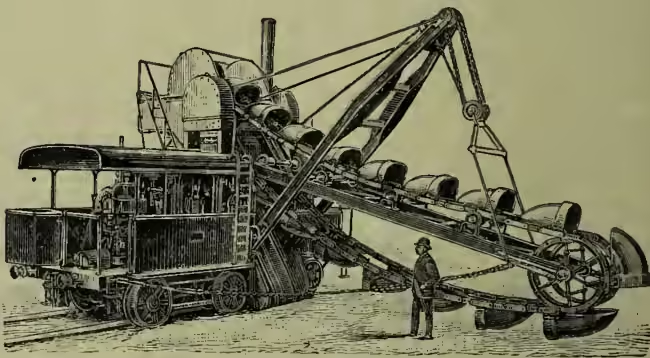
Excavators. These machines have been brought into use in the making of docks, railway-cuttings, canals, &c. Excavators are made of two kinds, each adapted for different kinds of work, although in some cases they work together very effectively. In making a long 'gullet' or cutting, the first to come into operation has the appearance and all the functions of the ordinary steam-crane, such as is used for loading railway trucks, with the exception that it is mounted on wheels to move on rails, and that, instead of the hook on the end of the chain, there is a large and strong plate-iron bucket or 'scoop,' with a very heavy handle or lever to which a second chain is fastened. The lever is heavy enough to counterbalance the scoop when filled with clay. The machine begins by lowering the scoop, and the two chains are made to push it into the bank until it is full. The suspension chain then lifts the scoop over the wagon, while the chain on the handle lifting it up empties it. The machine now swings round on its centre to renew the operation. The largest size can excavate two cubic yards per minute. As the excavator advances over its rails, those behind are brought to the front. The cutting is made as wide as the arm or 'jib' will reach on both sides of it, which leaves sufficient room for the men to work round it freely, and for wagons to pass. When the cutting has been made the requisite distance forward, the second class of excavator (shown in the engraving) is brought forward to make the cutting wider. The original conception of this is clearly derived from the Dredging-machine (q.v.), which has long been in use in deepening harbours and the mouths of rivers. Its sides are made sloping to an angle of 45 degrees, and on the top of the bank a temporary line of rails is laid a few feet from the edge. The machine is placed on the rails at the end of the cutting; the jib is lowered until the row of buckets it carries can cut into the clay; these scrape up the bank, reaching the top of it full of soil; they next pass over the machine, and are emptied into the wagons beyond it. The excavator and wagons move forward simultaneously, the latter receiving, in the case of some excavators, a continuous stream of clay equal to about four cubic yards, or two wagon-loads per minute. It will be evident from the foregoing explanation that the first kind of machine is best adapted for docks, and preparing the way in long and deep cuttings for the second kind to follow. It may be said that the first will perform a greater variety of operations, while the second cannot be surpassed in the quantity of material it will remove in a given time. All the movements of excavators are effected by the power of the engine, and two men manage each machine.