Fire. Countless stories of fireless men have been retailed by credulous travellers, and there is hardly a primitive mythology which has not woven a web of fable round its origin; not seldom it is ascribed to a special theft from the gods by some greatly daring hero, like the Greek Prometheus or the New Zealand Maui. As far as actual knowledge goes we find that the possession of fire and the art of making it by one method or other have belonged to the vast majority of mankind as far back as we can trace. The original method of finding fire was undoubtedly by the simple friction of two pieces of wood, which was developed by progressive art into more complex and convenient methods. One of the simplest methods in use is what Mr Tylor terms the 'stick-and-groove,' in which a blunt-pointed stick is run along a groove of its own making in a piece of wood lying on the ground. By this means a Tahitian can produce fire in a few seconds. Somewhat similar is the Malay process of striking fire by rubbing together two pieces of split bamboo, which has been conveniently fitted by nature with a siliceous coating. Again, the most widespread method is that to which Tylor applies the term 'fire-drill'—a primitive kind of boring instrument, thus described by Captain Cook from his observations of the native Australians: 'They take two pieces of dry soft wood; one is a stick about eight or nine inches long, the other piece is flat: the stick they shape into an obtuse point at one end, and pressing it upon the other, turn it nimbly by holding it between both their hands, as we do a chocolate-mill, often shifting their hands up, and then moving them down upon it, to increase the pressure as much as possible.' Many improvements upon this simple method are found, as that on the principle of the carpenter's brace used by the Gauchos of the South American pampas; the Eskimo method of winding a cord round the drill, so as by pulling the two ends alternately to make it revolve very rapidly; the Sioux bow-drill, in which a bow with a loose cord is substituted for a simple cord; and the pump-drill, familiar in English tool-shops, and used by the Iroquois to generate fire. The Fuegians strike sparks with a flint from a piece of iron pyrites (Gr. pyr, 'fire') upon their tinder—a use which the etymology of the word shows to have been known to the ancients. The flint and steel must have come into use soon after the beginning of the iron age, but its origin in the civilised world is wrapped in the mists of antiquity. Among savage peoples it has made its way along with iron, but has often failed to supersede the fire-sticks. The use of the burning-lens to generate fire was known to the Greeks, and we are told by Plutarch was the method of solemnly reviving the sacred fire at Rome. The last phase of fire-making—by lucifer matches—is fast making even the fire-sticks of the South African savage mere curious relics of the past. A strange survival of the ancient methods is the fire-churning still used in India for kindling the sacrificial fire, and the kindling by wild-fire alone of the English need-fire and German Nothfeuer, through which cattle were driven to avert pestilence down to the 19th century, in spite of the constant opposition of the clergy. The Easter and Mid-summer-eve bonfires, so closely connected with ancient sun-worship, were tolerated and even adopted by the church, but the need-fire was disallowed by Rome; while in Russia, on the contrary, it seems to have been practised under the direct sanction of the parish priests.
The religious history of fire is even more obscure than the history of its production, although everywhere we find that a rich mythology has gathered round the subject. Like all the chief manifestations of natural forces, fire was early personified and worshipped, and we see a similar process of personification and divinisation in the names of the first fire-givers—the Greek Prometheus, the pra-mantha of the early Aryans, and in his Chinese parallel Suy-jin. The god of fire possesses generally capricious and variable qualities, as in Loki; now severe and cruel like Moloch and Xiuhtecutli; now beneficent like Hestia, Agni, Atar, Ptah, and Baal Hamman. We find among the Greeks, the Phoenicians, the Egyptians, Slavs, and Mexicans the co-existence of several fire-gods who personify respectively the diverse functions of fire; in the Vedas, on the contrary, we have the notion of the identity of Agni alike in the fire, the sun, and the lightning. Again, the essential identity between life, and fire visible in the sky but latent in everything, is an elemental idea among Romans, Hindus, Persians, Slavs, and Red Indians alike. The phenomena of generation are assimilated to the production of fire, whence fire becomes regarded as the author of life, and its worship is appropriately associated with phallic rites. The human soul is of the nature of fire; and fire, the common element of gods and of their creatures, of beings and things, becomes the soul of the universe, and plays a cosmic rôle as universal creator—a conception as akin to the philosophic mind of Zeno as to the primitive worshippers of Ptah and Agni.
Fire has ever been regarded as the great purifying element par excellence, not so much from its devouring properties and its incorruptibility as from its power as the dispeller of the demons of darkness. Hence the universality of belief in its power over evil spirits, and the use of lighting fires upon tombs, as well as of ordeals by fire—a pure agent which cannot harm the innocent. Fire puts to flight specially the spirits which cause maladies, whence the philosophy of magical cauterisation, and of the need-fire spoken of above. Fire again is considered as the heavenly mediator, which descends in thunder and remounts in flames, devouring the offering and thus answering the prayers of the priest. From this follows naturally pyromancy, the interpretation of oracles by fire, and hence the religious character of the cremation of the dead, seen in the outward act of the apotheosis of a Roman emperor. Lastly, fire is considered as the protector of collective existence, whence the perpetual fires kept burning among various peoples, as by the Roman Vespals, the ancient Peruvians, Mexicans, the Damaras, and the like. Fire was carried by ancient Greek colonists from the sacred hearth of the mother-city, and is still the symbol of union among the red-skins of North America. See chap. ix. of E. B. Tylor's Researches into the Early History of
Mankind (1865), and Kuhn, Die Herabkunft des Feuers und des Göttertranks (2d ed. 1886); Goblet d'Alviella, Histoire Religieuse du Feu (1887); also the articles BELTEIN, NEED-FIRE, ORDEAL, PARIS, ZOROASTER.
The physics and chemistry of fire in various aspects will be found treated at COMBUSTION, FLAME, HEAT, LIGHT; see also ELECTRICITY, FRICTION, FUEL. Forest fires and prairie fires occur in some regions very frequently, and are often rapid in their progress and most destructive. The rest of this article is devoted mainly to an account of the means of preventing or extinguishing conflagrations and minimising the damage done by them.
Fire-engine, a machine employed to throw a jet of water for the purpose of extinguishing fires. Machines for the extinguishing of fires have been used from a very early date. They were employed by the Romans, and are referred to by Pliny; but he gives no account of their construction. Apollodorus, architect to the Emperor Trajan, speaks of leathern bags, with pipes attached, from which water was projected by squeezing the bags. Hero of Alexandria, in his Treatise on Pneumatics—written probably about 150 B.C.—describes a machine which he calls 'the siphon used in conflagrations.' It consisted of two cylinders and pistons connected by a reciprocating beam, which raises and lowers the pistons alternately, and thus, with the aid of valves opening only towards the jet, projects the water from it, but not in a continuous stream, as the pressure ceases at each alternation of stroke. By some it has been contended that he was not ignorant of the value of the air-chamber.
Little or nothing is known as to the extent to which engines of this kind were practically used. We have accounts of 'instruments for fires,' and 'water syringes useful for fires,' in the building accounts of the city of Augsburg, 1518; and, in 1657, Caspar Schott describes a fire-engine used in Nuremberg, which must have been almost identical in construction with that described by Hero. It had a water-cistern, was drawn by two horses, was worked by twenty-eight men, and threw a jet of water, an inch in diameter, to a height of 80 feet. It was not until late in the 17th century that the air-chamber and hose were added; the first being mentioned by Perrault in 1684, and the hose and suction-pipe being invented by Van der Heide in 1670. In England hand-squirts were used up to the close of the 17th century. They were of brass, and contained three or four quarts of water. A man held the handles at the sides, and pressed the button at the end of the piston against his chest; or two men held the handles at the sides, while a third forced up the piston. The nozzle was dipped in a vessel of water after each discharge, then raised, and the water again forced out. So clumsy an apparatus could have been but of little service in the fearful conflagrations to which our old wood-built towns were subject. By 1730 Newsham in London had made successful fire-engines; the first used in the United States were of his make.
With the addition of the air-chamber and hose, and some improvement in the details of construction, the 'siphons' of Hero became the modern fire-engine. The principle of the action of the air-chamber, and of its connection with the pumps, &c., will be easily understood by the aid of fig. 1, where a represents in section a piston ascending, d the other piston descending, f the pipe or hose communicating with the water-supply, g the hose that conveys the issuing stream to the fire, be the level of the water in the air-chamber, e the space above filled with compressed air. The rising piston raises the water from f to fill its cylinder; the descending piston forces the water contained in its cylinder into the bottom of the air-chamber, and thereby compresses the air in e. The pistons rise and descend alternately. The compressed air reacts by its elasticity, and pressing upon the surface, bc, forces the water through the hose, g. The hose, g, may have either a direct opening into the bottom of the air-chamber or through the top, as shown in the diagram; in the latter case the connecting pipe must go nearly to the bottom to prevent the chance escape of the air.
In the space e, above bc, the whole of the air that formerly filled the chamber a is supposed to be compressed. Assuming this to be one-third of its original bulk, its pressure will be about 45 lb. to the square inch, and this pressure will be continuous and nearly steady, if the pumps act with sufficient force and rapidity to keep the water at that level. As air may be compressed to any extent—and its elasticity is increased in exactly the same proportion—the force that may be stored in the compressed air is only limited by the force put upon the pumps, and the strength of the apparatus.
There are many kinds of fire-engines, great and small. The simplest consists of a force-pump and a receptacle for water. In the larger engines the cistern is dispensed with, a flexible suction-pipe stiffened with spiral wire being carried directly to the water-supply. The engines used by fire-brigades are usually drawn by two or four horses, though smaller engines are made to be drawn by hand or by one horse. The hose of leather, fastened by metal rivets, has been superseded by rubber-lined canvas, which is strong, light, and flexible.
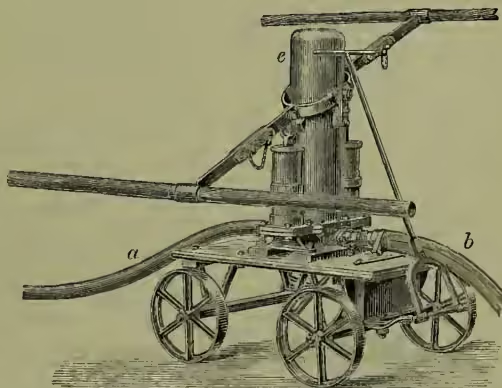
The 6-inch manual fire-engine of the Metropolitan Fire-brigade consists of a pair of single-acting force-pumps, mounted on a carriage with four wheels; at each stroke they discharge 1.63 gallon, whether working at a pressure of 100 lb. to the square inch or of only 2 or 3 lb. They are most effectively worked by about thirty men. Their weight, with implements, firemen, and driver, is about 30 cwt. These are found more convenient for general purposes than larger engines, as they can be drawn at a gallop by two horses for any distance up to fifteen miles. Four horses are occasionally used for greater distances. The pumps are worked by levers attached to a spindle passing lengthwise through bearings in the carriage frame, and on the spindle is a cross-bar to communicate motion to the pistons of the pumps. The levers are connected lengthwise by long horizontal bars to enable a number of men to work together upon the same pumps. Their principle of action will be understood from fig. 2, which represents a special fire-engine constructed for use in railway stations.
It has been selected for illustration as it shows at a glance the arrangement of the pumps, &c., which is alike in all manual engines, except that the air-chamber, c, is sometimes differently situated; a is the supply or suction pipe, and b the discharge or delivery hose.
The first fire-engine in which steam was used to drive the pumps was that of Braithwaite in 1829; Ericsson made a similar one in New York in 1840. The first application of the steam fire-engine was made when the Argyle Rooms in London were burned in 1830; but it was not till after 1860 that the use of steam fire-engines became effective or common. Floating fire-engines worked by steam came into use on the Thames about the same date.
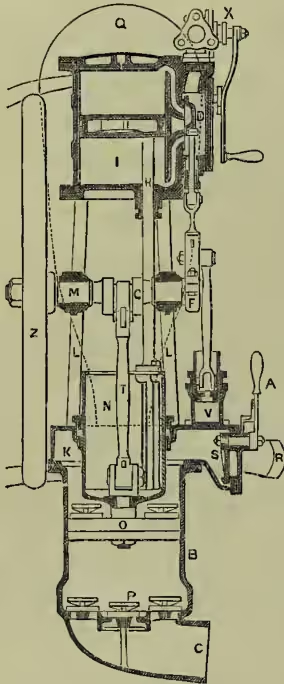
There is no difference in principle between engines worked by hand and those worked by steam, so far as regards the discharge of water. In ordinary cases hand-wrought engines are the most useful, as they can be set in action immediately. With steam power a certain time is required to get up steam. It is said that steam can be got up in from 6 to 7 minutes; but in practice it is found that, when the boiler fire-engine. The best fuel is dry shavings, dry firewood, and steam coal. Oil and spirit should not be used, as they leave a deposit of soot on plates and tubes. If the fire is kindled when the alarm is received, the steam may be well up ere the engine reaches the scene of the fire. As a rule, the simplest fire-engine is the best. In the United States steam fire-engines have almost wholly superseded manual engines; and the engines are usually larger and heavier than those used in England. The heaviest American engine, with water in the boiler and men on the engine, weighs over 5 tons, the lightest tons; those of about 3 tons have of late been preferred. A section of a single cylinder steam fire-engine is shown in fig. 3; the three-cylinder engine is similar in principle, but has no fly-wheel.
Various chemical liquids have been proposed, and to some extent used, as flame-extinguishers. In Germany a cardboard case is used, containing saltpetre, sulphur, &c., which when kindled produce a vapour capable of choking a fire in a closed space. Chemical fire-extinguishers are of various sizes and kinds, but mainly depend on the rapid production of carbonic acid gas, which is an enemy to all kinds of combustion. Water is capable of absorbing large quantities of carbonic acid, which is easily formed by the mixture of acid and alkali. When the gas is generated, its expansion acts as a propelling power, and, the fluid being forced into the flames, the gas in solution is liberated by the evaporation of the water containing it. Glass bottles containing the materials may be hung up in convenient places in factories or dwelling-houses, and these are so arranged that when the bottle is thrown down gas is generated, and tends directly to smother the flame. A portable fire-extinguisher, called the extincleur, is a cylindrical tank made so that it can be carried on the back, containing some 7 or 8 gallons of water. An internal handle is acted on by a lever from the outside, and breaks a bottle of acid when it is required for use. The combining of the elements give off carbonic acid gas sufficient to produce a pressure of from 70 to 100 lb. per square inch on the water, which may be discharged to a distance of 50 feet. Chemical engines on carriages are also in use in the United States and Germany, which carry each two tanks of water (80 gallons), carbonate of soda dissolved in the water, and sulphuric acid in a separate tank, which is mixed with the soda and water, so as to produce carbonic acid in sufficient quantity to give a pressure of 140 lb. In Berlin the steam-engines have tanks filled with liquid carbonic acid, which is liberated so as to expel the water until the steam has been got up. Another chemical contrivance discharges hydrochloric acid and ammoniacal gases. In the early stages of a fire even pails and buckets may be most serviceable; and where the water-supply is very good the hose may be attached directly to the fire-plug or hydrant without any engine.
Fire-brigades.—For working fire-engines a body of firemen are required. The fire-insurance companies formerly had separate establishments of fire-engines and firemen; but in 1825 some of them united, and by 1833 all the important companies combined, and the London Fire-brigade was formed under the management of Mr Braidwood, whose death in the discharge of his duties at the great fire in 1861 was justly deplored as a national loss. In 1865 an act of parliament empowered the Metropolitan Board of Works to take over the engines and appliances of the London Fire-brigade establishment; to secure the services of the brigade men; to construct additional engines and stations; to map out the metropolis into convenient districts; and to cause the firemen to act in harmony with a is filled with cold water, steam at 100 lb. pressure cannot be obtained in less than 14 minutes. To avoid this delay the water in the boiler may be kept always hot; but if this is done by a constant fire in the fire-box, smoke and soot accumulate to a serious extent. The plan adopted by Captain Shaw, of the Metropolitan Fire-brigade, is to have a removable gas-burner kept burning in the fire-box of the salvage corps. The men of the brigade wear a uniform, with strong helmets and metal epaulets to protect them from the blows of falling beams, &c. The courage and skill of the men in making their way through and about burning buildings, for the purpose of directing the stream from the hose, or for saving life and property, and the general efficiency of the whole organisation are worthy of the highest praise. The fire-brigade is supplemented by the police, the water companies, and the insurance companies' salvage corps, as well as by helpful members of the public.
There are traces of an organisation for the extinction of fire as far back as 2000 years B.C., whose records are still to be found in an old Egyptian papyrus. There was a large body of imperial firemen in Rome under Augustus; and some kind of hose was in use, commanded by a siphonarius or firemaster, 200 years later. In the middle ages little was done on systematic lines, though of course fires occurred, and zealous efforts were made to check them, not without success. A force-pump with hose was re-invented and used at Augsburg in 1518: in Amsterdam great progress was made by Van der Heides in perfecting the apparatus about 1672. Fire-brigades with an almost military organisation crop up in Germany between 1840 and 1850, and in the latter year Berlin had a regularly organised system.
Between 1865 and 1895 London more than quadrupled the number and apparatus of her fire-brigade. For the protection of London, with its area of 120 square miles, its 500,000 houses, and 5,000,000 inhabitants, there was, in 1896, a force of 791 firemen of all ranks, 92 coachmen and pilots, 137 horses, 155 fire-engines (of which 60 are worked by steam), 225 fire-escapes and other long ladders, and 35 miles of hose. There are 57 land stations, 4 floating stations, and 200 fire-escape stations. The number of firemen kept on watch is 111 during the day, and 359 at night, or 470 in the 24 hours. There is an admirable system of fire-alarm telegraphs and telephones. The number of calls received during the year 1894 was 4114, of which 845 proved to be false alarms, some were only alarms for chimneys, and the remainder, 3061, for actual fires, of which 361 resulted in serious loss. The number of journeys was 34,013, the distance run by engines and hose-vans, 60,085 miles. The quantity of water used was 45,000,000 gallons. The cost of the brigade is £130,000 a year, of which insurance companies pay £29,000, government £10,000 (for the protection of public buildings), and the ratepayers £91,000. The insufficiency of the London water-supply sometimes frustrates the exertions of the firemen.
In America all the fire departments were formerly voluntary; but this plan was gradually abolished in most large cities, and replaced by carefully organised paid departments. Americans are justly proud of their well-equipped firemen, to whom is assigned on public occasions a prominence unknown in Britain. The paid fire-extinguishing corps of the United States are generally organised into companies of from six to twelve officers and men each, equipped with either a steam fire-engine and hose-tender or a chemical fire-engine (called engine companies); or with a hose-carriage only (called hose companies); or with a hook-and-ladder truck (called hook-and-ladder companies). Permanency of position, dependent on good conduct, was first assured to the members of the fire-extinguishing corps in 1867. The fire-extinguishing corps in the United States are usually superior in size, number, and capacity of engines to those of most other countries; though the rapid growth of American cities is apt to produce a lack of organisation and carelessness. The New York fire department has long been regarded as a singularly perfect institution, and has practically a military organisation, under three commissioners appointed by the mayor. The men are constantly on duty, save when on parade or at their meals, and do duty in barracks beside their engine and ladder. The horses standing facing the engine, are loosened by an automatic electric arrangement when the warning is given, the harness ready suspended above them drops on their backs, and in a few seconds they may be harnessed to the engine, which is supplied with water at boiling heat from stationary boilers.
The hook-and-ladder, or scaling-ladder, which is an important item in the fireman's apparatus in New York and many other cities of the United States, is a pole about 12 feet long, with projections on both sides to serve as steps, and at the end a long hook nearly at right angles to the pole. Fixing one of these in the lowest window of a building, a fireman ascending to the top of it can fix a second ladder in the window of the next story; and so by using alternately the one and then the other scaling-ladder can reach the top of the highest building. Scaling-ladders have been used in connection with fire extinguishing in France for upwards of a century. In the United States these scaling-ladders were first adopted in St Louis; but the example was not lost on New York, which has a considerable percentage of its buildings so high that the windows of the top floors could not be reached by the longest 'extension ladders' in use. The 'jumping sheet' is designed to catch persons falling or jumping from a height at fires. The 'water tower' has also come to be in many American towns regarded as a valuable adjunct to the flexible hose, or substitute for it. It is a long length of iron tubing planted vertically on a carriage, and capable of being extended to the height of the topmost window of any house. The tower is connected beneath with the water-supply; and a nozzle at the top, at right angles to the tube, discharges solid water from close quarters.
The following is a table, from data referring to the period 1890-95, of the comparative position of twenty-two important cities in regard to organisation and appliances for the extinction of fire; only professional firemen who devote their whole time to the work being reckoned, even where constables also act as trained auxiliaries:
| City. | Population. | Firemen. | Hydrants. | Cost. | City. | Population. | Firemen. | Hydrants. | Cost |
|---|---|---|---|---|---|---|---|---|---|
| London ..... | 5,000,000 | 700 | 7,000 | £130,000 | Boston ..... | 540,000 | 619 | 7000 | £125,000 |
| Paris ..... | 2,400,000 | 1751 | 4,800 | 135,000 | Liverpool ..... | 520,000 | 521 | 4000 | 14,000 |
| New York..... | 1,600,000 | 1047 | 12,000 | 260,000 | Budapest..... | 512,000 | 231 | 4000 | 25,000 |
| Berlin..... | 1,600,000 | 746 | 4,850 | 75,000 | Birmingham..... | 500,000 | 591 | 4500 | 8,000 |
| Chicago..... | 1,500,000 | 917 | 7,000 | 310,000 | Madrid ..... | 472,000 | 196 | 4200 | 30,000 |
| Vienna..... | 1,300,000 | 373 | 2,800 | 20,000 | Brussels ..... | 440,000 | 156 | 2000 | 12,500 |
| St Petersburg... | 1,000,000 | 1087 | 2,000 | 50,000 | Milan ..... | 421,000 | 85 | 1230 | 6,500 |
| Constantinople.. | 900,000 | 1500 | (?) | (?) | Amsterdam..... | 408,000 | 200 | 3500 | 15,000 |
| Glasgow..... | 700,000 | 109 | 5,600 | 16,000 | Leipzig..... | 350,000 | 139 | 1530 | 17,500 |
| Manchester..... | 600,000 | 85 | 10,000 | 25,000 | Munich..... | 348,000 | 111 | 1785 | 12,500 |
| Haunburg..... | 570,000 | 246 | 5,000 | 35,000 | Edinburgh..... | 342,000 | 70 | 1900 | 10,000 |
It will be noted that London, with a population of near four millions, and property calculated at fourteen hundred millions of pounds, had but 576 firemen, and spent on its brigade only £103,000; while New York, with one-third of the population, spent £335,000.
Fire-alarms, &c.—Throughout many cities and towns are established electric fire-alarms—boxes placed in conspicuous places, at corners of streets, &c., which are connected with the fire-engine stations, and may be made to act by pressing a button or pulling a handle, after the glass covering the apparatus has been broken. There are also alarm boxes which are arranged to act of themselves when the heat of a fire touches them, by means of the expansion of a spiral strip of metal under the influence of the increasing temperature of the room or place where it is fixed.
When a fire is discovered by a policeman or a passer-by, the alarm will in some way be communicated to the fire-engine station as swiftly as possible. The bell is rung, and the men on duty, as soon as they feel sure it is a real appeal for help, immediately harness the horses to the engine and start. The start should, according to circumstances, be made in from one to four minutes after the alarm is received; the pace of the horses should be a mile in four minutes with good horses. On a warning to a fire-escape station at night, the firemen in charge should in less than one minute be moving towards the fire with the escape, at a rate of six miles an hour.
Among appliances that are or may be carried by firemen are axes, mattocks, ladders, canvas buckets, lamps, saws, &c. And the firemen may to a certain extent be helped to breathe in a room full of dense smoke by various devices, such as a breathing-tube, a portable bag of air, a smoke-cap (a kind of respirator or air-filter), a smoke-jacket of cowhide with an air-tube from the engine, or even a complete diver's dress of the Fleuss type (see DIVING).
Fireproof Buildings.—The problem of constructing warehouses, dwelling-houses, &c. that shall be proof against all risk of conflagration has not yet been solved. The liability to conflagration may be greatly diminished by the construction of a building, but cannot be entirely averted; and therefore, in all 'fireproof' buildings containing furniture or other combustible materials of any kind, the ordinary precautions against fire should be strictly observed. Unless this be understood, a so-called fireproof building may be more dangerous than an ordinary one, especially in warehouses, &c. intrusted to the care of watchmen and others, who, relying upon the supposed immunity the name expresses, are liable to neglect many precautions they would not fail to observe in a building believed to be dangerous.
The nearest approximation to fireproof construction may be obtained as follows: The walls should be of stone or brick, and any ties, lintels, &c. required in the construction should be of iron. Wherever wood is inevitably used, it should be prepared with silicate or tungstate of soda, or dissolved alum. Brick arches of small span thrown between iron girders form one of the earliest kinds of fireproof flooring. But experience has shown that, in different ways, both wrought-iron and cast-iron beams are frequently destroyed in the case of a building taking fire. By Whichcord's method the metal girders are incased in fireclay blocks. Measure's patent fireproof flooring consists of iron girders, 3 to 4 feet apart, resting on the lower flanges of which are placed iron fillets at intervals of 9 inches. Concrete is then filled in between the girders, and supported by centering until it sets. In Dennett's system concrete arches are thrown between iron girders. Northcroft's flooring is constructed by forming flat arches of specially moulded firebricks. Each arch is double or in two rings, slightly apart, and with the space between them filled up with cement. The arches rest on fireclay skewbacks, which inclose the supporting iron beams. The roof should be constructed in like manner, wooden rafters being entirely excluded. The doors should be of iron, and the security would be much increased if the doors between any two apartments containing combustible materials were double, with a space between them equal to the thickness of the walls. Of course, it is not practicable to carry out all these precautions in a dwelling-house, but the danger from fire may be considerably diminished by attending to some of them. The most important conditions for a warehouse are that each apartment shall be separated from the next by stout walls of non-conducting materials, and more especially that each shall be as nearly as possible airtight; and whenever, from the nature of the goods, ventilation is required, it should be obtained by periodically opening the doors and windows. If the apartments are air-tight, any fire will extinguish itself, unless there be along with the combustible goods some oxygen-giving substance, such as saltpetre, chlorate of potash, or other nitrates or chlorates.
At first sight it may appear that a warehouse built entirely of iron would be effectually fireproof, but this is far from being the case. In the first place, iron conducts heat more readily than any other material used in building; secondly, cast-iron is liable to crack and split when suddenly heated or cooled. Iron supports may, under some circumstances, be even more objectionable than wood, for if the water from a fire-engine were to play upon a heated cast-iron girder it would probably give way immediately, while a stout wooden beam might have the fire in it extinguished before it was burned through. In great fires the heat is sufficient to fuse iron.
In most civilised countries there are laws regulating the building of houses, so as to render fires less likely and destructive. The theory of all such laws is that the materials and modes of construction should themselves prevent the spread of fire without the presence of firemen; but these laws are very seldom rigorously enforced, and are often defied with impunity.
But even the most perfect fireproof buildings may become dangerous by reason of their contents. Thus, all explosives and combustibles require special care and superintendence. Many manufactures are essentially dangerous, as when oil is largely used. And it is known that spontaneous combustion may positively take place when considerable masses of lampblack, tow, linen, paper, cotton, calico, woollen stuffs, hemp, wood ashes, or ochre are slightly soaked in oil, and packed so that the air has access to them, especially if reached by the moderate warmth of the sun.
Many terribly sudden and fatal conflagrations in theatres have proved that they are, and inevitably it may be, specially exposed to risk from fire. Among valuable precautions are a strong iron screen to let down, so as wholly to separate the stage (where the fire usually begins) from the auditorium; wide passages leading directly to the exit doors; numerous doors easily opened and made to open outwards; illumination not by gas but by electric light; as well as the ordinary rules of safety applicable to all buildings. Fires on shipboard, unless discovered and checked at an early stage, are wont to be specially disastrous.
Sprinklers.—Amongst precautions against fire, attention has been much directed to sprinklers con- nected with the water-supply distributed throughout a building. Some of these are turned on by hand, others are automatic. It is claimed for one of these automatic sprinklers that it will discharge water whenever the temperature around it reaches 160° F. When the temperature rises to 160°, the solder joint melts rapidly, the valve seat is withdrawn, and the valve, falling down, makes a deflector for the distribution of water in a spray. Early forms of sprinkler were rose-heads, or hollow perforated bodies; but it was found that the perforations were stopped by dust, or, when in action, by sediment in the pipes. Some sprinklers are arranged to act by means of a thread which burns when the heat becomes sufficient, and so releases the discharge. Lines of horizontal distributing water-pipes (connected with the public water-supply, with a tank on the roof of the building or on a tower) are carried through the building, near the ceilings, from 8 to 10 feet apart, and the sprinklers are attached to these pipes, one to every 10 feet.
Fireproofing.—There are many means by which fabrics may be prevented from flaming, their combustion being reduced to a slow smouldering. By moistening the fabric with a solution of any saline substance, which, upon drying, will leave minute crystals deposited in or between the fibres, its inflammability will be greatly diminished; but the salt imparts a degree of harshness to the fabric. Alum, sulphate of zinc, and sulphate of soda are effectual to prevent flaming, but weaken the fibre. Common salt does the same. Phosphate and sulphate of ammonia are less objectionable on this account, but the former decomposes by contact with the hot iron in ironing. Tungstate of soda is said to have no injurious effect on the fibre. Sulphate of ammonia, chloride of ammonium (sal ammoniac), and borax are among the best fitted for domestic use, though they are not unobjectionable. For made-up clothing, borax is, perhaps, the best, as it is most effectual in its action, and is the least injurious to the appearance of the article, though it is stated to have some weakening effect on the fibre. Wood has been treated in a similar manner. Milk of lime, alum, sal ammoniac, sulphate of ammonia, chloride and sulphate of zinc, sulphuret of lime and baryta, &c. have been used, and its inflammability, but not its combustibility, is removed. The most efficient protection to wood is silicate of soda. If planks of moderate thickness be brushed three or four times over on each side with a strong solution, they are rendered absolutely uninflammable and almost incombustible; they will only burn when very intensely heated. The silicate fuses and forms a glass which envelops the surface, and even the internal fibres of the wood if it be sufficiently saturated, and thus seals it from the oxygen of the air. But it seems necessary that the saturation should be periodically repeated if the process is to retain its effect. Asbestos paint is serviceable to some extent, but is apt to peel off (see ASBESTOS).
Fire-escapes.—An immense number of contrivances have been at different times proposed for enabling people to escape by windows and house-tops from burning buildings. They are of two distinct kinds—one for affording aid from outside, and the other for enabling those within the house to effect their own escape. Of the latter the simplest is a cord that should be firmly attached to the window-sill of every sleeping-apartment, and coiled up either in a box on the floor or under a dressing-table or other suitable place. A rope one-quarter or three-eighths of an inch thick, and knotted at intervals of about a foot, is well adapted for the purpose. A man with tolerable nerve may let himself down by means of such a cord, either by placing his feet against the wall and working down by holding to the knots, or by clinging with his feet and knees to the rope as well as with his hands. A man may let down a woman or child by means of a sack at the end of the rope, or simply by fastening them to the end, and letting the rope pass through his hands, aided if necessary by the friction of the rope on the window-sill. In American cities large tenement-houses are commonly provided with a permanent fire-escape in the shape of iron ladders running up the back of the building, with light iron balconies at each story.
Fire-escapes to be used from without consist either of simple ladders kept in police-offices or other convenient stations, or a series of ladders that can be jointed together; of poles with baskets attached; of ropes with weights at one end, that they may be thrown or shot into windows; of combinations of ladders, ropes, bags, baskets, nets, &c.
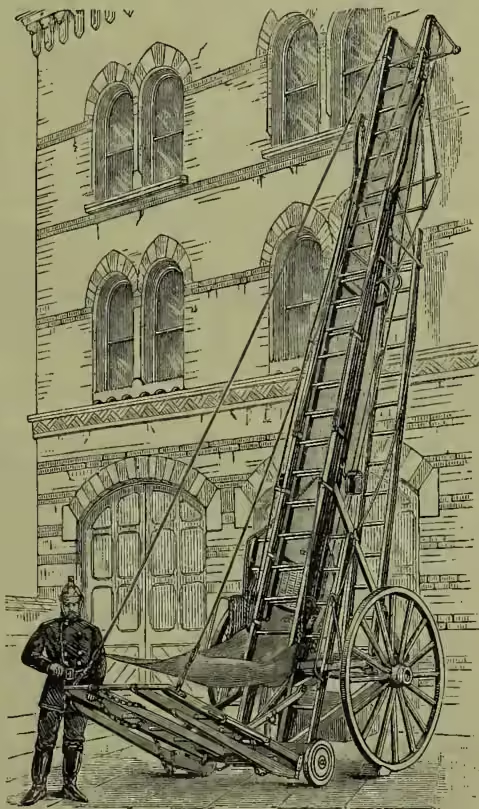
Messrs Shand, Mason, & Co.'s London Fire-escape.
But what is usually known as a fire-escape is a ladder mounted on a carriage with four wheels. Fire-escapes are of various patterns, but the best are very like one another. The fire-escape generally used by the London Fire-brigade (fig. 4) consists of a main ladder, the sides of which are strengthened with patent wire-robe, and fitted with an uninflammable trough of copper-wire netting, in which persons may slide with ease and safety from a window to the ground; a fly-ladder, jointed to the main ladder, along which it lies when not in use, and raised when required by ropes and levers; a third or detached piece called the first-floor ladder, which when not in use is carried under the main ladder, but can be jointed to the end of the fly-ladder; and a fourth piece known as the supplemental length, which can be added when the greatest total height (60 feet) is required. The whole is mounted on a light carriage with springs and high wheels, and can be moved anywhere by two men. The fly-ladder is constructed so as to be immediately detached for use in narrow courts, alleys, &c., or it can be used as an independent means of escape when not required on the main ladder, forming with the detached ladders four distinct means of escape from burning buildings. When required, the fire-escape is run to the burning house, the main ladder standing nearly upright all the while. It is then directed to the required window at a considerable inclination, and the fireman ascends the ladder, and either helps the inmates to descend by it, or, if they are unable to do this, he lets them down by the trough, which forms an inclined plane along which they may easily and safely descend with the aid he is enabled to afford them.
The following is a list of notable fires:
A.D.
- 64. Rome burned for eight days; 4ths destroyed.
- 1086. London; great part of the city destroyed.
- 1212. London; great part of the city destroyed.
- 1666. London, Great Fire, Sept. 2-6; 436 acres; loss, £10,750,000.
- 1794. London; 650 houses burnt; loss, £1,000,000.
- 1812. Moscow fired, September 14-20; loss, £30,000,000.
- 1835. New York, December 16; loss, £3,000,000.
- 1842. Hamburg, May 5-7; loss, £7,000,000.
- 1845. New York, July 20; loss, £1,500,000.
- 1861. London, Tooley St., June 22-July 22; loss, £2,000,000.
- 1871. Paris, Communist outrages in May; loss, £32,000,000.
- 1871. Chicago, October 8-10; 2124 acres; loss, £39,000,000.
- 1872. Boston, U.S., November 9-10; loss, £15,000,000.
- 1882. London, Wood Street, December 8-10; loss, £1,000,000.
- 1887. Exeter theatre; 127 lives lost.
- 1890. London, Thames Street; loss, £500,000.
- 1894. Terrific forest fires in Wisconsin and Minnesota.
BIBLIOGRAPHY.—See Dana, The Fire Department in the United States (Boston, 1858); Young, Fires, Fire-engines, and Fire-brigades (1866); Roper, Handbook of Modern Steam Fire-engines (1876); Magirus, Das Feuerlöschwesen (Ulm, 1877); other German works by Lindner (1881), Döhring (1881), Lenz (1889 and 1893), and Hörner (1890); Costello, Our Firemen: History of the New York Fire Department (1887); Gerhard, Prevention of Fire in Hospitals, Asylums, &c. (1887); Fire Protection: Organisation, Machinery, Working, &c. of the London Fire-brigade (1877; new ed. 1889), and other works by the present writer.