Firearms. The generic term 'firearm' includes Cannon, Rifles, Guns, Revolvers (q.v.), and other weapons in which an explosive is used as an agent for the propulsion of projectiles. The history of the invention of Gunpowder (q.v.) is an appropriate prelude to that of firearms, the existence of the latter being wholly dependent upon the discovery of a certain recondite quality in the former.
Inflammable material has been employed in warfare from remotest antiquity; sulphur and resinous gums were the ingredients of some, and naphtha and bituminous substances with nitre of other, of the mixtures known to the ancients as 'Greek fire,' 'wild-fire,' or 'Medea's oil'; but the vessels in which these inflammable compounds were deflagrated cannot properly be termed firearms.
A weapon of the pyrotechnical species was developed by some of the eastern nations, and is said to have been used extensively until the 15th century for the frightening of horses and cattle on pillaging expeditions and in warfare. The weapon was in construction similar to a 'Roman candle' of the pyrotechnists, the inflammable filling of Grecian wax and metal filings being alternated with layers of gunpowder and balls of tow mixed with sulphur; the weapon was lighted at the muzzle, and as the 'filling' burned down, the balls were shot out by the gunpowder immediately beneath them.
The knowledge of gunpowder and firearms may be presumed to have extended in a westerly direction through the Arabs, who used them in the 8th century under the name of 'manjaniks,' and introduced them into Spain in the 13th century. Seville was defended in 1247 by cannon throwing stones; Niebla in 1259; and in 1273 Abu Yusuf employed cannon firing stone balls at the siege of Sidi-Moussa, near Algiers. Ghent possessed a small cannon in 1313, and Florence ordered cannon and iron balls about 1325. In Germany, Anberg possessed a cannon in 1301, and in 1327 the English employed some Hainaulters, who used cannon for King Edward III. against the Scotch. Cannon were used in 1339 at Cambrai, in 1340 at Mirepoix, in 1345 at Monségur, in 1346 at Crécy. In 1350 some North German knights armed themselves with iron guns, and in 1365 Einbeck was very effectually defended with the aid of firearms.
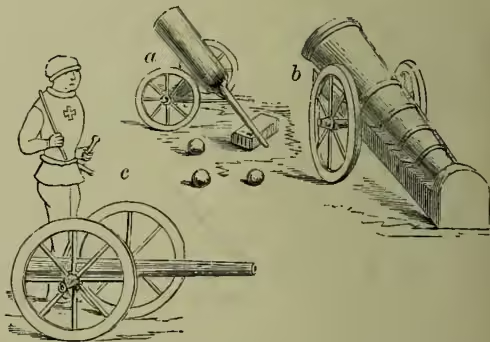
Different countries had different names for these early firearms—in Italy 'bombardo,' in France 'quenon,' in Germany 'buchsens,' in the Netherlands 'vogheleer,' in England 'crackeys' or 'engymnes' of war; but it was not until the 15th century that firearms were classified and named accordingly. Bombards were short, capacious vessels, from which stone balls were shot with small charges to a short distance and at considerable elevation; they were essentially the parents of the present bombs or mortars. The cannon (canna, 'a reed'), on the other hand, were, for some time at least, of extremely small bore, scarcely larger than muskets of the 18th century; they discharged leaden bullets, and would have probably been used as hand-weapons but for their cumbrous and heavy workmanship, which necessitated small carriages. Arms of this description are doubtless those referred to as having been brought by Richard II. to the siege of St Malo, to the number of 400 pieces, where they are said to have kept up an incessant fire day and night on the town without success. a (from the Chroniques de St Denis, 14th century); b, bombard of the 15th century (from Froissart); c, cannon of the 15th century (from Les Vigiles de Charles VII.).
All these early firearms were usually loaded to the muzzle, and fired at an extreme angle. Charles V. classed mortars separately, mounted cannon upon carriages, added trunnions, and effected other improvements in his artillery, which consisted of cannon; great, bastard, and small culverins; falcons and falconets. The classification of firearms led to the development of various types to be used for specific purposes, and an invention which effected a great improvement to one type was useless or inapplicable to another. Cannon of 120 tons and pocket-pistols of 4 ounces, although they have a common origin, have not a common history. Cannon were of wrought iron, built up by the handicraft of the smith, of rods and rings, and were used as they left his forge. Cannon of a copper and tin alloy were cast at Augsburg in 1378; they have since been made of hollowed blocks of stone; or cylindrical holes, bored in the solid cliffs, have been used to fire projectiles, as at Alexandria, Constantinople, and Gibraltar; they have been made of wood, of rope, of leather, and of papier-maché, as well as of almost every pure and alloyed metal it is possible to cast or forge. The early cannon were chiefly used at sieges, as their weight and the badness of the roads, added to the inefficiency of the weapons themselves, precluded their advantageous use as field-pieces, and if utilised in a pitched battle they were fired but once. But on the one hand the development of cannon into small portable weapons produced hand firearms, and on the other the increase of size and weight led to the large weapons so important for the defence of fortifications. Of this type the 'Mons Meg' of Edinburgh Castle is an early specimen; it weighs nearly 4 tons, and fired a stone shot of over 300 lb. The powder-chamber is of a less diameter than the bore of the cannon, in this particular resembling the mortar, and exhibiting the reverse of the principle of enlarged powder-chamber now employed. Such cannon were made at Ghent in the 15th century.
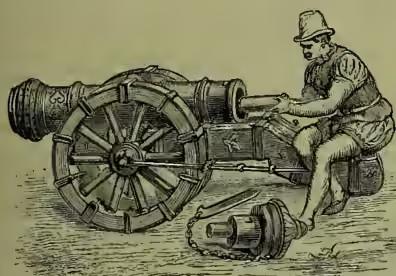
The culverin, a useful size of cannon, was employed generally in England until after the Commonwealth. Culverins fired stone shot, iron balls, leaden bullets, and composite projectiles—a leaden jacketing being cast round uneven stones to make them heavier, and the better to fit the interior of the cannon. Such cul- verins and projectiles were made by the blacksmiths of Deritend, Birmingham, in the 17th century, and were used at the battle of Worcester.
Field-pieces were not greatly developed until the 18th century, when the improved finish of the interior allowed of long and uniform ranges, and a certain definite accuracy being obtained. The breech-loading field artillery are now of a high degree of excellence; but whether firing shot or shell the limit of power will be found in recoil, as is the limit of accuracy in the correctness of the aim.
For defensive purposes, as well as for certain offensive operations, special arms were required and constructed: of these the long-barrelled wall-pieces for defence; the 'petard,' and mortars firing bars, oblong and square bullets, for making a breach; explosive shells and grenades for clearing a trench; grape and chain shot for mowing down compact squares of infantry or destroying the rigging of battle-ships, are the best known. From the 'orgue de bombardes,' another type of early firearm, the quick-firing, many-barrelled machine guns have been developed. The earliest form of this weapon is the 'ribaudequin,' of Italian origin, which consisted of a number of small cannon and pikes arranged upon a portable carriage; it was fired but once during an engagement, and was primarily intended as a defence against a cavalry charge. The 'orgue de bom- bardes' (fig. 3), with more cannon (fired simultaneously) and fewer pikes, succeeded the ribaudequin.
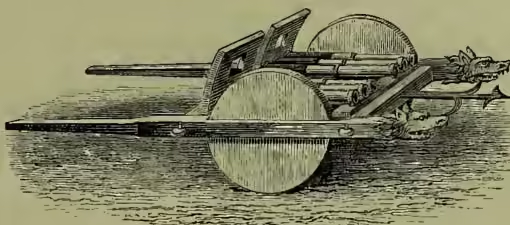
Further developments survived into the era of percussion firearms.
With the cannon and quick-firing machine guns, the improvements have depended less upon the ingenuity of inventors than on the achievements of mechanical science to accomplish accurate workmanship, and work great masses of material as skilled workmen can handle smaller pieces. The improvements in explosives, in the quality of the metal, and in the machinery available, have rendered possible the production of such immense weapons, that the limit of size would appear to be rather in the cost of manufacture and the enormous expenditure risked upon the aim, than in the inability of modern mechanicians to produce still larger and more powerful weapons (see CANNON).
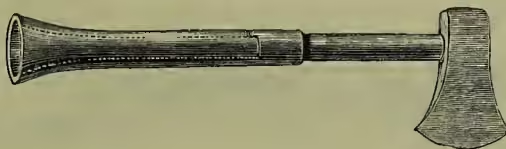
The development of the hand firearm, on the contrary, called for the ingenuity of the handicraftsman, and at first this ingenuity was exercised in the combination of a firearm concealed with some other weapon, so that its firing unexpectedly should produce a consternation; and for the same reason repeating and double-barrelled weapons were produced. Firearms were incorporated with daggers, swords, pikes, clubs, maces, axes, and shields; and it was the use of these devices by cunning warriors that disgusted the knights and led to their loss of prestige, and hastened the decay of feudalism. The hand firearms owed their success quite as much to the consternation caused by their unexpected discharge as to the execution done by their projectiles: hence Montaigne wrote in 1585, when the muskets in use were much superior to the earlier culverins, that their effect, apart from the shock caused by the report, was so insignificant that he hoped the use of them would be discontinued. It was as a surprise weapon that Neapolitan brigands and French postillions were armed with whips, the handles of which were cunningly devised and well-hidden pistols.

The culverin or hand cannon was a small tube of or inch internal diameter, fixed to a straight piece of wood or welded to an iron handle. At the close of the 15th century they were extensively used. In 1471 culveriners were in the army of Edward IV. after his landing at Ravenspur, Yorkshire; and hand firearms were used at the siege of Berwick in 1521. The smallest hand-culverins—about 4 feet in length and weighing 15 lb.—were used on horseback; heavier weapons up to 60 lb. weight were used by the foot-soldiers. The culveriner was attended by a 'varlet' to aid in firing the piece, which was always supported upon a forked rest. The arquebus was a smaller and improved culverin, requiring but one man. Grose writes of the equipment of the culveriner: 'He had, in addition to the unwieldy weapon itself, his coarse powder, for loading, in a flask; his fine powder, for priming, in a touch-box; his bullets in a leathern bag, with strings to draw to get at them; whilst in his hand were his musket-rest and his burning match.'
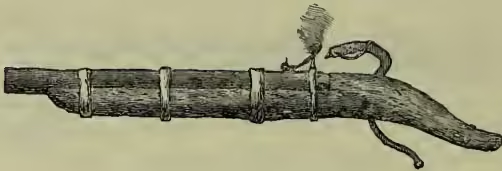
The touch-hole of the culverin was in late patterns placed in the side, instead of on the top as with cannon, a flash-pan was added, and early in the 16th century the serpentín or lever to hold the burning match was invented, and the matchlock quickly followed. In the best matchlocks the flash-pan was covered with a hinged lid, and the serpentín was forcibly thrown upon the touch powder in the flash-pan by a spring; but in the ordinary types the burning slow match was made to descend by pulling the lower end of the serpentín towards the stock. From the matchlock arquebus came the hagbut, hackbutt, hackenbuse, and the musket, which was originally a heavier weapon, and carried a double bullet. These early firearms were loaded with difficulty; at Kissingen in 1636, and at Wittenbergen in 1638, the musketeers fired seven shots in eight hours, which is accounted for by the fact that musketeers were harassed by the opposing cavalry and archers, and that the loading had to be effected whilst the forked-rest was attached to the wrist by a short thong, and the soldier 'in skirmish doth charge his musquet afresh, and train his forke or staffe after him.' The matches of slow burning fuse, even when carried in the hat, or in a perforated metal case at the girdle, gave much trouble, especially in wet and foggy weather, and at the battle of Dunbar (1650) the English musketeers were unable to retain their fire on account of the weather. The wheel-lock originated from a gun in which pieces of pyrites were placed near the flash-pan, and the igniting spark was produced by the friction of a file rubbed against them. In the wheel-lock the flint is held in the flash-pan by a spring pressing against the opposite extremity of the lever to the one in which the flint is fixed; in the flash-pan is a grooved wheel with serrated edges, which is rapidly rotated by a chain and flat or V spring, or as is the drum of a watch. The wheel was wound up as in a watch, with a movable key, and was released upon the trigger being pulled; its rapid rotation against the flint firmly pressing upon it produced a stream of sparks instantly, and made ignition more certain. The wheel-lock was produced in Germany early in the latter half of the 16th century, and with its introduction the use of firearms for sporting purposes became more general.
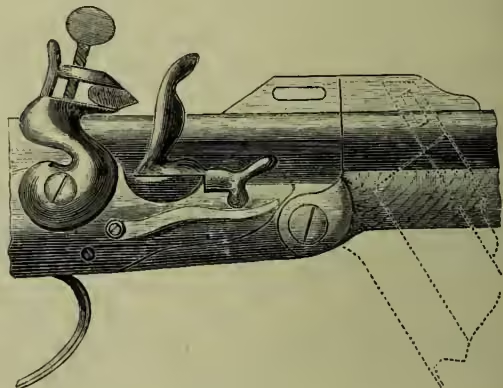
French Flintlock Breech-loader, 18th century.
The firelock or flintlock, more common than the expensive wheel-lock, was produced in Spain about 1625, as a cheap substitute for the wheel-lock. In the flintlock the hammer or cover-plate to the flash-pan is knocked backwards by the blow of the flint screwed in the jaws of the cock, and, uncovering the priming in the flash-pan, exposes the touch powder to the sparks produced by the flint grating against the steel face of the hammer. The early flintlock was clumsy, simple, and inefficient; it is said to have been produced by marauders, to whom the burning match of the arquebus was dangerous as betraying their presence; and, roughly made, it did not answer as a military weapon so well as the matchlock. Improvements in the latter half of the 17th century caused its more general adoption. It was common in the Netherlands, and was introduced into the English army in the reign of William III., and remained in use until 1840; the last firelocks supplied to the British government were for use abroad, and were made in 1842. The firelock or flintlock musket is still an article of commerce, as it can be used wherever there is a supply of powder and lead. The flintlock in its highest degree of perfection was manufactured in London as a double sporting weapon at the beginning of the 19th century.
Pistols were developed from the small hand cannon termed 'poitralin,' and were made in 1540 by Camillio Vettelli at Pistoia. They were used as concealed weapons, the German Ritters being the first to adopt them for military purposes. At the battle of Renty in 1554 the Ritters defeated the French through a manoeuvre termed 'caracole,' in which the pistols played the most important rôle. The pistols, from having short barrels and heavy, clumsy butts, improved into successful cavalry arms when furnished with wheel-locks, and they were generally adopted as an auxiliary weapon. Double and four-barrelled pistols were common in the 18th century, and the revolving pistol, termed the 'pepper-box,' preceded the introduction of the modern revolver by Colonel Colt (see REVOLVER).
As a triumph of handicraft and exact workmanship the duelling pistol is without a rival, and the twenty-pace pistols firing a large bullet with a small charge of powder, as made in Paris at the present time, are not to be equalled as weapons of precision by any firearm extant. The revolver has superseded the pistol entirely for military and police purposes in civilised countries, but the revolver will in its turn have to make way for a magazine or repeating pistol.
Many of the early cannon hand-forged from rings and bars were breech-loading, the system employed being that of the movable breech-block, secured in position during the discharge by hammer-driven wedges; or a through pin uniting the block with the breech frame of the cannon. Such weapons date from the 14th century, and similar weapons formed part of the equipment of the Mary Rose, which foundered about 1545. Small-arms intended for the use of illustrious persons were occasionally made breech-loading. In the Tower collection is a musket which closely resembles the modern Snider in its breech mechanism, and this remarkable specimen of an efficient breech-loader is said to have belonged to Henry VIII., whilst several other varieties of arms having a movable breech-block were made prior to his reign. Small-arms and cannon with detachable breech-plugs—in which the charge was placed and fired—were made in the 16th century, and before its close breech-loaders with hinged barrels had been introduced. The hinge was usually at the joint, as in the weapon illustrated (fig. 7), and not a couple of inches forward of it, as in the Lefauchex and other modern developments of the sporting gun. The 17th and 18th centuries were particularly prolific in the production of breech-loading mechanisms, but, owing to the absence of a cartridge containing its own ignition, none were successful until revived after the introduction of the percussion cap.
Amongst the early manufacturers of arms who aided the development by their handicraft or invention the Italian and Spanish smiths deserve mention; the accurately forged barrels of Nicolas Bis, and the fine workmanship on the pistols of the Comminazzo family, cannot be surpassed. Köllner of Vienna, and Kotter of Nuremberg, produced rifling; and Lazarino, Dax, and Nereiter improved the appearance and handiness, and added to the utility of firearms by minor inventions. The wheel-locks were neither manufactured nor used extensively out of Germany and Italy, but the Saxon collection in the Dresden Museum indicates the importance with which the invention was once regarded. The most curious arms were manufactured in Paris, Amsterdam, Hanover, Liège, and Lisbon, and later at the Moscow arsenal.
That necessity is the mother of invention has never been more truthfully demonstrated than by the development of firearms. The wars in Flanders and Germany during the middle ages quickened the genius of their inventors and improved the skill of their armourers; just as the tension in mid-Europe since the war of 1870-71 has given to France and Germany the finest repeating rifles and best artillery; whilst the leisure and taste of the Englishman has called for the finest sporting weapons. The invention of rifling in Germany in the 15th century led to the development of weapons of precision, the highest degree of accuracy being attained by a heavy muzzle-loading small-bore rifle with a high trajectory. The requirements of the military firearm—lightness, ease and quickness of manipulation, extreme range and great velocity, have led to the sacrifice of precision for the advantages possessed by light breech-loading arms (see BREECH-LOADING, and RIFLES).
Of the inventions which have been applicable to all firearms the most important has to do with the ignition of the charge of explosive. Fulminating or detonating powders were made by the French chemists of the 18th century; and about 1800 an Englishman, benefiting by their experiments, produced a highly sensitive explosive, composed of fulminate of mercury and saltpetre, which possessed all the requisite qualities of a priming powder for the flintlock firearms. In 1807 Alexander J. Forsyth, a Scottish clergyman, patented the application of the detonating principle for exploding gunpowder in firearms. Many inventors claimed the copper percussion-cap which followed and was first made in England in 1818, its introduction leading to the abandonment of the firelock. The expansive bullet, invented by Greener and improved by Minié, increased the range and accuracy of rifles, and made an accurate breech-loading rifle possible. The cartridge-case containing its own means of ignition, or the percussion-cap, is a French invention improved by Lefauchex, Lancaster, Needham, Pottet, and others, and to it is due the success of modern breech-loading small-arms, this cartridge-case of solid drawn brass being used for all quick-firing machine guns and some of the smaller cannon. The expansion of the case at the moment of discharge causes it to act as an obturator and block all escape of gas into the breech-loading mechanism, whilst its contraction after firing admits of its being withdrawn with ease.
Sporting firearms consist of the shot-gun and the rifle for large game shooting. The use of hail-shot became general in Germany in the 16th century, and with the introduction of the wheel-lock the use of the arquebus for sporting purposes became more common. The earliest double-barrelled guns were made for military purposes, but sporting guns with two barrels side by side were made in Italy in the 17th century, and the art of shooting on the wing was first practised about 1580. The introduction of better forged barrels in the latter half of the 18th century made a light double-barrelled fowling-piece a possibility, and since then shot-gun barrels made of iron and steel fragments (1798) and twisted scelps (1806) have increased in strength and lightness. Old horseshoe nails and scraps of iron and steel were made into shot-gun barrels; but after 1850 new metal was employed and is now preferred. As the fowling-piece with hand-welded barrels made of twisted rods became more general, the supremacy of continental gun-makers over the English was lessened, and early in the present century the improvements made by Manton, Nock, Cook, Egg, and others placed English guns ahead of all competitors. The French invention of composite cartridge-case and breech-loading was turned to practical account by the English, who have unceasingly improved upon the original idea. In addition to the breech-loading mechanism, the shot-gun has been improved in range by the use of choke-boring—i.e. the constriction of the barrel at the muzzle; in safety, by the rebounding lock, which again has been superseded by various hammerless locks, or arrangement of the firing mechanism within the head of the gun; and in self-ejecting mechanism. See BREECH-LOADING; also GUN (Sporting).
The sporting rifle is a type of firearm evolved from the wheel-lock hunting weapons of Germany. Its production is proof of the adaptability of firearms to special needs; the desiderata of a weapon for large game hunting include the quick firing of a second shot, and a paralyzing effect from the penetration of the bullet. The repeating rifle cannot be twice fired as quickly as the double rifle, and length of range with a light ammunition and continuous quick firing are points sought in a military weapon. Precision is dependent upon the weight of the projectile being sufficient to maintain the direction imparted to it during its passage through the barrel. The bullet is helped to do this by the rifling giving the projectile a rotary motion, which equalises irregularities in the bullet, and lessens its tendency to deflect. The greater the velocity, the less quickly must the rifling turn; but with improved solid bullets, covered with nickel or steel, it is possible to get the bullet to grip the rifling at a velocity of 2000 feet per second, and a complete turn is made in ten inches, in which case the bullet has a double rotary motion and takes a corkscrew flight. The modern sporting or express rifle, as it is termed, fires a hollow expansive bullet at a high velocity for a few hundred yards, accuracy and range being sacrificed to force at impact. The average muzzle velocity of the military rifle is 1500 feet per second, of the express 2000 feet per second; and although with new ammunition and improved explosives the latest military rifle attains this initial velocity, the force of the bullet on impact does not approach that of the sporting rifle projectile. The smallest sporting rifle fires a bullet of about 120 grains, and the largest a bullet of 1600 grains (see RIFLES). Firearms are also used for a variety of secondary purposes: for the firing of signal shells at sea (in lieu of rockets), shooting oil-filled vessels from ships to prevent the breaking of the waves in stormy weather, for firing harpoons with a line attached, as used in whale and narwhal fishing, &c.
In the manufacture of early firearms the smith was the first and last workman. The Italians were amongst the first to ornament firearms, and finish them by chiselling, chasing, and engraving, as the Spaniards were amongst the first to supplement the work of the smith by filing and smoothing the exterior of the weapons, and polishing the interior of the barrels. For the last three centuries the most skilled handicraftsmen of Europe have been employed in the making or beautifying of firearms, and at the present day the manufacture of sporting guns remains essentially a handicraft, the mechanical processes having but lightened the labour of the workman, not superseded him. Some 20,000 workmen are now employed in Europe in the manufacture of sporting guns, the chief centres being Birmingham, Liège, and Prague, whilst the machine factories of Europe, together with the government arsenals engaged in making small-arms, employ a much larger number. In addition to the places mentioned, at Suhl, St Etienne, Steyr, and Tula, and at Springfield, Hartford, and elsewhere in the United States, large numbers of firearms are made yearly. The idea of making army muskets with interchangeable parts originated with the French about a century ago, but the only successful result was the 'drop forging' or stamping out of the various limbs, and about 1797 Whitney made some 10,000 muskets in America from stampings, and used improved machinery in finishing the parts.
The perfecting of the machinery for the manufacture of interchangeable arms is the work of Hall, of Harper's Ferry, U.S., whose system was adopted in government workshops in 1818; and of Blanchard, whose improved lathes produced interchangeable stocks. The system of making firearms by machinery was introduced into England in 1856, since which date many futile attempts have been made in various countries to produce fine sporting arms wholly by machinery.
The improvements immediately sought in firearms are such as will tend to simplify or strengthen the breech-loading mechanism (see BREECH-LOADING), and to strengthen and at the same time lighten the barrel; the discovery of a material stronger than steel; and such inventions as will increase the range or precision of the weapon or lessen its recoil. For the capabilities of various weapons, see CANNON, RIFLES, REVOLVERS, &c.
The best military small-arms—rifles—are available to a range of 2000 yards, and the best express to 300 yards. A match-rifle will fire with a mean deviation of 1.75 feet or less at 1000 yards range, and a shot-gun will put upwards of two-thirds of its charge of shot into a circle thirty inches in diameter at 40 yards range, and the last shot of the charge will not be more than ten feet behind the first one that reaches the target at that distance.
The killing range of the average shot-gun is about 45 yards, of wild-fowling guns with swan shot 140 yards. After the pulling of the trigger, until the charge of shot reaches the muzzle, .007 of a second elapses, and .13 before the shot, having passed the muzzle, strikes the target 120 feet distant.
For the early history of firearms, see Grose's Military Antiquities; Wilkinson, Engines of War (1841); Greener, The Gun and its Development (1881). For modern arms, J. H. Walsh ('Stonehenge'), Modern Sportsman's Gun and Rifle (1882-84), and Weapons of War (1885); Greener, The Gun (1889 edition), and Shot-guns (1888). For firearms manufacture, Brandeis, Moderne Gewehr-Fabrikation; and Greener, The Gun.
PROVING OF FIREARMS, in Law. All weapons manufactured or offered for sale in England must be proved either at one of the government proof-houses in England or at the Banc d'Épreuve at Liège. A royal charter granted in 1637 to the London gunmakers gave them powers to search for and prove and mark all manner of hand-guns, great and small daggs, and pistols. The several statutes of 1813, 1819, and 1855 rendering the proving of firearms compulsory have been superseded by the Gun-barrel Proof Act, 1868 (31 and 32 Vict.), regulating the duties and powers of the proof-houses in London and Birmingham (the only two in England). By this statute the forging or counterfeiting of the proof-marks or stamps is treated as a misdemeanour punishable by imprisonment for not more than two years; and a fine of £20 is imposed on any person selling or exposing for sale barrels not duly proved, or exporting or importing barrels with forged proof-marks. These penalties are to be levied on conviction before two justices or a metropolitan or stipendiary magistrate. The statute does not extend to Scotland or to Ireland, and arms manufactured for Her Majesty are exempted from its operation.
The introduction of new and more powerful explosives and guns of improved types has necessitated changes in the proof-house tests. The most important provides that weapons shall be tested with such explosives and projectiles as those with which they will be charged in actual use. Until April 1888, both shot-guns and rifles were tested with fixed charges of common gunpowder and leaden bullets.