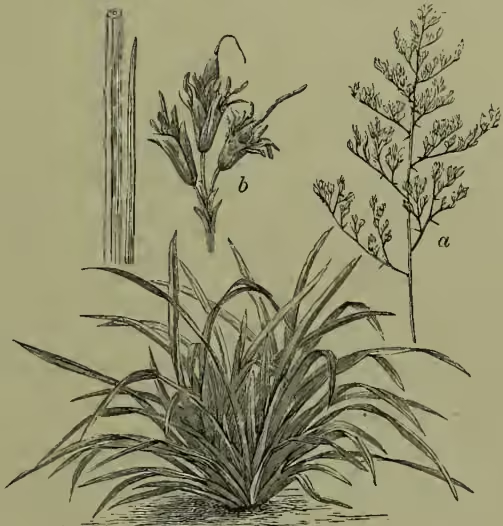
a, inflorescence; b, separate flowers, enlarged.
Flax, NEW ZEALAND, a valuable fibre quite different from common flax, and obtained from the leaf of a monocotyledonous, instead of the stem of a dicotyledonous plant. The plant yielding it is Phormium tenax, often called New Zealand Flax, and sometimes Flax Lily and Flax Bush (Harakeke of Maoris). It belongs to the order Liliaceæ, and is an evergreen growing wild over large areas, and very easily cultivated, even upon the poorest soils; it has also been introduced into southern France and Dalmatia, and is familiar in colder climates as a decorative plant in greenhouses and sheltered gardens. Its leaves resemble those of an Iris, and are from two to six feet long and one to two or three inches broad. The flowers are produced in a tall branched panicle, and are numerous, brownish-yellow, and not very beautiful; the fruit is a three-cornered capsule, with numerous compressed jet-black seeds. The fibre of the leaves is both very fine and very strong, and was used by the New Zealanders, before their country was discovered by Europeans, for making dresses, ropes, twine, mats, cloth, &c. New Zealand flax is imported into Britain for making twine, ropes, sailcloth, and other uses to which its strength and durability alike well adapt it. To obtain the fibre the leaves are cut thrice yearly, and the fibre is easily separated by maceration. But the New Zealanders procure the fibre in its greatest perfection, very long and slender, shining like silk, by a more laborious process, and without maceration, removing the epidermis from the leaf when newly cut, separating the fibres by the thumb-nails, and then more perfectly by a comb. The root-stocks are bitter and purgative, and have been used as a substitute for sarsaparilla. The leaves, when cut near the root, exude a viscid juice, which becomes thick and gummy, and is then eaten; the New Zealanders prepare a sweet beverage from the flowers.