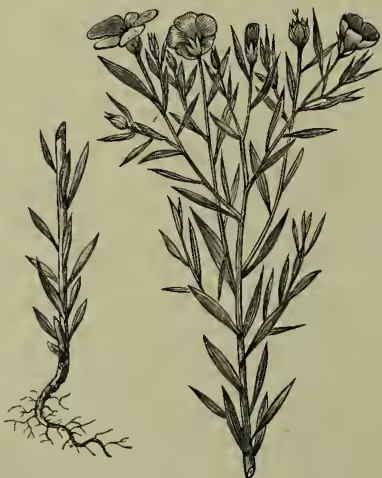
Flax (Linum), the typical genus of Linaceæ, a sub-order of Geraniaceæ, consisting of about 140 species of annual and perennial herbaceous plants, with a few small shrubs, all inhabitants of temperate climates, most abundant in Europe and northern Africa. Some are cultivated as showy garden annuals—e.g. Linum grandiflorum, &c., while the allied Radiola millegrana (Allseed) is the smallest of our phanerogamic weeds. L. catharticum, an annual weed, is the Purging Flax, long a standard resource of domestic medicine. But all essential interests centre round the Common Lint or Flax, well named by Linnæus L. usitatissimum, since in its importance for civilised man it rivals the staple food plants. There are two main varieties or sub-species—vulgare and crepitans, the latter distinguished by its shorter and more branched stems and rather larger leaves, but more easily by its larger capsules, which burst open when ripe with a characteristic sound, so scattering the seed. Though shorter, this yields the finer, softer, and whiter fibre. In both the flower is a loose corymb of beautiful blue flowers. L. austriacum is also cultivated in France, L. maritimum in southern Europe, and L. Levisii in North America, but all yield a coarser fibre. The flax of prehistoric times found in the Swiss pile-dwellings, and in the remains of the stone age in northern Italy, was derived from L. angustifolium, as not only the manufactured product but the actual remains of the stems, fruit, and seeds clearly show. The common lint of the Aryan peoples was, however, L. usitatissimum, and the occurrence of the name lint with little modification in all European languages is usually interpreted as indicating that its use dates from the remote antiquity of their common home. The same culture is shown by an examination of the mummy-cloths of Egypt, which are always of linen; and the species is also recognisably delineated upon the walls of the tombs.
The quantity of flax produced in Great Britain, once large, has steadily decreased, and is now quite inconsiderable; but the flax grown in Ireland is still an important crop. While in Scotland and England the total area under flax was in 1895 but 2023 acres, in Ireland there were in that year 95,202 (as against 106,886 in 1874 and 108,147 in 1885). The crop of Ireland varies from a little above 4,000,000 tons a year to something under it. But by far the most important producing country is Russia. The acreage in flax in Russia is about 4,000,000 acres; in Germany about 250,000 acres; in Belgium, 100,000 acres; in Austria, 200,000 acres; in France only 70,000. In the United States flax was grown as early as 1626; bounties for its production in Virginia were given in the middle of the 17th century, and the British parliament made grants to the patentees of Georgia in the middle of the 18th century. Manufactories of sailcloth were established at Salem and Springfield in 1790. The average American crop produces between 1,000,000 and 2,000,000 lb. of fibre, and 7,000,000 or 8,000,000 bushels of seed.
For an account of the mode of preparation of its bast as a textile fibre, see below; for processes of manufacture, see LINEN; and for a description of the useful applications of its seed, see LINSEED, OILCAKE, OIL.
FLAX-DRESSING.—Growing stems of flax are not cut by scythe or reaping-machine, but pulled up by the roots. The best time for doing this is when the stalks begin to turn yellow at the base, and the seeds begin to change from green to a pale brown. A heavier crop is obtained when the plant is ripe, but the quality of the fibre is injured. It is of importance that the stems of equal length should be separated, uniformity in this respect simplifying the dressing processes.
Rippling, the process of removing the seeds, follows the harvesting. The ripple, or rippling-comb, consists of a row of round iron teeth set in a wooden frame which is fixed to a plank. In length the teeth are about 18 inches, and at the pointed tops they are about half an inch apart. The rippler, taking up a bundle of flax, spreads out the tops like a fan, and generally draws first the one half of it and then the other through the teeth, a sheet being placed on the ground to receive the seeds or bolls as they fall. One or two machines have been introduced for rippling flax. One of these removes the seeds by passing the stems between two cast-iron cylinders. Another performs the operation by means of beaters which loosen the seeds, and shakers which then shake them out of the bundles of flax-straw.
Retting is the name given to the next process in the treatment of the stems of flax. Its object is to facilitate the separation of the useful fibre from the boon or woody part of the stem through the removal, by fermentation, of the gummy or resinous matters present in the plant. This is done either by dew-retting or by water-retting with or without the aid of heat. Dew-retting consists in spreading the flax on the grass, and exposing it to the influence of dew, rain, air, and light for a considerable time. It is a method practised in Russia, and produces a soft and silky fibre. Water-retting or steeping is the plan most generally followed. Soft water is essential, and the dam or pond should not be more than four feet deep. In this the flax bundles or 'beets' are placed in rows, roots downwards, and then covered with weeds or straw weighted with boards and stones, or with, turf and stones, to keep the flax below the water. If the weather is warm fermentation begins soon, a change which causes the flax to rise in the water, and it must then be more heavily weighted. The flax sinks again as the fermentation slackens, the extra weight being then removed. Great judgment is required to determine when the retting has proceeded far enough. The stems are examined with much care, and if one finds on breaking them at one or two places, or twisting them in the middle in opposite directions, that the woody core called 'shore' or 'shive' separates freely from the fibre, the flax is ready for removal from the pond. From ten to fourteen days are required for the process with water at ordinary temperatures. The smell that accompanies the process is most offensive, and water in which flax has been steeped is valuable as a liquid manure.
A quicker process of retting, in which water at a temperature of 75° to 90° F. is used, was introduced by an American, R. B. Schenck, in 1847. Wooden vats are employed, and the fermentation goes on so much more rapidly that the time of steeping is reduced to from 50 to 60 hours. By another invention (Pownall's) the flax is passed between heavy rollers after it is taken from the vats, clean water being kept flowing over the stems during the operation to remove the gummy matters. Schenck's method is not much favoured now.
Grassing follows the ordinary retting process. The flax stems are spread in rows of thin layers upon short grass for a few days, during which time they are sometimes turned with a pole; but if this is not done, the tips of the stems of one row should overlap the root ends of the next. The flax is lifted when it is found that a slight rubbing suffices to separate the woody core from the fibre.
Breaking.—After the retted stems are dried they undergo 'breaking' to prepare them for the scutching process. One simple and efficient machine for breaking consists of two pairs of horizontal fluted rollers—one pair having finer flutes than the other—mounted in a frame, and turned by the necessary gearing. There is also a feed-table. In passing between the rollers the brittle woody parts of the stems are broken throughout their length. Later breaking-machines have more numerous fluted rollers, some of which have a reciprocating motion. The more efficiently the breaking is performed the less will be the amount of scutching required.
Scutching.—The woody matter of the flax stems being broken up and ready to be separated from the fibrous portion, this is done either by hand-scutching or, as is chiefly now the case, by scutching- machines. In the hand-process the flax is hung up in such a position that it can be struck repeatedly with the blade of a scutching-knife, so as entirely to remove the woody portion. In scutching-mills—which are usually driven by water-power—the scutching is performed by a series of vertical wheels, on each of which are mounted a few wooden blades projecting considerably beyond the rim. These blades take the place of the scutching-knife, and work against wedge-shaped projections in a partition, striking the flax in the direction of its length, a workman sliding the 'broken' flax gradually forward as the scutching proceeds. Besides this arm-scutch in scutching-mills there are scutching-machines of more elaborate construction used in the dressing of flax. Brushing-machines are sometimes employed to give the flax a final cleaning before baling it for the market. For the manufacture of flax into cloth, see LINEN, and SPINNING.