Florence (Ital. Firenze), a city of Italy, capital of the former duchy of Tuscany, is situated in the valley of the Arno. It is about 123 feet above the level of the sea, 194 miles NW. of Rome, 62 E. of Leghorn by rail. Pop. (1881) of town, 132,039; of commune, 169,001 (in December 1893, 200,300). The Arno, spanned by four fine bridges, divides the city into two unequal parts, the chief on the northern bank of the river. Beyond the line of the ancient walls are thickly peopled suburbs, and a lovely, fertile, and salubrious neighbourhood, encircled by sloping hills, and studded with pictur- esque villas and fruitful vineyards and gardens. Florence and its environs, viewed from the heights of Fiesole, appear but one vast city. The influx of population consequent on the establishment here, in 1864-65, of the seat of the Italian government, necessitated a considerable extension of the city, and it is now nearly double its former extent. The ancient walls of the city have been razed; but several of the old towers pertaining to the various gates are retained, and constitute an interesting historical feature of modern Florence and a useful topographical indication of the former limits of the city. Many improvements and embellishments have been effected in the Florence of our day, and amongst these none ranks higher than the magnificent carriage-way known as the Viale dei Colli. It ascends from the Porta San Niccolo to the historic church and cemetery of San Miniato, and gradually slopes down to the Porta Romana. From the highest level of the drive, the Piazza Michel Angiolo, the panorama of Florence, the Arno, with the surrounding hills and distant Apennines, is quite unique for beauty and variety of scenery. Fine new streets, which stretch along the Arno, also add much picturesque attraction to the town, and the hygienic conditions of Florence have been greatly improved by the thickly planted avenues which encircle the greater part of the city, by the opening of several spacious squares, and by the erection of extensive new market-halls. Many causes render this city a most attractive place of residence to foreigners—a lovely country and healthful climate, cheap living, and the universal courteous intelligence of the people, united to the immense sources of interest possessed by the city in her grand historical monuments and collections of art.
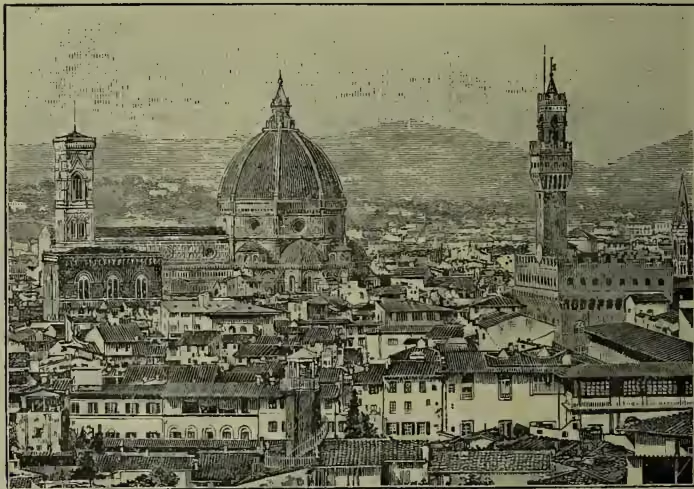
The massive and austere forms of Florentine architecture impart an air of gloomy grandeur to the streets, for the most part regular and well kept. The chief building in the city is the Duomo, or Cathedral, the foundations of which were laid with great solemnity in 1298; while in 1387 the completed façade was uncovered amidst equal pomp and ceremonial in the presence of the Italian sovereigns. The Florentines having ambitiously resolved on erecting a monument which for architectural splendour and proportions should outvie all preceding structures, the honour of preparing the design was entrusted to Arnolfo di Cambio. On his death Giotto superintended the works; and many eminent architects were employed before this splendid edifice was completed. Brunelleschi, the last, conceived and erected the grand dome, so much admired by Michael Angelo as to have served him as model for that of St Peter's. The church contains sculptures by Ghiberti, Luca della Robbia, Michael Angelo, Sansovino, Bandinelli, and other famous artists. At the side of the cathedral springs up the light and elegant Campanile (q.v.), detached, according to the custom of the times. In front is the Baptistry of San Giovanni, in form an octagon, supporting a cupola and lantern; all three edifices being entirely coated with a varied mosaic of black and white marble. Three bronze gates in bassorilievo are a great additional adornment of the Baptistry; the two by Ghiberti (q.v.) have been immortalised by Michael Angelo, with the name of Gates of Paradise. The church of the Santa Croce, the Pantheon of Florence (built in 1294—architect, Arnolfo), contains monuments to Galileo, Dante, Macchiavelli, Michael Angelo, Alfieri, &c. The church of San Lorenzo was consecrated as early as 393 by St Ambrose, and rebuilt by Brunelleschi in 1425, by command of Giovanni and Cosmo de' Medici. It contains an interesting monumental memorial of Cosmo il Vecchio, bearing inscribed the title Pater Patriæ, which had been conferred on his memory by public suffrage the year following his death. In the Nuova Sagrestia, or New Sacristy, are the two famous monuments by Michael Angelo to Julian and Lorenzo de' Medici. The Medicean chapel, gorgeous with the rarest marbles and most costly stones, agate, lapis lazuli, chalcedony, &c., stands behind the choir, and contains the tombs of the Medici family and their successors of the House of Lorraine. Annexed to the church of San Lorenzo is the Laurentian Library, with its inexhaustible store of rare MSS., founded by Giulio de' Medici. The beautiful church of Santa Maria Novella, formerly Dominican, dates from 1278 to 1360, and has famous frescoes by Cimabue, Orcagna, Filippino Lippi, and Ghirlandajo. The church of San Marco dates from 1436; adjoining it is the former monastery of San Marco, now secularised as the Museo Fiorentino di San Marco. Fra Angelico, Savonarola, and Fra Bartolommeo were inmates, and it is still adorned with the famous frescoes of Fra Angelico.
Amongst the numerous palaces Il Bargello, long a prison, but now restored and opened as a national museum, is one of the most ancient, and was formerly the abode of the republican magistrate, the Podesta. In 1841 some interesting portraits were brought to light by the removal of a coating of whitewash from the revered features of Dante, Brunetto, Latini, Corso Donati, &c., in the chapel of the palace. The Palazzo Vecchio, the seat of the republican government from its establishment till its abolition in 1530, is an imposing mass of building, surmounted by a lofty tower 260 feet high, the great bell of which used to warn the citizens of danger or summon them to defence. Adjoining the palace is the Piazza della Signoria, a square containing a fine collection of statues, and a noble arcade, the Loggia dei Lanzi, under the porticoes of which are magnificent groups of sculpture. In one of the halls of the Palazzo Vecchio there now stands a colossal statue of Savonarola a few paces distant from the spot where the reformer perished at the stake. The Palazzo degli Uffizi is a handsome building adjoining the Palazzo Vecchio, founded by Cosmo I., in the first floor of which are deposited the archives of the court of justice and other public offices, also the Magliabechi Library, now united with that of the Pitti Palace to form a national library of 200,000 volumes and 10,000
MSS. On the second floor, in a circular suite of twenty-three rooms, is contained the famous Florentine gallery of art; rich in paintings, engravings, sculpture, bronzes, coins, gems, and mosaics. A splendid apartment, known as the Tribuna, contains the rarest treasures of the collection. The Palazzo Pitti, formerly the grand-ducal residence, boasts of a superb gallery of paintings. Behind it are the beautiful Boboli Gardens, royal, but accessible to the public. The Palazzo Riccardi, now public property, is the residence of the prefect. The Palazzo Strozzi is a fine type of Tuscan architecture. Florence abounds in other public edifices and monuments, too numerous to mention, and there are several fine libraries besides those already named.
Since Italy has become a united kingdom, Florence, in common with the other cities of the country, enjoys a greatly improved educational organisation. Although not in possession of a university, the Florentines have the advantage of several superior and special educational institutions. The foremost of these, the Istituto di Studi Superiori, has adopted the ordinary university curriculum, and confers various degrees. Its success has been largely due to the able and enlightened direction of Italy's chief historian, Professor Pasquale Villari. The School of Social Science was founded by the Marchese Alfieri di Sostegno. In the Museum of Natural History medical students derive exceptional advantage from the admirable anatomical wax models of Susini; and, since 1871, in the same museum a most interesting collection of Galileo's instruments has been placed. Florence contains also a good school of art and a musical institute.
The hospital of Santa Maria Nuova contains an ancient college of medicine and surgery. The Academy of the Fine Arts and the Museum of Natural History afford unlimited resources to the public interested in their collections. There are three hospitals, one lunatic asylum, nine theatres. The Academy della Crusca (see ACADEMY) is entrusted with the care of sifting and preserving uncorrupted the Italian language. The Academy dei Georgofili was established in the interests of agriculture. Florence is the seat of an archbishop, the seat of a prefecture and of numerous provincial courts, as well as the military headquarters of the district. Its railway communications are ample. The chief industrial occupations of the Florentines are the fabrication of silk and woollen textures, and of straw-plaiting for hats, &c., jewelry, and exquisite mosaics in rare stones. The Florentines are famous for their caustic wit and natural gifts of eloquence, as well as for their shrewd thriftiness and unflagging labour. In their moral superiority may be recognised the effects of a better and more upright government than those which existed in most parts of the peninsula previous to the recent union of Italy.
History.—The city of Florence sprang originally from Fiesole (q.v.), at the foot of which it lies extended. The inconvenient and hilly site of the Etruscan Fiesole, perched on the crest of an irregular height, rendered that town so difficult of access to the traders who resorted to its market-places with their varied merchandise that it was at length decreed they should assemble at the base of the hill, in the fertile plain traversed by the Arno. The few rough shelters erected for the accommodation of these traders may be considered the original nucleus of the important and splendid city of Florence. It would seem that as early as the time of Sulla there was a Roman colony here; another was established after the death of Julius Cæsar, and it soon became a thriving town. The Florentini are mentioned by Tacitus, 16 A.D., as sending delegates to Rome, but it was not till the time of Charlemagne that Florence began to rise out of obscurity. It was now governed by a political head with the title of Duke, assisted by various subordinate officers, who were elected by the united suffrages of the duke and citizens. In the 11th century Florence and a great part of Tuscany were bequeathed to Pope Gregory VII. by his friend and partisan the Countess Matilda, who inherited from her mother, the Countess Beatrix, her jurisdiction over the city. Under the protection of Rome, Florence speedily adopted the forms and institutions of a free city; and the republican spirit which then arose amongst the people imparted an impulse to national life, and awoke a spirit of patriotism and enterprise. As early as the 11th century the Florentines were European traders and the possessors of commercial depôts in the seaports and cities of France and England, and their skill as workers in gold (see FLORIN) and jewels had grown famous. The 'arti' or trade-guilds were of great importance. In proportion as papal preponderance increased in Florence, that of the empire sank; and in 1113 the citizen forces routed the troops and slew the delegate of the emperor at Monte Cascioli, near Florence. During the bitter wars between pope and emperor which raged throughout Italy, Florence and all Tuscany seemed to have been saved from the feuds of Guelphs and Ghibellines—the former adherents of the papacy, the latter of the empire. But in 1215 Florence became involved in the great party struggle, owing to a private feud breaking out between two noble families, chiefs of the contending principals. A Guelph noble, Buondelmonti, mortally incensed the Ghibelline family of the Amidei, by breaking off his alliance with a daughter of their house, and contracting marriage with a member of a Guelph family. To avenge this insult the Amidei appealed to their powerful kinsmen, the Uberti, and in fact to all the Ghibelline party of Florence. Buondelmonti was stabbed to death as he crossed the Ponte Vecchio, and was speedily avenged by the Guelphs in the blood of his enemies. Thus for thirty-three years was Florence distracted by the deeds of bloodshed and violence of these two rival factions, who assumed the names and adopted the respective causes of Guelphs and Ghibellines. See GUELPH AND GHIPELLINE.
In 1250 the animosity of these parties seemed somewhat blunted, and public attention was directed to wise internal reforms. Twelve magistrates, or anziani, were appointed in place of the consuls, each of the six sections into which the city was divided being entrusted to two of these magistrates, whose tenure of office was annual. To avoid all local dissensions, two other magistrates, strangers by birth, were elected: the one, invested with supreme authority in civil and criminal cases, was called the podestà; the other, with the title of captain of the people, had the chief command of the militia, in which were enrolled all the youth of the state, who were bound, at the call of this magistrate, to join their company fully equipped for fight: twenty companies defended the town, ninety-six the country. After the death of the Emperor Frederick II., the great protector of the Ghibellines, the Guelph or papal party gradually rose in power in Florence, and during ten years of their predominance the city increased in grandeur and prosperity, until it stood not only the first in Tuscany, but one of the first of all Italy. Its forces successively humbled the adjoining towns of Siena, Arezzo, Pisa, and Pistoia, and in 1254 captured Volterra. In 1260 the standard of civil war was again raised by the Ghibellines of Florence, who, in league with Manfred of Naples, attacked the Guelphs, and cut their forces to pieces in the sanguinary battle of Monte Aperto. The conquerors entered Florence forthwith, and in the name of Manfred abolished all trace of the popular institutions, establishing an exclusively aristocratic executive; they even strongly advocated the entire destruction of the city, the hotbed of Guelphism. This barbarous scheme was indignantly repudiated by their own famous leader, Farinata degli Uberti, immortalised by Dante for his patriotism. He even declared his intention of heading the Guelphs, were such a sacrilege perpetrated by his own party.
Pope Urban IV., French by birth, summoned against the Ghibelline Manfred a French army, led by Charles of Valois, to whom he offered the prospective kingdom of the Two Sicilies. Manfred was defeated and slain in the famous battle of Benevento, and Guelph ascendancy was restored anew throughout Italy and Florence. Charles fully restored to the Florentines their internal institutions, and received their offered allegiance for ten years in 1266. In 1282 the Priori, a new executive power, was established in Florence; and in 1293, by the consent of the Priori, a higher chief than their own order was elected, with the title of Gonfaloniere. In 1300 Dante became one of the Priori, and the former feud was recommenced with new vigour between two factions, who now bore the names of Bianchi (Whites) and Neri (Blacks). Their dissensions were, however, interrupted by the appearance of Charles of Valois, sent by Boniface VIII. to restore tranquillity, in 1301. Charles espoused the part of the Guelphs or Neri, and sanctioned every outrage on the Bianchi, who were plundered and murdered barbarously, the survivors being exiled and beggared; among these were Dante and Petracco dell'Ancisa, the father of Petrarch. In 1306 Pistoia was besieged and taken by famine with great barbarity. In 1315 the Florentines met with a severe check from the Ghibellines of Pisa, under the command of Uguccio della Faggiula; and in 1325 they were completely defeated by Uguccio's successor in command, the valiant Castruccio Castracani, in the battle of Altopascio. Florence, weakened by long dissensions, and alarmed by Castruccio's threat of marching on the city, appealed to the king of Naples for aid. They received joyfully an officer of the king, entitled the Duke of Athens, sent as viceroy; and, such was the public demoralisation of the moment, they proclaimed him dictator of the republic, unanimously suppressing the offices of priori and gonfaloniere. The intrigues of this ignoble schemer to overturn the republic being discovered, he was ignominiously expelled by a general popular rising, and barely escaped with his life. An attempt to admit a proportion of the nobles into the government signally failed at this time, and only led to renewed animosity between them and the citizens. This was the last effort of the nobles to secure power.
A terrible pest decimated Florence in 1348, sweeping off 100,000 inhabitants (see BLACK DEATH). The chief power of Florence about this time seems to have been alternately wielded by the democratic families, the Alberti and the Ricci, and by their patrician rivals, the Albizzi, who for the space of fifty-three years guided the republic in the path of progress. In 1406 the ancient and illustrious republic of Pisa (q.v.) fell under the sway of Florence, after a heroic resistance. From 1434 the history of Florence is intimately bound up with the House of Medici, distinguished for their patronage of art and literature—especially Lorenzo the Magnificent (see MEDICI). The Medici were repeatedly banished from Florence for aiming at sovereign power; and to their intrigues Florence owes her final loss of republican rights and institutions. The extraordinary labours of Savonarola (q.v.), his trial and execution at the stake, belong to the last decade of the 15th century. Pope Clement VII., of the House of Medici, formed a league with the Emperor Charles V., by which the liberties of Florence were to be extinguished and the sovereign power to be invested in Alexander de' Medici. In September 1529 an army of imperialists, under the Duke of Orange, entered Tuscany; and on the 8th August 1530 the siege of Florence terminated, after a defence of unexampled devotion and bravery on the part of the citizens.
Thus fell the name and form of the republic of Florence, quenched in the best blood of the city. From this period Florence loses her distinctive history, and is only known as capital of the grand-duchy of Tuscany, Pope Pius V. having conferred on Cosmo de' Medici the grand-ducal dignity. On the extinction of the Medici in 1737, Tuscany fell to the Duke of Lorraine; and in 1808 was given by Napoleon to his sister Elise. Florence continued to be the seat of the grand-ducal court until 1859; and after the constitution of the united kingdom of Italy the city held the position of provisional capital of the country from 1864 until 1871. The departure of the court gave for a time an inevitable check to the prosperity of the town. Some idea of the splendour of Florence as a republic may be gathered from the facts that her capitalists were so enormously wealthy that they supplied the chief sovereigns of Europe with funds; her manufactures of wool, silk, and gold brocade were exported throughout the world; and she possessed great commercial establishments in all the countries of Europe.
In art Florence holds a unique place: the Florentine school of painting, from Cimabue to Andrea del Sarto, is admittedly the most important in Italy. In Italian literature the position of Florence is only hardly less conspicuous. Florentine eminence is attested by the names of Florentine worthies such as Dante and Boccaccio; the painters Cimabue, Gaddi, Orcagna, Masaccio, Ghirlandajo, the Lippis, Andrea del Sarto, Carlo Dolci; the sculptors Luca della Robbia, Donatello, Ghiberti, Bandinelli, Cellini; the architect Brunelleschi; the musicians Lully and Cherubini; Machiavelli and the historian Guicciardini; the navigator Amerigo Vespucci; the Medici, &c. Through the works of its writers the Florentine Italian, not that of Rome, became classical.
In July 1895 the city suffered from earthquake, but the public buildings were hardly injured.
See the articles BOCCACCIO, DANTE, ITALY, MACHIAVELLI, MEDICI, MICHAELANGELO, PAINTING, SCULPTURE, &c., and works there quoted: historical works by Capponi (1875), Perrens (1877-90; trans. 1893), Mrs Oliphant (1876), Duffy (1892), Johnson (1892), and especially Villari (trans. 1895); books on the city by Yriarte (1880; trans. 1882), Hare (1884), Grant Allen's Historical Guide (1897), Ruskin's Mornings in Florence, and George Eliot's Romola.