Fluke (Fasciola (or Distomum) hepatica), the parasitic worm which causes the 'liver-rot' of sheep. It belongs to the class of Trematodes (q.v.), and to a large genus of about three hundred species, if the two titles Fasciola and Distomum be regarded as identical. The adult fluke, which occurs in
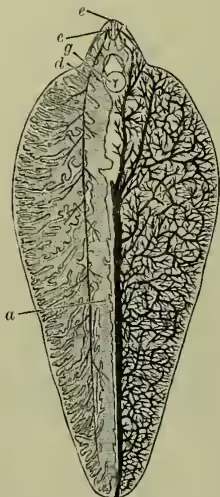
The alimentary and nervous systems only are shown on the left of the figure; the excretory system alone on the right side; a, right main division of the alimentary canal; c, lateral ganglion; d, lateral nerve; e, mouth; g, ventral sucker. is well developed; the excretory system consists of two very much branched vessels opening at a posterior pore; the reproductive system is hermaphrodite, and exhibits a complex division of labour.
Life-history.—The history of the fluke is happily an intricate one and full of hazards. The ova are probably fertilised by male elements from the same animal, a very unusual occurrence, all but exclusively restricted to certain parasitic flat-worms. The eggs are furnished with nutritive capital from a yolk gland, are surrounded by a shell, and begin to develop a little within the parent animal. After extrusion from the latter they may be found in the bile ducts in enormous numbers, each fluke being said to produce about half a million. Such prolific multiplication is a very frequent characteristic of parasitic animals, and is probably associated with the abundant and at the same time stimulating food. Its utility in securing the continuance of the species in face of the numerous risks of failure is obvious. From the bile duct of the sheep the segmented ovum enclosed in its shell passes to the exterior. The embryo develops for two or three weeks, and the successful result eventually becomes free in water. It swims for some hours by means of a covering of cilia, but its sole chance of life appears to lie in meeting and attaching itself to a small water-snail (Limnaustruncatulus), into which it bores its way. Having established itself, the embryo fluke loses its cilia, and is metamorphosed into what is called a sporocyst. This may divide transversely into two; but usually certain cells within the sporocyst behave like parthenogenetic ova, and develop into a fresh generation or several generations known as rediae. The rediae burst out of the sporocyst, and migrate into the liver or some other part of the snail, killing their host if they are very numerous. Like the sporocyst, they give rise internally to more embryos, of which some may be simply rediae over again, while others develop into tailed embryos or cercariae. These emerge from the rediae, wriggle out of the snail, swim freely in the water, climb up grass stems or such like, swing their tails off, and encyst. If the encysted cercaria on the grass stem be eaten by a sheep it grows into the adult and sexual fluke. To recapitulate, the developing embryo becomes a free-swimming form; this bores into a snail and changes into a sporocyst; from certain cells of the latter asexual rediae arise; these eventually give origin in a similar way to tailed cercariae, which, eaten by a sheep, grow into flukes. There are thus several asexual generations interrupting the ordinary sexual process, illustrating what is known as 'alternation of generations.' The asexual process usually takes place by special cells, but there may be likewise transverse division of the sporocyst. The above history has been independently worked out by Leuckart and Thomas.
Practical Importance.—The disease of liver-rot in sheep is widespread and disastrous, killing, it is said, not less than a million per annum in the United Kingdom. It is especially common after wet seasons, and in low, damp districts. The external symptoms are described as 'emaciation, tenderness in the loins, harshness and dryness of the wool, and a scaly condition of the skin.' The preventives suggested are drainage of pastures and dressings of lime or salt; destruction of eggs, infected manure, and badly fluked sheep; giving the sheep salt and a little dry food. The same fluke occurs in other ruminants, and rarely in man. A related form, Distomum lanceolatum, has a similar distribution, and not a few other species have been reported as rare human parasites. The genus BilharZIA (q.v.) is not far removed. Other parasites, as of Fishes (q.v.), are likewise called flukes.—See also ANCHOR, FLOUNDER.
See PARASITISM, TREMATODE; also Leuckart, Parasiten des Menschen (1863; new ed. 1879 et seq., trans. by Hoyle; Thomas, Quart. Jour. Micr. Sci. XXIII. (1883); W. E. Hoyle, A General Sketch of Trematoda (Edin. 1888).