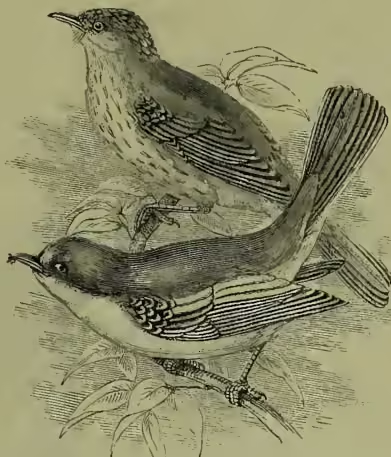
Fly-catcher, a name applicable to any of the numerous birds which make up the Passerine family Muscicapidae. The family includes a large number (over 40 genera and 280 species) of usually small-sized and often brightly coloured forms, very abundant in the warmer parts of the Old World and Australia, scarcer in temperate and colder regions, and wholly absent from North and South America, where they are represented by the Tyrant-shrikes or Tyrannidae. The nature of the bill is a distinctive feature; it is strong, short, and somewhat swallow-like, laterally compressed towards the slightly hooked point, and with bristles on the broad and flat basal portion. The common British Fly-catcher (Muscicapa grisola) is a tiny brownish-gray bird, which reaches our shores from Africa in early spring, and leaves again with its brood in autumn. The upper surface is mouse-coloured, the under side is whitish, with brownish-gray longitudinal spots. Its cry is a monotonous chirp; its habit, like that of its neighbours, is jerkily active. It remains quietly seated till an insect is observed, makes a successful dart, and returns to its perch. In nesting it is nowise shy; a beam in an outhouse, the side of a timber-stack, the branch of a tree trained on a building, and even a lamp-post are among the sites recorded. The parents have been seen to visit their nest with food for the young not less than 537 times in a single day, which indicates a marvellous quickness of movement and adroitness in food catching. The Pied Fly-catcher (M. atricapilla or luctuosa), with different colour, is common in south Europe, and has been recorded in Britain. There are ten other species in Europe and Africa. Among the other fly-catchers outside the genus Muscicapa are the Fantails (Rhipidura), with spreading tails, in oriental and Australian regions; the beautiful long-tailed Paradise Fly-catcher—e.g. Terpsiphone paradisi of the East Indies; the important genus Myiagra of Australia and the Moluccas; the interesting Australian 'Grinder' (Seisura inquieta), which 'hovers' like a kestrel, descends rapidly to the ground upon insect prey, and emits a curious noise (comparable to that made by a grinder at work) just before alighting, or when poising a few feet from the earth.