Flying, or FLIGHT, is the locomotion of an animal in the air by means of wings, organs specially adapted to that purpose. By means of these organs the animal raises itself from the ground and sustains itself in the air, as well as moves forward in any direction it desires. Birds and bats are the only existing vertebrate animals possessing the power of true flight; the lateral membranes of flying squirrels, flying lemurs, flying phalangers, &c. sustaining those animals in the air after the manner of the paper dart familiar to schoolboys. This toy is a folded, pointed arrangement, having this section , which, when projected from the hand with some force, will travel through the air for several yards. Flying-fishes, which possess enormous pectoral fins, are also sustained in the air for short flights on the same principle—rising and falling over the waves by means of the upward air-currents induced by the curved surfaces presented by the waters below. Examination of a bird's wing—so different from that of an insect—will at once show that the mechanism of its flight is also different. The wing exhibits various curves, from its inner part where it inclines downwards to its tip, which is horizontal and sometimes turned upwards. Dr Pettigrew has endeavoured to show that all natural wings are screws, and that when vibrating they twist in opposite directions during the up and down strokes. Professor Marey points out the fallacy of this theory, and urges that the alternating movement of the wing cannot fairly be compared to the action of a screw. For, although we may admit that the wing revolves on an axis, its rotation is only a fraction of a turn, and is followed by the reverse action. This reversal in a screw would destroy the effect of the previous movement, just as the reversal of the movement of a ship's propeller will cause it to go backward instead of forward. A bird's flight is dependent upon mechanical laws; but there has always been a difficulty found in explaining it by those laws on account of the great rapidity of movement exhibited by birds when flying. We are, also, in ignorance of the exact amount of supporting power offered by the air to swiftly moving bodies of particular form. But form, we know, must play an important part in this aspect of the matter, as we find in the extreme cases of the fall of a solid round bullet and that of the same amount of lead beaten out into the form of a sheet.
Hence many theories have been put forward to explain the flight of a bird, including the absurd notion that the bones and quills are charged with a light gas, such as hydrogen. It is obvious that there are marked differences in the mode of flight of different birds; some, like the humming-birds, progressing through the air by short and rapid strokes of the wings; whilst others—including the larger birds—combine such movements alternately with a period of apparent rest, when, with outstretched wings, they seem to sail along without any movement of the pinions whatever. This question of the 'sailing' of birds has given rise to much discussion, some averring that they have seen birds rising and remaining in the air for long periods without any movement of the wings. It is certain, however, that such periods of rest cannot be possible without an initial impulse by means of wing action, or by means of the impetus which would result from an oblique downward movement. We must also remember that the alleged stillness of the bird may be only apparent, and that the wings may be subject to slight variations of position which will enable them to take advantage of helpful currents in the atmosphere. We may take it for granted that a bird cannot 'sail' in perfectly still air for any long period, for such a power would be contrary to the natural laws with respect to falling bodies.
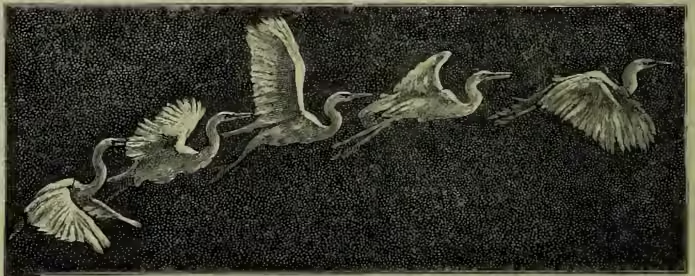
It may be assumed that in all creatures possessing the power of true flight the same principles are involved, although the movements vary with differences of form and structure. These movements have been subjected to careful analysis; but it must be admitted that the earlier investigators formed their conclusions more upon conjecture than upon direct experiment. Professor Marey, the eminent French physiologist, seems to have been the first to cause these movements to make their own records, which he did by carefully constructed apparatus, the principle employed being the same as that adopted in the sphygmograph and other modern instruments, in which a point in direct connection with the moving part is made to trace a line on a blackened (smoked) surface. The same investigator was also the first to apply (in 1882) the photographic method to this field of inquiry. By means of a camera of special construction, which he called a photographic gun—for it was aimed at a flying bird like a fowling-piece—he was able to secure twelve different images of the bird on one plate in a single second of time; whilst by means of a chronographic attachment the duration of each movement was ascertained. He noticed in this way in the case of a flying gull four typical movements of the wings, which were repeated three times in one second. By placing the photographs thus obtained in a phenakistoscope attached to an optical lantern he was able to combine the successive images upon a screen and reproduce the movements of flight. These pictures were little more than outlines or silhouettes; but under the microscope sufficient details of the feathers could be detected to enable Professor Marey to draw from their appearance certain conclusions. He states that each feather has a proper and independent motion, and that whilst they are brought closely together during the downward motion of the wing, they are somewhat separated and placed on edge during the return movement, so as to offer to the air as little resistance as possible. But he was forced to admit that such experimental photographs must be greatly multiplied, and taken with birds of various kinds in different positions with regard to the camera, before the study of flight could be made thoroughly complete. In 1884 further advances in photographic methods, and more especially the perfection to which the manufacture of rapid dry plates attained, enabled Anschütz in Germany to obtain photographs of birds in flight of a far more perfect character. These were so complete from an artistic as well as a scientific standpoint that they exhibited plainly the details of every feather on the flying bird. This inquirer had a concealed camera above a pigeon-house, and later on had the opportunity of making constant photographs of a stork's nest from a similar point of vantage. The photographs taken showed the parent birds (1) in flight, (2) hovering above the nest, (3) departing from it, and (4) arriving at their home. They fully corroborated the observations previously made by Marey.
The common argument, that because man has obtained such complete mastery of the ocean he should also be able to navigate the air, is fallacious, and can only be advanced by those who fail to comprehend the vast difference which exists between the two media. Air is compressible to an extraordinary degree—is elastic, and will offer little resistance or recoil if struck. Water, on the other hand, is almost incompressible—is inelastic, and offers such recoil if struck that a swimmer in diving from a height will suffer serious injury from contact with its surface, unless he take proper precautions. We must remember, moreover, that a ship on the water is supported thereon without any need of energy, except to provide means for its propulsion. A flying creature, on the other hand, must be endowed with power to counteract the effects of gravitation, as well as to propel it through the air. It has been well shown by Dr Pettigrew how nature varies the travelling apparatus of different animals according to the medium in which the creature is destined to move. And he gives as illustrative examples the bull with comparatively small feet adapted for land; the turtle, with far larger travelling extremities adapted for water; and the bat, with immense wings in proportion to its size, for flight in air.
It is natural that man should from the very earliest times have endeavoured to fly, and the history of many countries records the various attempts that have been made in this direction, which attempts have always ended in ignominious failure. The balloon is but a thing of yesterday compared with the numberless devices which have been suggested and contrived to enable men to imitate birds in their passage through the air; for the balloon can boast of little more than a hundred years of existence, while these attempts at flight have been going on for thousands of years. It must be admitted, however, that the problem is no nearer solution to-day than it was at its first inception. It is true that we understand the principles of flight better than our forefathers did, and that we have at command new materials and methods of construction which they knew not of. Yet with all these advantages we cannot master the art of flying, and the reason of our failure is not far to seek. If we were able to construct a perfect pair of wings, endowed with every property pertaining to the natural mechanism of flight, we should be no nearer our goal, for the simple reason that we should lack muscular power to move them. Birds are not only light in proportion to their size—the largest weighing little more than 28 lb.—but they possess enormous strength. The pectoral muscles of a swallow are said to exceed in weight all its other muscles combined; and it may be said generally that those muscles in a bird upon which the wing action depends are hundreds of times proportionately more powerful than the muscles which actuate the movements of a man's arm. We must observe, too, that most of the swiftly-flying birds are carnivorous, are able to assimilate their food in a concentrated state, and that the temperature of their bodies is higher than in the mammalia. In this respect they may be compared to a small engine working at high pressure, and developing an enormous amount of energy. We must come, therefore, to the inevitable conclusion that, although it may be possible for man to make an experimental flight from a height with artificial wings, as has been done in the past, he will never be capable of sustained action in the air by the same means. Whilst we cannot concede the possibility of a man flying by his own muscular exertions, we must admit that a flying-machine is theoretically possible, and we may now point out the many practical difficulties which stand in the way of its achievement, and which hitherto have baffled the labours of the enthusiasts who have devoted much time to the matter. It may at once be remarked that the balloon has in no way helped in the solution of the problem. It is a mere lifting-machine, which, like a cork in the water, has no movement of its own, but is the sport of every current in the medium by which it is supported. A true flying-machine is one which will rise from the ground by self-contained energy—such energy being applied to (1) screw-propellers or (2) wings. So long ago as 1796 Sir George Cayley designed a toy on the propeller principle, which was actuated by means of the energy stored in a bent bow. Of more recent years flying toys have been made, working propellers or wings by means of twisted strands of india-rubber. We may also mention that flying toys on the kite principle have been constructed with some success. But when we come to consider the construction of a machine on a large scale, we find that we are beset with many difficulties. The most serious of these is the want of a motor powerful enough for the purpose which shall not be held to earth by its own weight. After reviewing all those which are at present known—including those actuated by compressed air, gas, and electricity—we must award the palm to the steam-engine, as being by far the most convenient means which we have for affording a continuous supply of energy of definite amount in proportion to its weight. But this energy falls far short proportionably of the amount expended by a bird in flight; and we must conclude that, until a motor be found that will in this respect approximate to the living bird, a flying-machine will be an impossibility. But supposing that such a motor be discovered, there will still remain the difficulty of the perfect balancing of the machine. A child learning to walk will be safe enough on a flat floor, but will soon fall down if its first steps are taken over unequal ground. The air may be compared to a surface having such inequalities, for it is not homogeneous, but is subject to eddies and currents in both upward and downward directions. A bird soaring in the air will instinctively meet an unexpected eddy affecting one wing by an immediate compensating movement; but a mere machine made by the hands of man would not possess this instinct; and it is difficult to believe that any mechanism, however beautiful in design, can effectually take the place of that which is associated alone with the breath of life.
See Pettigrew's Animal Locomotion (1873; new ed. 1882); M. Marey's Animal Mechanism (1874); Reports of the Aeronautical Society of Great Britain; S. P. Langley, Aero-dynamics (1891); for Maxim's massive machine and experiments, see Nature, August 1895; and the Aeronautical Annual (1896-98).