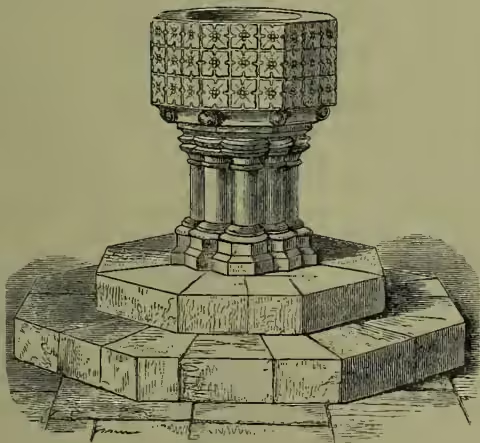
Font (fons baptismalis), the vessel used in churches as the repository of the baptismal water. In the early period, while immersion continued to be the ordinary rite in the administration of the sacrament of baptism, the Baptistry (q.v.) was furnished with a basin in the floor sufficiently capacious to admit of the immersion of a certain number of converts at one time. When infant baptism became general, fonts of an oblong form were employed, of suitable size for the immersion of a child. When it became customary to baptise by affusion—i.e. by pouring the water on the head of the person to be baptised—the size of the basin was naturally diminished, and eventually it assumed the dimensions and the form which are now familiar to us in most of the medieval churches in Great Britain and upon the Continent. The baptismal font, in its normal form, consists of a basin or cup, more or less capacious, but usually about 2 feet 6 inches in diameter, hollowed out of a solid block, and supported upon a stem or pedestal. It is ordinarily of stone, but some ancient examples of leaden fonts also occur, and a few of copper or of bronze. In general it may be said that the font, in its external design and character, followed the prevailing style of ecclesiastical architecture and ornamentation. There is some doubt as to whether any existing specimen in England really belongs to the Saxon period; but examples are found of all the later styles, from the Early Norman down to the latest revival of Gothic architecture in our own day; the Early English; the Decorated, of which a beautiful example exists in the church of All Saints, Norwich; and the Perpendicular, which is seen in its highest perfection at East Dereham in the same county of Norfolk. The annexed illustration exhibits a highly characteristic specimen of the fonts of the beginning of the 14th century, which stands in the church of Swaton, Lincolnshire, erected about 1310.
The external figure of the basin was often octagonal, sometimes circular, sometimes square, more rarely hexagonal. Ancient sarcophagi were sometimes employed. The basin was commonly supported on a single pillar or stem. Many cases, however, occur in which it rests on three, four, or five pillars, or, as in the engraving, on a group of pillars or pilasters united into a solid stem. In the square font the central basin rested on a solid central stem, and four shafts supported the four corners. The angles of the frame were used for carrying the salt, the oil, and the candles employed (see V. le Duc, Dictionnaire, vol. v. p. 539, for illustration). The exterior, as well of the basin as of the pedestal, was often highly decorated, ordinarily with sculpture, but occasionally also in gold and colours; the designs on the basin commonly representing subjects connected with baptism, or its types and symbols. We frequently meet around the pedestal figures of the apostles, sometimes only eleven in number, Judas being omitted.
In the Catholic Church the 'chrism,' or consecrated oil blessed by the bishop, and also the so-called 'oil of catechumens' are mingled with the baptismal water, which is reserved for subsequent use. With a view to the preservation of the water thus reserved, the font, especially when it is of porous stone, is sometimes lined with lead; and from an early date it has been furnished with a lid, which is secured by a lock. The lid was originally a flat wooden cover, but in later times it is carried up like a spiral canopy, and is often of a highly ornamental character.
The ordinary place of the font is at the western end of the nave, near the entrance of the church; but in some cases, especially on the Continent, it stands in a separate chapel or baptistery, or at least in a compartment screened off for the purpose. Even when it stands in the open nave, it is properly enclosed by a rail.
The baptismal font is not to be confounded with the 'holy-water fount,' which usually stands near the entrance of Catholic churches, and from which persons entering sprinkle their forehead, in recognition of the inward purity with which we ought to enter the house of God; nor with the piscina or cuvette, which is found in the chancel or the sacristy of ancient churches, and which was intended to receive and carry away the water used in cleansing the sacred vessels and the other furniture used in the administration of the eucharist, though the font itself is also sometimes called piscina.