Formic Acid, or , derives its name from the circumstance of its having been first obtained from the red ant (Formica rufa). It occurs in ants, in the stings of bees, wasps, and nettles, in fir needles, and in various animal secretions. It may be obtained from any of these by distillation with water. Anhydrous formic acid is a mobile liquid of extremely penetrating odour, crystallising at , and boiling at , miscible in all proportions with water and alcohol. It produces a painful blister if dropped on the skin. The aqueous acid is prepared in the following manner: Half a pound of oxalic acid is mixed with one pound of glycerine, and the mixture heated in a retort to ; a little dilute formic acid distils; another quantity of oxalic acid is added, and the mixture again heated, and so on indefinitely, the glycerine remaining unchanged at the end of the operation. The decomposition is as follows:
| Oxalic Acid. | Formic Acid. | Carbonic Acid. |
| = |
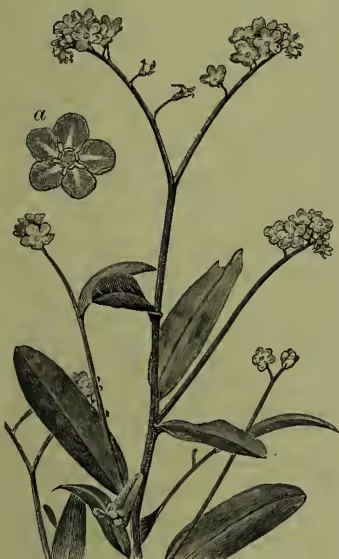
(Myosotis silvatica):
a, a flower.
Acid containing 56 per cent. of the pure substance is obtained in this way. The anhydrous acid is procured by preparing the lead salt, and decomposing this with sulphuretted hydrogen. It may be formed synthetically in various ways: (1) By direct combination of carbonic oxide, CO, and caustic potash, KOH, forming , potassium formate; (2) by boiling aqueous prussic acid; (3) by heating chloroform with caustic potash. Formic acid and all its salts (called formates or formiates) are strong reducing agents, and precipitate metal from solutions of gold, silver, or mercury salts. Formic acid is obtained in small quantities by the oxidation of a great number of organic substances. Formates of silver and lead are sparingly soluble; all the others are freely so. By heat they are converted into oxalates yielding pure hydrogen.
Potassium Formate. Potassium Oxalate. Hydrogen.