Friction (Lat., 'rubbing;' Fr. frottement). In the science of Mechanism as well as in practical engineering one of the two main hindrances to motion and work is the tangential reaction between the pieces of a machine when one slides or rolls upon another. Since no surface is absolutely smooth, any two bodies in contact produce a mutual resistance to relative motion at all the points where they touch, and some measurement of this obstructing force is of the first importance in certain practical problems. A recent theory is that frictional resistance is due to the development of electricity over the area of contact.
Statically, friction is a force acting in the tangent plane of two bodies, when one slides or rolls upon another, and always in a direction opposite to that in which the moving body tends. The laws of the action of this resistance were investigated in 1781 by Coulomb at Rochefort, and more fully illustrated in 1830-34 by Morin at Metz, but the conclusions reached by George Rennie's experiments are of still greater importance in practical mechanism.
The general results established as to friction are—(1) It does not depend upon the extent of the surface in contact, but upon the pressure exerted between the touching bodies; (2) it does not depend upon the rate of relative motion of the surfaces, except in certain extreme cases; (3) statical friction—i.e. for the state bordering on motion—is increased if the surfaces have for a certain time remained in contact; (4) the energy which seems lost, owing to friction, develops heat or electricity; (5) the lighter the normal pressure between two pieces of a machine, the finer and more fluid should be the unguents applied to reduce the friction; (6) in rolling friction, and especially carriage traction, the resistance is inversely as the radius of the wheel or roller.
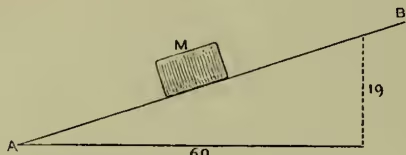
A main object of all the experiments was to obtain that measure of the force of friction which is called its coefficient. If M (fig. 1) represents a block of oak resting on an elm plank, AB, then when the plank is raised till M is just on the point of sliding down the inclined plane the fraction is called the 'coefficient of friction for oak on elm,' 60 being the length of the base, and 19 the perpendicular or vertical at its extremity. Thus, the angle A is called the angle of friction, and is another name for the coefficient of friction. That fraction is easily shown to be the ratio of the resistance to the normal pressure between the surfaces in contact.
Statical friction or adhesion must manifestly vary according to the quality of the surfaces in contact. In some woods, when smoothed by rubbing, the coefficient of friction is reduced from to ; and when the surfaces are smeared with oil, grease, or other lubricant the adhesion is not only greatly diminished, but is affected so long as any trace of unctuous matter remains. If wood rests motionless on wood for 100 seconds, the adhesion is greater than after resting only 20 seconds; but after about two minutes the coefficient is not increased by continuing the contact.
When once the adhesion is overcome, the friction is sensibly diminished during motion, as is shown by the following coefficients selected from Morin's tables :
| Surfaces in Contact. | Adhesion. | Friction during motion. |
|---|---|---|
| Wood on wood, dry..... | .50 | .36 |
| " " soaped..... | .36 | .14 |
| " " greased..... | .19 | .07 |
| Wood on metal, dry..... | .60 | .42 |
| " " greased..... | .63 | .45 |
| Metal on metal, dry..... | .18 | .18 |
| " " oiled..... | .12 | .07 |
The coefficient of friction was determined by George Rennie for all ordinary bodies with various details. The following are some of his results for kinetic friction :
| Steel on ice..... | .014 | Soft steel on soft steel..... | .146 |
| Ice on ice..... | .028 | Leather on iron..... | .25 |
| Hardwood on hardwood... | .13 | Granite on granite..... | .30 |
| Brass on wrought-iron..... | .135 | Sandstone on sandstone.... | .36 |
| Yellow deal on deal..... | .35 | Woollen cloth on cloth..... | .43 |
The following table gives not only the coefficient of certain selected substances, but also their angle of friction as already defined :
| Surfaces in Contact. | Friction. | Angle. |
|---|---|---|
| Wrought-iron on brass..... | .17 | 9° 39' |
| Steel on cast-iron..... | .20 | 11° 19' |
| Marble (polished) on marble..... | .16 | 9° 6' |
| Birch on birch..... | .64 | 32° 38' |
| Wrought-iron on oak..... | .62 | 31° 47' |
| " " elm..... | .25 | 14° 3' |
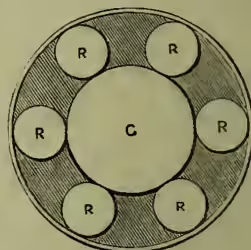
It should be noted that, though technically prejudicial to the work of machines, friction plays an important and useful part in practical mechanics as well as ordinary life. It is necessary, e.g., not only to enable a man to walk, but for the action of the driving-wheel of every locomotive; and is essential to the utility of all nails, screws, and wedges, as well as railway-brakes, &c. In the important case of a strap round a drum, friction is utilised to convey motion most simply and usefully. Besides lubricants rollers or wheels are often used in mechanism to diminish friction, by changing a sliding or rubbing motion to a rolling one. A roller is theoretically better than a wheel, because in the latter case the stress is thrown on a slender axle. Fig. 2 gives an instance of the former contrivance, showing a cross section of a gudgeon, G, turning midway between six rollers, R, of the same size enclosed in a fixed circular box with closed end.
With reference to the reduction of friction by lubricants, it is found that if suitably chosen and applied they tend to equalise the coefficient or measure of obstruction. Thus, hog's lard and olive-oil interposed in a continuous stratum between the surfaces of wood on wood, wood on metal, metal on wood, or metal on metal (when in motion), have nearly all the same coefficient of friction—the value being in all cases included between .07 and .08. Tallow gives the same coefficient as the other unguents, except in the case of metal on metal, when the coefficient rises to .10. Blacklead is frequently used to reduce the friction between wood and wood.
With regard to fluid friction, we need only note that it depends on the viscosity of the liquid, and in certain cases is reduced by increase of temperature. Thus, a solid body in ice-cold water finds greater resistance to motion than in warm water. Some recent physicists have shown that the fluid friction due to our ocean Tides (q.v.) is gradually retarding the earth's rotation, and bringing the moon nearer. See Thurston's Friction and Lost Work in Machinery (New York, 1886).
END OF VOL. IV.



22501632230
Bay 181


CHAMBERS'S
ENCYCLOPÆDIA
A DICTIONARY
OF
UNIVERSAL KNOWLEDGE
NEW EDITION
VOL. V
FRIDAY TO HUMANITARIANS
WILLIAM & ROBERT CHAMBERS, LIMITED
LONDON AND EDINBURGH
J. B. LIPPINCOTT COMPANY, PHILADELPHIA
1901
All Rights reserved.
Q. REF
YK / CHA
The following Articles in this Volume are Copyrighted by J. B. LIPPINCOTT COMPANY in the United States of America :
GEORGE, HENRY.
GEORGIA, U.S.
GRANT, ULYSSES S.
HARRISON, BENJAMIN.
HARTE, FRANCIS BRET.
HARVARD UNIVERSITY.
HAWTHORNE, NATHANIEL.
HOLMES, OLIVER WENDELL.

Among the more important articles in this Volume are the following:
| FRIENDLY SOCIETIES.. | Rev. J. FROME WILKINSON. | GUN ..... | W. W. GREENER. |
| FRIENDS..... | JAMES G. SMEAL. | GUNNERY, &c ..... | Lieut.-Colonel DUNLOP, R.A. |
| FRUIT ; FUNGI..... | Professor PATRICK GEDDES. | GUNPOWDER, &c..... | Major-General ARBUTHNOT. |
| FUEL..... | R. E. ANDERSON. | GUNPOWDER PLOT..... | T. GRAVES LAW, LL.D. |
| FUERO..... | Rev. WENTWORTH WEBSTER. | GYMNASTICS..... | Dr CHARLES W. CATHCART. |
| FURS..... | HENRY POLAND. | GYPSIES..... | F. HINDES GROOME. |
| G ; H..... | Canon ISAAC TAYLOR. | GYROSCOPE ..... | Professor CARGILL G. KNOTT. |
| GAELIC..... | Professor MACKINNON. | HADRIAN'S WALL..... | Dr J. COLLINGWOOD BRUCE. |
| GAINSBOROUGH..... | J. M. GRAY. | HAFIZ..... | W. A. CLOUSTON. |
| GALLAND ; GALLEY.... | STANLEY LANE-POOLE. | HAIR..... | Professor D. J. CUNNINGHAM. |
| GAMBETTA ; GREY .... | G. BARNETT SMITH. | HAIR MANUFACTURES. | ALEXANDER GALLETLY. |
| GARDENING ..... | R. D. BLACKMORE. | HALL MARKS ..... | G. E. GEE. |
| GARIBALDI..... | LLOYD C. SANDERS. | HALLAM..... | FRANCIS WATT. |
| GARRICK..... | R. W. LOWE. | HALLUCINATIONS..... | Dr T. S. CLOUSTON. |
| GAS ; GAS-LIGHTING .. | Dr ALFRED DANIELL. | HALOS ..... | R. T. OMOND. |
| GAS-ENGINE..... | Professor EWING. | HAND ; HIP-JOINT..... | Dr HEPBURN. |
| GAY ; GOLDSMITH..... | AUSTIN DOBSON. | HANDEL..... | Sir GEORGE GROVE. |
| GEOG. DISTRIBUTION .. | G. G. CHISHOLM. | HANNIBAL ; HAZLITT.. | WALTER WHYTE. |
| GEOGRAPHY ..... | JOHN S. KELTIE, F.R.G.S. | HARBOUR ..... | D. & T. STEVENSON. |
| GEOLOGY..... | Professor JAMES GEIKIE. | HARMONY..... | FRANKLIN PETERSON. |
| GEOMETRY ..... | J. S. MACKAY, LL.D. | HARRISON, BENJAMIN | General LEW WALLACE. |
| GEORGE I.-IV..... | W. FRASER RAE. | HASTINGS, WARREN.... | H. G. KEENE, C.I.E. |
| GEORGE, HENRY..... | HENRY GEORGE. | HAWAII ; HONOLULU... | C. P. LUCAS, Colonial Office. |
| GEORGIA, U.S..... | C. JONES, LL.D. | HAWTHORNE..... | GEORGE PARSONS LATHROP. |
| GEORGIA..... | W. R. MORFILL. | HAYDN ..... | J. F. ROWBOTHAM. |
| GERMANY ..... | FINDLAY MUIRHEAD. | HAYTI..... | Sir SPENSER ST JOHN. |
| GERM THEORY..... | Dr R. W. PHILIP. | HEAT..... | Professor P. G. TAIT. |
| GIBBON ; FULLER..... | THOMAS DAVIDSON. | HEBREW..... | Rev. Professor A. B. DAVIDSON. |
| GIBBONS, ORLANDO.... | Sir GEORGE GROVE. | HEGEL ..... | Professor EDWARD CAIRD. |
| GLACIAL PERIOD..... | Professor JAMES GEIKIE. | HEINE ; HOFFMANN.... | J. T. BEALBY. |
| GLACIERS ; GEYSERS... | JOHN GUNN. | HEMANS, MRS..... | ROBERT COCHRANE. |
| GLADSTONE, W. E..... | JUSTIN MCCARTHY, M.P. | HENRY I.-VII..... | W. DUNDAS WALKER. |
| GLANDERS ..... | Principal WILLIAMS. | HENRY VIII..... | P. HUME BROWN. |
| GLASGOW..... | JAMES PATON. | HERALDRY..... | Dr G. BURNETT. |
| GLASS..... | H. CHANCE. | HERAT..... | ARMINIUS VAMBÉRY. |
| GLASS-STAINING..... | WILLIAM MORRIS. | HERBERT, GEORGE..... | JOSEPH HENRY SHORTHOUSE. |
| GNOTICS ..... | Rev. A. P. DAVIDSON. | HEREDITY..... | Professor J. ARTHUR THOMSON. |
| GODWINS ; HOOK..... | F. HINDES GROOME. | HERODOTUS ..... | F. B. JEVONS. |
| GOETHE..... | Professor EDWARD DOWDEN. | HEYWOOD..... | A. H. BULLEN. |
| GOLD..... | C. G. W. LOCK. | HIBERNATION ..... | Dr ROBERT BROWN. |
| GOLF..... | CHARLES E. S. CHAMBERS. | HIEROGLYPHICS..... | E. A. WALLIS BUDGE. |
| GORDON, GENERAL.... | Colonel Sir W. F. BUTLER. | HIGHLANDS ..... | DUKE OF ARGYLL. |
| GORILLA..... | FRANK E. BEDDARD. | HILL FORTS ..... | Dr JOSEPH ANDERSON. |
| GOSPELS..... | Rev. J. SUTHERLAND BLACK. | HIPOCRATES ..... | Dr J. P. STEELE. |
| GOTHIC ARCHITECTURE | D. MACGIBBON. | HITTITES..... | Rev. W. WRIGHT, D.D. |
| GOTHS..... | HENRY BRADLEY. | HOBBS..... | Professor A. SETH PRINGLE-PATTISON. |
| GOVERNMENT..... | CHARLES I. ELTON, M.P. | HOGARTH ..... | AUSTIN DOBSON. |
| GOWRIE CONSPIRACY.. | LOUIS BARBÉ. | HOLBEIN ..... | J. M. GRAY. |
| GRAIL, HOLY ..... | ALFRED NUTT. | HOLLAND ..... | H. TIEDEMAN. |
| GRAMMAR..... | Dr JOHN PEILE. | HOLOTHURIANS..... | W. E. HOYLE. |
| GRANT, ULYSSES S. .... | General JAMES GRANT WILSON. | HOLMES ; BRET HARTE | Dr F. H. UNDERWOOD. |
| GRAVITATION..... | Professor A. C. MITCHELL. | HOMER ..... | Right Hon. W. E. GLADSTONE, M.P. |
| GREAT BRITAIN— | HOMOEOPATHY..... | Dr A. C. POPE. | |
| Geology..... | Professor JAMES GEIKIE. | HOOD..... | CANON AINGER. |
| Climate..... | Dr BUCHAN. | HOOKER ; HALES..... | THOMAS DAVIDSON. |
| Statistics ..... | M. G. MULHALL. | HORACE ..... | J. W. MACKAIL. |
| GREECE..... | F. B. JEVONS. | HOROLOGY..... | H. M. FRODSHAM ; J. R. FAIRMAN. |
| GREEK ARCHITECTURE. | D. MACGIBBON. | HORSE ..... | W. E. HOYLE. |
| GREEK CHURCH..... | His Excellency JOANNES GENNADIOS. | HORSERACING ..... | W. C. A. BLEW, of the Field. |
| GREENLAND..... | Dr HENRY RINK. | HOSPITALS..... | FLORENCE NIGHTINGALE. |
| GROTE..... | G. BARNETT SMITH. | HOWE, JOHN..... | Rev. JAMES INGLIS. |
| GUILDS ..... | THOMAS KIRKUP. | HUGO, VICTOR..... | W. E. HENLEY. |
| GUIZOT ; HAMPDEN.... | WILLIAM WALLACE, LL.D. | HUGUENOTS ..... | F. F. ROGET. |
| GULF STREAM..... | Sir JOHN MURRAY, K.C.B. | HULL..... | WILLIAM ANDREWS. |
The Publishers beg to tender their thanks, for revising the article 'Fungi,' to Mr GEORGE MURRAY ; for 'Girton College,' to the VICE-MISTRESS ; for 'Gray,' to Mr GOSSE ; for 'Grégoire,' to Professor CASPAR RÉNÉ GREGORY ; for 'Green (J. R.),' to Mrs GREEN ; for 'Greenock,' to Ex-Provost CAMPBELL ; for 'Harrow,' to the Rev. J. C. WELLDON ; for 'Heredity,' to FRANCIS GALTON, Esq. ; for 'Hereford,' to the Hon. and Very Rev. Dean HERBERT ; for 'Hobbes,' to Professor CROOM ROBERTSON ; for 'Howard,' to WALTER RYE, Esq. ; for 'Huddersfield,' to Mr G. B. NALDER, Town-clerk.
• MAPS FOR VOL. V.
| PAGE | |
|---|---|
| GERMANY..... | 176 |
| GREAT BRITAIN..... | 372 |
| GEOLOGICAL..... | 372 |
| PHYSICAL..... | 373 |
| GREECE, ANCIENT..... | 384 |
| HOLLAND..... | 738 |
CHAMBERS'S
ENCYCLOPÆDIA
A DICTIONARY OF UNIVERSAL KNOWLEDGE
