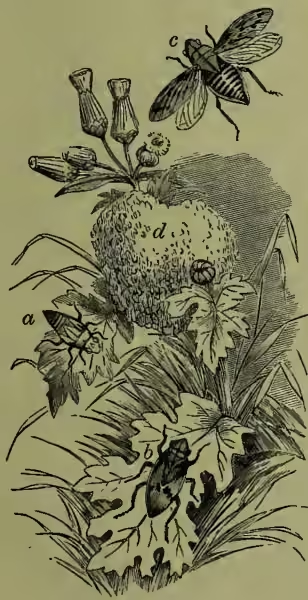
a, larva; b, perfect insect, with wing-covers closed; c, perfect insect, in the act of flight; d, the froth on a plant.
Froude, JAMES ANTHONY, an eminent English historian, was born at Dartington, near Totnes, Devonshire, 23d April 1818. The youngest son of the Archdeacon of Totnes, he was educated at Westminster and Oriel College, Oxford, took a second-class in classics in 1840, and in 1842 was elected a Fellow of Exeter College. He took deacon's orders in 1844, and was sometime under the spell of Newman's influence, but ere long his opinions underwent a fundamental change, as revealed to the world in 1848 in his outspoken book, The Nemesis of Faith, a work in which the solemnity and sadness of religious scepticism are relieved by a singularly tender and earnest humanity. The book was written with great and even startling power, and not only cost Froude his fellowship, but also an educational appointment in Tasmania. For the next few years he employed himself in writing for Fraser's Magazine and the Westminster Review, and in 1856 issued the first two volumes of his History of England from the fall of Wolsey to the defeat of the Spanish Armada, completed in 12 vols. in 1869. In this work Froude shows supreme literary ability—no reader can ever forget his narrative of the death of Mary Stuart and the disasters that befell the great Armada. In the art of making history as fascinating as fiction Macaulay is his only rival. But like him he is a man of letters first and an historian afterwards, and the defects of his merits have sadly impaired the permanent value of his work. As has been said with truth, he taught himself history by writing it; still his use of his materials never becomes critical, and his views of men and motives are always distorted by being seen through 19th-century spectacles, and these, moreover, spectacles of his own. Natural love of paradox and the faculty of seeing easily what he wished to see helped him to make a hero of Henry VIII.—the greatest blot upon his history. Four volumes of remarkably brilliant essays and papers, entitled Short Studies on Great Subjects, appeared between 1867 and 1882. Froude was elected rector of St are all plant parasites, mostly small in size, often
Andrews University in 1869, and received the degree of LL.D. For a short time he was editor of Fraser's Magazine. His next history, The English in Ireland in the Eighteenth Century (3 vols. 1871-74), showed the same merits and the same defects as the greater work, and the same may be said of his Cæsar: a Sketch (1879), a subject for the treatment of which he possessed but one qualification—consummate style. In 1874, and again in 1875, Froude visited the South African colonies on a mission from the home government, and published his impressions in Two Lectures on South Africa (1880). As Carlyle's literary executor, Froude edited his Reminiscences (1881), Mrs Carlyle's Letters (3 vols. 1882), and Carlyle's own Life (4 vols. 1882-84); and by giving to the world the copious personal criticism and family details contained in these works, he suggested grave doubts as to his editorial discretion. Later works are Oceana (1886), a delightful account of an Australasian voyage; the English in the West Indies (1888—assailed by West Indians as quite misleading); The Two Chiefs of Dunboy (1889), an Irish historical romance; The Divorce of Catherine of Aragon (1891); and The Spanish Story of the Armada, and other Essays (1892). Minor works were Calvinism (1871), Bunyan (1880), Luther (1883), and Beaconsfield (1891). In 1892 he was appointed Professor of Modern History at Oxford, in succession to Freeman, and he died at Salcombe in Devonshire, 20th October 1894. The Life and Letters of Erasmus (1894) and Lectures on the Council of Trent (1896), both delivered as lectures at Oxford, exhibit his unique merits and his characteristic defects—a power and skill of statement that rank him with the very greatest masters of English prose, a partisan spirit on great issues, and a carelessness about accuracy in details and not unimportant facts. See Skelton's Table-talk of Shirley (1895).—His elder brother, RICHARD HURRELL FROUDE, a leader in the Oxford Tractarian movement, was born at Dartington, in Devonshire, 25th March 1803. After graduating at Oxford in 1824 he became Fellow and tutor of Oriel College. Tracts 9 and 63 were from his pen. He died on 25th February 1836. His Remains were published three years after his death by Keble and Newman. —Another brother, WILLIAM FROUDE, born in 1810 and educated at Westminster and Oriel College, Oxford, was trained to be a civil engineer, and in 1838 became assistant to Brunel. Retiring from professional work in 1846, he devoted himself, down to his death at the Cape, 4th May 1879, to investigating the laws of naval construction.