Fuze, a means of igniting an explosive at the required instant, whether it is used in blasting operations, military demolitions and mines, or as the bursting-charge of a shell or Bomb (q.v.). In the former cases electricity would generally be used, but for hasty military demolitions Bickford's fuze is employed in the British army. It is of two kinds—'instantaneous' and 'ordinary,' the first burning at 30 feet a second, the other at 3 feet a minute. The 'ordinary' consists of a train of gunpowder in layers of tape covered with gutta-percha; in the 'instantaneous,' which is distinguished by crossed threads of orange worsted outside, quick-match takes the place of the gunpowder. Powder hose is sometimes used when no other fuze is available. It is made of strips of linen, forming, when filled with powder, what is called a 'sausage,' to 1 inch in diameter.
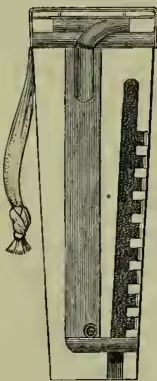
The fuzes used for shells are of a totally different character and of many patterns. They are of two classes, those which depend for their action upon the rate of burning of the composition in them, called 'time'-fuzes, and those which burst the shell on its striking the target, ground, or water, called 'percussion'-fuzes. In the British army time-fuzes are hollow truncated cones of beech-wood, carrying a column of fuze-composition which burns at a fixed rate—marks and figures on the outside show twentieths of a second or less, and indicate where the hole must be made by a fuze-borer in order that the flame may have access through it to the bursting-charge, and so open the shell at the desired instant during its flight. They are chiefly used with Shrapnel Shell (q.v.) and mortars. Their length varies from 3 to 6 inches, and they are fixed in to the head of the shell before firing. The thickness of iron would prevent the passage of the flame through the hole made by the borer in the shorter fuzes, and therefore two or more powder channels are made in them, parallel to the fuze-composition, to communicate its flame to the bursting-charge. In guns having windage the fuze is ignited by the flame of the cartridge enveloping the shell, and quickmatch is placed on the top of the fuze to facilitate this. A metal cover protects the quickmatch until the last moment, and is then torn off by means of a tape provided for that purpose. In guns having no windage a percussion arrangement is placed in the head of the fuze, so that the shock of discharge may ignite the fuze-composition. Fig. 1 shows a section of the common time-fuze, through one powder channel. A section of the percussion-fuze designed in the Royal Laboratory at Woolwich is shown in fig. 2. It is a hollow gun-metal cylinder, a, arranged so as to screw into the head of the shell. Inside is a movable pellet or ring, b, of white metal driven with fuze-composition like a tube, and carrying a percussion-cap. It has four feathers or shoulders projecting from its sides, and above these a gun-metal guard, c, fits round the pellet loosely, so as to prevent the cap of the pellet coming into contact with a steel pin which projects downwards from the top of the fuze. A safety pin, d, goes through the fuze with the same object, but is removed before firing, and a lead pellet, e, then closes the aperture left by its removal. On discharge the shock causes the guard to shear off the feathers, and set back with the pellet against the bottom of the fuze. The shock of impact on the target or ground causes the pellet to set forward, bringing the cap against the pin, igniting the fuze-composition, and bursting the shell. Percussion-fuzes are chiefly used with 'common' Shell (q.v.). Very many others are in use, chiefly modifications of these two types—e.g. the 'delay' action fuze has both a percussion and time arrangement, so as to burst the shell an instant after impact. All are delicate and apt to deteriorate hopelessly with age or exposure to damp. In the American pneumatic dynamite gun, the shell contains an electric battery, and the circuit is completed by the shell striking either water or the target.