Shell, a term applied to the hard outer covering or skeleton of many animals, to the internal skeleton of some invertebrates, and to the outer covering of the eggs of various animals. Shells differ so much from one another in structure and chemical composition that a small piece often serves to distinguish not only the family or the genus, but even the species to which an animal belongs. In the class Protozoa, which consists of unicellular animals usually of microscopic size, the shell is very diversified in form and composition, being formed of calcium carbonate, as is typically seen in Foraminifera; flint, as in many Heliozoa and Foraminifera; acanthin, in some Radiolaria; and chitin, as in some Foraminifera. In the
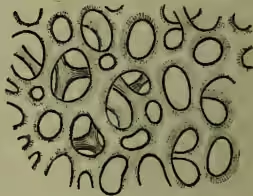
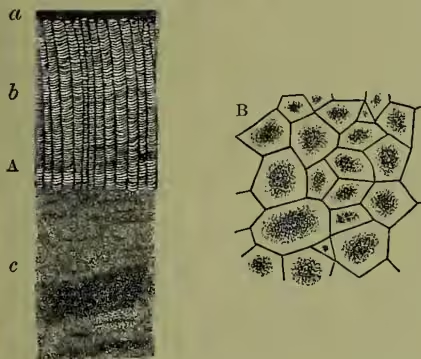
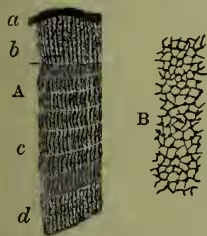
Cœlenterata (Sponges, Corals, &c.) the shell may be either continuous or more or less interrupted or formed of spicules or granules; and it may be composed of salts of calcium and magnesium, flint (silica), or 'horny' or chitinous material. Among the Echinodermata the skin becomes calcified so as to form generally a very complete skeleton. The shell of a starfish or of a sea-urchin presents the appearance seen in fig. 1, which shows the calcified areolar tissue. In the Mollusca, including the Brachiopoda, a shell, which is closely associated with the breathing organ, is usually present, and appears in the embryo as a growth from a special gland. Its further development depends on the mantle. It grows in superficial extent at the edge of the mantle, and increases in thickness by growth from the surface of the mantle already covered. It is thus essentially a cuticular structure. It may be univalve or bivalve: in only one genus (Chiton) is it composed of several pieces. A section of the shell of the fresh-water mussel (fig. 2) shows (a) the thin, horny, uncalcified outer layer which is formed by the thickened edge of the mantle, and is the first to be deposited; (b) the middle layer, consisting of numerous calcified polygonal prisms placed side by side, slightly obliquely to the surface of the shell; (c) the nacreous or pearly inner layer, finely granulated and traversed by delicate striæ. The calcium carbonate, to which the hardness of the shell is due, may be dissolved away, leaving the organic basis. In the Mollusca shells are distinguished according to their texture as porcellaneous, nacreous, and fibrous. In composition they usually consist of carbonate of lime (in the form of calcite, less commonly of aragonite). Some Cephalopods develop an internal calcareous shell. In Arthropoda (Crustaceans, Insects, &c.) the shell is composed of a firm, coloured, lamellated, nearly structureless layer of chitin, with or without an interstitial few vertical pores. The organic substratum is chitinoid, and the calcareous matter is chiefly calcium carbonate, and to a much less extent calcium phosphate.
For an account of the structure of shells and the literature on the subject, see Rolleston's Forms of Animal Life (2d ed.); Carpenter's Microscope and its Revelations; and Quekett's Lectures on Histology (vol. ii.), in which there are many excellent drawings. See BIVALVES, CONCHOLGY, EGG, FORAMINIFERA, IRIDESCENCE, MOLLUSCA, MOTHER OF PEARL, NACRE, &c.