Shell, a hollow projectile containing a bursting charge of gunpowder or other explosive ignited at the required instant by means of either time or percussion Fuses (q.v.). Originally shells were made of cast-iron, spherical in form, filled with powder, and fired only from Mortars (q.v.) or Howitzers (q.v.) with time fuses. They were called Bombs (q.v.) at first, and afterwards common shells. A smaller kind were thrown by hand and called hand-grenades. Shells appear to have been first used by the sultan of Gujarat in 1480; they were in general use about the middle of the 17th century.
But the introduction of Shrapnel shell (so called from the inventor, Colonel Henry Shrapnel, R.A.; died 1842) during the Peninsular war led to the employment of this projectile first with specially manufactured shell-guns, and then, as at present, with all guns of whatever construction. Shrapnel shells have thinner walls than common, and, instead of powder, are filled with bullets and a small bursting charge just strong enough to open them without disturbing the flight of the bullets. The latter then spread over a considerable area with the velocity which the shell had at the moment of bursting. These projectiles are generally burst by time fuses at least 100 yards in front of and some 50 feet above the target, so that what is called the cone of dispersion of the bullets may be as favourably placed as possible. They are essentially man-killing projectiles, in contradistinction to common shells, which are chiefly useful for destroying matériel.
The original Shrapnel shell was of course spherical for use with smooth-bore guns. It was improved by the introduction of a diaphragm to separate the bursting charge from the bullets. When rifled guns and elongated projectiles came into vogue it was found that the ricochet of a solid shot was so erratic that it could not, like the old round shot, have any useful effect, and solid shot gradually ceased to be used, Shrapnel and common shell and case-shot being the artillery projectiles retained.
The Armstrong Segment shell (a sort of Shrapnel) is filled with iron segments built up inside it instead of bullets. It was found to give poor results owing to the spin of the shell due to the rifling dispersing the segments on bursting. The German and Swiss Ring shell is somewhat similar, having rings of iron built up inside it round the bursting charge; but it is a substitute for common shell, not for Shrapnel.
Until quite recently Shrapnel shell found no favour with foreign nations, but by 1892 they had all followed the example set by Great Britain in adopting it. Fig. 1 is a section of modern British steel Shrapnel, with soft metal driving-band at
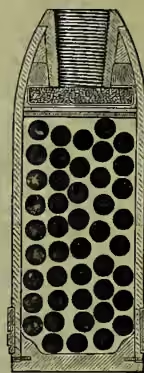
Shrapnel Shell.
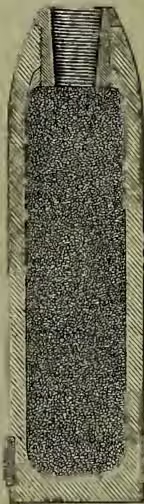
Common Shell.
base to give rotation, instead of the metal studs or lead-coating formerly used for that purpose. The bursting charge is at the base of the fuse-hole, and the head is filled with wood. Fig. 2 is the section of a common shell. Shells of all sizes are constructed on the same principles.
Palliser's shells have sharp-pointed heads, no fuse-holes, and very thick walls. They are cast head downwards in thick metal moulds. Their heads are thus chilled, and become hard enough to pierce ship's armour. In passing through the armour the bursting charge is exploded, so that no fuse is needed.
The Lyddite shell, used in warfare at Omdurman (1898) for the first time, and with great effect, is a steel-cased shell filled with lyddite, which is a special preparation of picrate of potash. It is claimed for this shell that it explodes with such force as to ensure destruction to any living thing within 200 or 300 yards. Used with the new breech-loading howitzer it is certainly a most effective weapon of war. See also CANNON, CASE-SHOT, GRENADE, PALLISER, &c.