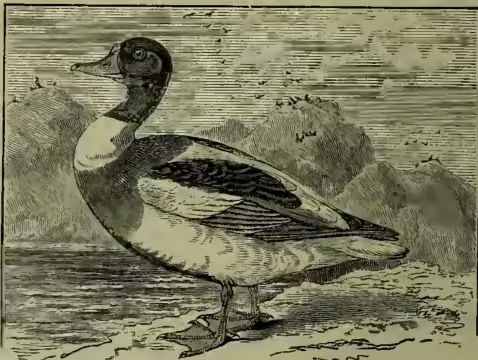
Sheldrake (Tadorna), a genus of birds of the Duck family Anatidæ, having the hind-toe free. The Common Sheldrake (T. cornuta or vulpanser) is one of the most remarkable of all the duck tribe for its size and the beauty of its plumage. It is fully 2 feet long. The head and neck are dark glossy green; below this is a collar of white, and lower still a collar of rich chestnut extending over part of the back; the rest of the back is white; the middle of the under-parts is black; the wing speculum green, the primaries and part of the secondaries black; the bill and frontal knob bright carmine; the legs, feet, and webs flesh pink. The female is rather smaller and duller, and has no frontal knob. The sheldrake is confined to salt water, and is found upon flat shores, links, and sand-bars on various parts of the coasts of the British Isles. It is abundant in Sweden, Denmark, the Baltic, and Norway; it is a winter visitor to the Mediterranean, but resident in the Black Sea and the Caspian; it is found in Asia in salt lakes, and as far as Japan. It breeds in burrows made by rabbits and foxes in sand-dunes (hence the name Burrow Duck by which it is sometimes called), or it may make its own burrows. In some sandy islands off the coast of Jutland burrows are made by the inhabitants, who protect the birds for the sake of their eggs and down. The food consists of small molluscs, sand-hoppers, and seaweed. The flesh is coarse and unpalatable. The note of the male is a shrill whistle; the female utters a harsh bark. The Ruddy Sheldrake (T. rutila or casarca) is rare as a British bird, and not common anywhere north of the Alps and Carpathians. It is not uncommon in Spain and various parts of North Africa. It is more abundant in the Black Sea area, southern Russia, and the elevated parts of Asia as far as China and Japan. In India, where it is known as the Brahminy Duck, it is very common during the cold season. Four other species are found respectively in South Africa, the Malay Archipelago, Australia, and New Zealand. The name is doubtless derived from shield, from the markings on the plumage. Other names are Skeel-duck, Skeeling-goose, Sly-goose, St George's Duck, and Bargander.