Gargoyle

Chambers's Encyclopaedia, Volume 5: Friday to Humanitarians, p. 85–86
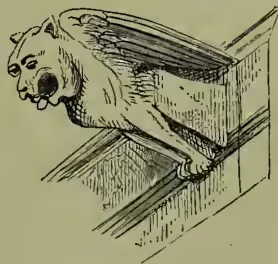
A black and white line drawing of a gargoylic creature, possibly a griffin or a winged lion, perched on a stone ledge or parapet. The creature has a human-like face with a wide-open mouth, large eyes, and a small nose. It has a muscular body with large, leathery wings spread wide. Its front paws are resting on the edge of the ledge, and its hind legs are visible behind it. The drawing is detailed, showing the texture of the stone and the creature's fur or feathers.
St Stephen's, Vienna.
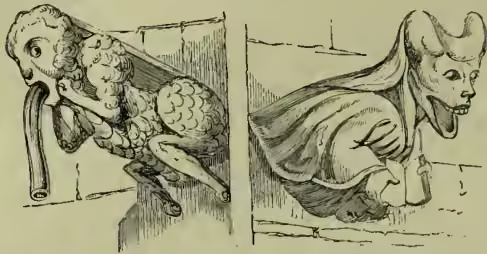
Two woodcut-style illustrations of gargoyles. The left one is from St Alkmund's Church, Derby, circa 1450, showing a gargoyle with a long, curved, pipe-like mouth. The right one is from Horsley Church, Derbyshire, circa 1450, showing a gargoyle with a more human-like face and a long, pointed tongue.
St Alkmund's Church, Derby; circa 1450.      Horsley Church, Derbyshire; circa 1450.

Gargoyle, a projecting spout, leading the water from the roof-gutters of buildings. Gargoyles of various forms have been used in almost all styles of architecture, but were peculiarly developed in connection with Gothic architecture. Some gargoyles are small and plain, others large and ornamental, according to their various positions. They are carved into all conceivable forms—angelic, human, and of the lower animals; and, as in fountains, the water is generally spouted through the mouth. In late castel-lated buildings, they frequently assume the form of small cannons projecting from the parapet. Gargoyles are generally carved in stone, but are sometimes executed in wood, and are made of great length so as to throw the water into the gutter formed in the middle of the streets of some old towns. In modern times the use of leaden pipes to convey away the water from roofs has almost entirely superseded the use of gargoyles.

Source scan(s): p. 0094, p. 0095