Gem, a term often used to signify a precious stone of small size, such as may be used for setting in a ring, or for any similar purpose of ornament; but sometimes by mineralogists in a sense which they have themselves arbitrarily affixed to it, for the purpose of scientific classification, as the designation of an order or family of minerals, generally hard enough to scratch quartz, insoluble in acids, infusible before the blowpipe, without metallic lustre, but mostly brilliant and beautiful. Among them are included some of the minerals which, in popular language, are most generally known as gems—ruby, sapphire, spinel, topaz, beryl, emerald, tourmaline, hyacinth, zircon, &c.—and some other rarer minerals of similar character; but along with these are ranked minerals, often coarser varieties of the same species, which are not gems in the ordinary sense of the word, as emery and common corundum, whilst diamond and some other precious stones, much used as gems, are excluded. See Streeter's Precious Stones and Gems (1879). While the term gem is thus used currently to denote jewels and precious stones, it is strictly applicable only to such hard and precious stones as have been worked by engraving. When the engraved design is sunk in the stone the gem forms an intaglio, signet, or seal, and when the subject is in relief the gem is a Cameo (q.v.). The rarer and more costly precious stones, such as the diamond, ruby, emerald, and sapphire, are seldom treated by engraving, because, in addition to the excessive difficulty of working them by engravers' methods, their value principally depends on their brilliance of sparkle and colour. The stones of the gem-engraver are almost exclusively the variously coloured, mottled, and banded varieties of chalcedony quartz, which are differently named according to the appearance they present. From the gem-engraver's point of view, the most important stones are carnelian, sard, chrysoprase, plasma, bloodstone, jasper, agate, and onyx. As these names indicate only differences of colour and shades, degrees of translucency, and alternations of bands, all of which characteristics merge into each other, they are incapable of precise definition. The banded stone, generally called Onyx (q.v.), is used as the principal material for cameo-engraving, the relief subject being worked in one coloured band or stratum on a ground of a different colour.
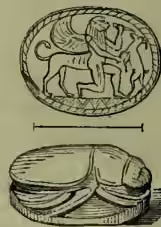
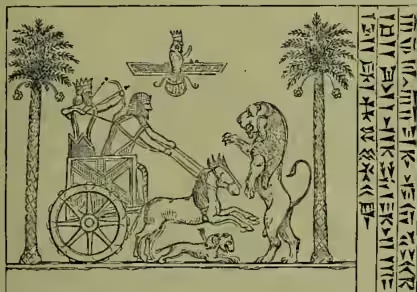
The art of gem-engraving developed from the customary use of seals among the ancient Egyptians and other early civilised communities of the East. In addition to abundant remains of seals of high antiquity, we have ample testimony to their important functions from numerous references in early literature. Thus, in Genesis, xxxviii. 18, we read that Tamar demanded of Judah his signet as a pledge; and Pharaoh, in investing Joseph with the office of principal minister, gave him his signet-ring as a token of authority. The early seals of the Egyptians were cut in the form of the scarabæus or sacred beetle, with the intaglio design engraved in a flat base; and in this form they were followed by the early Greeks and the Etruscans. Among the Chaldeans, Babylonians, and Assyrians the primitive seals took the form of cylinders, around which the intaglio device was engraved. An impression in soft clay or other medium was obtained from such seals by gently rolling the cylinder over the surface to be impressed. The earliest of such intaglios were cut in steatite, serpentine, and other comparatively soft stones; but these materials by degrees gave way to the harder and more enduring materials in which it was possible to sculpture fine details with great minuteness. The cylindrical signet of Darius I. of Persia, engraved in chalcedony, and preserved to the present day, is an example of the art at its highest development among the Asiatic monarchies.
From the nature of the subjects engraved on gems, and from the method in which they were mounted, it is evident that they soon came to be employed otherwise than as signets. Gems came to be worn as personal ornaments mounted in rings and in other settings, they were treasured as works of art, and they were treated as charms to avert evil and to win success and the favour of gods and men. For the breastplate of the Jewish high-priest, Moses was instructed to 'take two onyx stones, and grave on them the names of the children of Israel. . . . With the work of an engraver on stone, like the engravings of a signet, shalt thou engrave the two stones' (Exodus, xxviii. 9-11). With the extension of the uses of gems, the forms of the stones also changed; in the case of cylinders first into cones engraved on the base, then into hemispherical stones, ultimately taking a flat thin form through which the light would pass sufficient to show the engraving by transmitted light; and with this view the stones were sometimes convex and cut en cabochon. Ancient gems, like ancient coins, were generally irregular in outline, but at all times their prevailing form was oval.
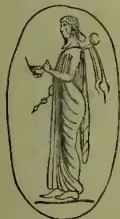
Greek Sard, with
Indian Bacchus.
The earlier engraved gems of the Greeks, as already mentioned, were in the form of scarabs. In these the engraved intaglio was enclosed in a guilloche or engrailed border, and the engraving was stiff and formal, in every respect like Etruscan work. Gem-engraving in Greece reached its highest perfection during the three centuries which preceded the Christian era, and the names of some of the most famous artists of that period have been handed down to the present day. In Rome the art was encouraged, and flourished till the period of the Antonines, after which it rapidly declined; and such Byzantine work as exists is rude in execution, and interesting only from the fact that with it Christian subjects begin to appear in gems. Cameo-engraving was not practised till the days of imperial Rome.
The subjects of ancient gems embrace the whole circle of ancient art, and follow the laws of its development, animal forms being succeeded by those of deities and subjects derived from the battles of Greeks and Amazons and Centaurs, the exploits of Hercules and other heroes; then by scenes from tragedians and later myths; and finally by portraits, historical representations, and allegories. The inscriptions consist of the names of deities, heroes, and subjects; dedications to deities; the names of artists, sometimes in the genitive case, but often accompanied by the verb epoei, 'fecit;' addresses to individuals; gnomic or other sayings, indicating that the gems are amulets against demons, thieves, and various evils, or charms for procuring love; the names of the possessors, and sometimes addresses, occasionally even distichs of poetry, and various mottoes. These inscriptions were often added by subsequent possessors, and are not of the age of the gem itself.
With the decline of the arts generally, the art of gem-engraving sank during the middle ages, to be awakened again only through the patronage of the Medici family in Italy in the 15th century, and with varying fortunes it continued to be practised till the early part of the 19th century. Strictly classical models, and to a large extent classical subjects, have been chosen by modern engravers, and towards the end of the 18th century the practice of foisting modern imitations on buyers of gems as genuine Greek works of the best period became very prevalent. Prince Poniatowsky, who inherited a small collection of ancient gems from Stanislaus, last king of Poland, employed the most skilful engravers of his day to fill up his cabinet with imitation antiques on which the names of the most eminent engravers of antiquity were forged. The Poniatowsky forgeries did much to bring gem-engraving into disrepute, and to lower the value of even fine and undoubted works. The diagnosis of gems has been rendered a work of extreme difficulty; and, as the modern imitator possesses conveniences for his task which were not at the disposal of the ancient artist, works of high artistic merit and great finish are more likely to be modern than ancient.
In modern times a considerable trade has been carried on in the preparation of artificial gems, both cameos and intaglios, for jewelry purposes and for the cabinets of collectors. The most famous and successful maker of pastes was James Tassie, a native of Pollokshaws, near Glasgow, who in the latter half of the 18th century settled in London, and then, with marvellous industry, succeeded in copying upwards of 15,000 of the most famous and artistic gems of ancient and modern times. But Tassie's activity was not confined to the copying of gems alone. He produced in cameo a large series of portraits of his most famous contemporaries, and, while his whole productions are now highly prized, these large cameos are in great request, and command high and steadily-increasing prices.
Paste copies of existing gems are made with comparative ease, by obtaining an impression from the original in very fine moist Tripoli earth or rotten-stone, which mould is carefully dried. A piece of glass of the required colour and size is then laid over the mould, and placed in a furnace, which is raised to a heat sufficient to melt the glass, causing it to flow over and accurately fill the mould. When a cameo is being made, the raised portion alone is so moulded in opaque white glass, and, its back being ground flat and smooth, it is cemented to a mount of any desired colour. In some cases the mount itself is melted to the already formed relief portion, which for this purpose, after grinding away of the superfluous glass, is reintroduced into the furnace embedded in a Tripoli mould to allow of the mount being melted over it. Portrait cameos are made from wax models, casts of which are taken in the same way as moulds are obtained from gems.
For the making of imitation gems or precious stones (engraved or not) from glass specially prepared and coloured, as well as for the production of actual but artificial precious stones by chemical methods, see STONES (PRECIOUS), as also DIAMOND, RUBY, PEARL, &c. For seals, see SEAL.
The chief implement used by the ancient engravers appears to have been made by splitting corundum into splints by a heavy hammer, and then fixing these points like glaziers' diamonds into iron instruments, with which the work was executed by the hand (ferra retusa). The drill, tercbra, was also extensively used for hollowing out the deeper and larger parts of the work, and emery powder, the smaris or Naxian stone, for polishing. The so-called wheel, a minute disc of copper, secured to the end of a spindle, and moistened with emery powder or diamond dust, and driven by a lathe, does not appear to have come into use till the Byzantine epoch. It has been conjectured that the artist used lenses of some kind, or globes filled with water, to execute his minute work; but the ancient, like the modern engraver, rather felt than saw his way. All these processes were not employed by the same artist, for, besides the engraver (sculptor cavarius, dactylioglyphus), there was a polisher (politor), not to mention arrangers (compositores gemmarum), and merchants (gemmarii, mangones gemmarum) who drove a flourishing trade in emeralds and pearls and engraved stones in the days of Horace.
The principal writers of antiquity who treated of gems are Onomacritus or the Pseudo-Orpheus, Dionysius Periegetes, Theophrastus, and Pliny, whose chapter is compiled from antecedent Greek and Roman authors. Isidorus, 630 A.D., gives an account of the principal stones; so do Psellus and Marbodus in the 11th century.
See Mariette, Pierres Gravées (Paris, 1750); Raspe, Descriptive Catalogue of Engraved Gems (Lond. 1791); Millin, Introduction à l'Étude des Pierres Gravées (Paris, 1797); Krause, Pyrgoteles (Halle, 1856); King, Antique Gems and Rings (3d ed. 2 vols. 1872), and Handbook of Engraved Gems (2d ed. 1885); Bucher, Gesch. der technischen Künste (1875); Billings, Science of Gems, &c. (Lond. 1875); Pannier, Les Lapidaires Français du Moyen Âge (Paris, 1872); Jones, History and Mystery of Precious Stones (1880); Gatty, Catalogue of the Engraved Gems in the Collection of J. Mayer (1879); Catalogue of the Engraved Gems in the British Museum (Lond. 1889).