Glands are secreting structures, the component elements of which in various ways alter the material brought to them by the blood, extracting and excreting waste products as in the kidneys, or manufacturing valuable by-products, such as the glycogen and bile of the liver. In a typical gland three parts have to be distinguished: (a) the secreting cells usually enclosed in some more or less distinct membrane; (b) the surrounding network of blood-vessels; and (c) the duct by which the products of secretion pass from the gland.
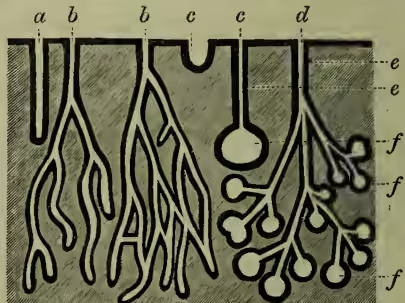
Most true glands are pockets of glandular skin, mucous membrane, or epithelium, and occur on the outer surface of the body, as in the sweat-glands of the skin; on the lining of the alimentary canal—e.g. salivary glands, liver, pancreas, intestinal glands, &c.; or on other internal surfaces—e.g. in connection with the genital ducts. They may be classified according to their origin from (1) the ectoderm or epiblast, (2) the mesoderm or mesoblast, and (3) the endoderm or hypoblast. Thus, (1) in connection with the outer skin there are, besides glandular cells (so-called unicellular glands), numerous secretory pockets, such as the sweat, scent, anal, poison, adhesive, byssus, slime, spinning, and mammary glands. At each end of the (endodermic) gut there is a more or less prolonged invagination of ectoderm, and the glands connected therewith are obviously in the above embryological category. (2) The kidneys of most animals illustrate glands of mesodermic origin, but it is inaccurate to speak of the reproductive organs (as is often done) as glands. They liberate reproductive cells, differentiated elements, not products of secretion. (3) The numerous glands connected with the main part of the alimentary canal are of endodermic origin.
The structure of secretory pouches varies greatly, and, as the accompanying diagram suggests, glands may be classified according to their morphological complexity, as tubular, saccular, lobed, much branched or racemose, &c. The more complex glands—e.g. liver or kidney—will be discussed under their proper headings. In all simple glands the pouch is at first a mere sac; but as the epithelium increases greatly, and yet is more or less circumscribed in its expansion, lobing and branching naturally result.
A third classification of glands is possible—viz. according to their functions—excretory or secretory, lubricatory or digestive, and so on. The various functions of the different glands will be discussed under separate headings; see the articles CIRCULATION, DIGESTION, KIDNEYS, LIVER, PANCREAS, REPRODUCTION, SALIVA, SECRETION, SPLEEN, &c.
Many structures are often called glands, which are so far removed either in structure or in function or in both from those above mentioned that the term is misleading. Such are the reproductive organs, the 'pineal gland,' the spleen, the thyroid and thymus 'glands,' the 'lymphatic glands,' the supra-renal capsules, and so on.
DISEASES OF THE GLANDS.—The 'lymphatic glands' are subject to enlargement from acute inflammation and abscess, usually in consequence of irritation of the part from which their lymphatics spring, as in the case of scarlet fever (in which the glands of the throat are affected), in gonorrhea (the glands of the groin), &c. The treatment of such abscesses belongs to the ordinary principles of surgery (see ABSCESS, ADENITIS). A much more troublesome affection of the glands is the slow, comparatively painless, at first dense solid swelling which they undergo in Scrofula (q.v.), which tends very slowly, if at all, to suppuration, and sometimes remains for years. In Syphilis (q.v.) and Cancer (q.v.) there are also enlargements of the lymphatic glands. Scrofulous or tubercular disease of the mesenteric glands in children constitutes Tabes mesenterica (see MESENTERY). The larger glands, as the liver, kidney, pancreas, spleen, thyroid, thymus, testicle, have all their special diseases, which will be noticed, so far as necessary, in treating of these organs.